
Are you leaving your year-end accounts to the last minute? Many Irish businesses approach their year-end accounting as an afterthought, rushing to gather records, reconcile figures and complete Corporation Tax returns just days before the tax return deadline. The result? Costly errors, missed Corporation Tax payment dates and Revenue penalties that could have been avoided entirely.
The solution is straightforward: a structured, step-by-step approach to year-end closing accounting that starts early, follows proven year-end accounts procedures and ensures your CT return is accurate, compliant and filed on time.
This guide covers year-end accounting, CT1 form requirements, Corporation Tax filing and payment dates in Ireland and practical steps to meet your tax return deadline.
Key Takeaways
- CT returns are due by the 23rd of the ninth month after year-end, missing this triggers surcharges.
- Ireland’s trading income Corporation Tax rate is 12.5%; passive income is taxed at 25%.
- Year-end closing accounting requires reconciling bank statements, VAT, payroll and loan records.
- The CT1 form must be filed electronically alongside financial statements and preliminary tax calculations.
- A change of accounting year-end in Ireland must be formally notified and impacts CT filing dates.
- End of year accounts for sole traders are required for income tax they do not file Corporation Tax returns.
- A year-end accounting closing checklist keeps your financial close and reporting process structured and penalty-free.
Understand the Reporting Timeline
Before starting year-end accounting, confirm your accounting year-end date and statutory deadlines.
In Ireland, Corporation Tax returns are generally due by the 23rd day of the ninth month after the accounting period ends. This deadline covers:
- Filing the CT return
- Submitting the CT1 form
- Paying the balance of Corporation Tax payment
Clear awareness of these Corporation Tax filing dates helps businesses plan their financial close and reporting process effectively.
The process follows four sequential steps each one building on the last to ensure your CT return is accurate, compliant and filed on time.
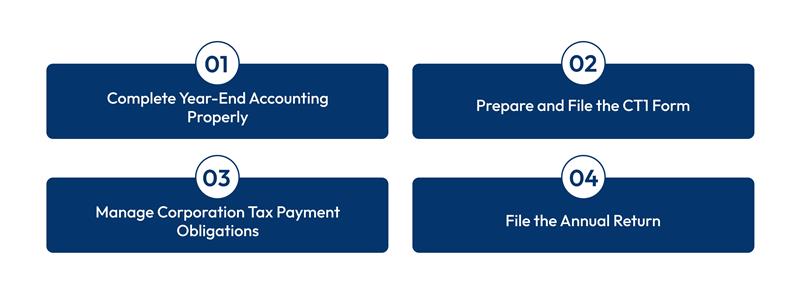
Missing any one of these steps can lead to errors, delays or penalties. Here is how to approach each one correctly.
Step 1: Complete Year-End Accounting Properly
Accurate year-end accounting forms the foundation of compliant Corporation Tax returns. Following structured year-end accounts procedures reduces errors and strengthens reporting accuracy.
Gather and Reconcile Financial Records
Collect and reconcile:
- Bank statements
- Sales and purchase invoices
- Payroll reports
- VAT returns
- Loan agreements
This supports effective year-end closing procedures in accounting and aligns with financial close process best practices.
Record Year-End Adjustments
Typical adjustments include:
- Accruals and prepayments
- Depreciation
- Stock valuation
- Director loan balances
These adjustments ensure accurate end of year accounts and correct tax computation.
Prepare Statutory Financial Statements
Prepare:
- Profit and Loss Account
- Balance Sheet
- Notes to the accounts
These must be finalised before submitting the CT return, as financial statements are filed alongside the CT1 form.
Step 2: Prepare and File the CT1 Form
Once year-end accounting is complete, move to Corporate Tax return preparation.
The CT1 form includes:
- Trading income
- Capital allowances
- Losses carried forward
- Close company surcharge disclosures
Under Corporate Tax rules in Ireland:
- Trading income is generally taxed at 12.5%
- Passive income is generally taxed at 25%
The completed CT return must be filed electronically before the tax return deadline, together with the correct Corporation Tax payment.
Step 3: Manage Corporation Tax Payment Obligations
Accurate Corporation Tax returns must align with correct Corporation Tax payment dates.
Preliminary Tax
Preliminary tax is paid during the accounting period. The remaining balance becomes due when filing the final CT return.
Typical Corporation Tax Payment Dates
| Accounting year-end | Filing & Payment Due |
|---|---|
| 31 December | 23 September (following year) |
| 30 June | 23 March (following year) |
Always confirm the applicable Corporation Tax filing dates based on your accounting year-end date.
Step 4: File the Annual Return
Separate from Corporation Tax returns, companies must file an annual return with the Companies Registration Office. This includes director details, shareholder information and financial statements.
Timely filing supports ongoing compliance and audit exemption eligibility.
Change of Accounting Year-End in Ireland
A change of accounting year-end in Ireland must be formally notified and reflected in the next CT return. It may impact:
- Corporation Tax filing dates
- Preliminary tax calculations
- Reporting cycles
Proper planning is essential before making changes.
Audit Requirements and Exemptions
Some companies must complete statutory year-end audit procedures depending on size thresholds.
Even where exempt, complete year-end accounting and accurate Corporation Tax returns remain mandatory.
Conclusion
Effective year-end accounting and timely Corporation Tax returns protect businesses from penalties and ensure compliance with Irish regulations. From preparing accurate end of year accounts to submitting the CT1 form and meeting Corporation Tax payment dates, each step requires organisation and attention.
For businesses that need additional structure or capacity during the financial close and reporting process, Outbooks supports Irish companies with year-end accounting and Corporate Tax return preparation in a practical, deadline focused manner. The support complements internal finance teams and ensures compliance is handled efficiently without disrupting daily operations.
For expert support, reach out to the Outbooks team at info@outbooks.com or call +353-21 206 9255 to ensure compliance and timely filing.
FAQs
What is the tax return deadline in Ireland?
What is the Corporation Tax rate in Ireland?
What documents are needed for year-end accounting?
What happens if Corporation Tax returns are filed late?
Can a company change its accounting year-end in Ireland?
Are end of year accounts required for sole traders?

Parul is a content specialist with expertise in accounting and bookkeeping. Her writing covers a wide range of accounting topics such as payroll, financial reporting and more. Her content is well-researched and she has a strong understanding of accounting terms and industry-specific terminologies. As a subject matter expert, she simplifies complex concepts into clear, practical insights, helping businesses with accurate tips and solutions to make informed decisions.