
You have sent a polished, professional proposal. The prospect has read through it, replied promptly and the tone is positive. Then comes the line: “That all looks great, but can you do anything on the price?” In that moment, there is a split second of discomfort. You want the client. You do not want to lose the deal over price. And you are not quite sure what to say.
How you respond to that question defines far more than the fee. It sets the tone for the entire client relationship. Discounting at the proposal stage signals that your original price was negotiable and once a client believes that they will test it again. It erodes trust, trains the client to focus on cost rather than value and compresses your margins before the relationship has even begun.
Key Takeaways:
- Why discounting accounting proposals is rarely the right move
- What to say when a prospect asks for a lower price
- How to reframe the conversation without losing the client
- Practical alternatives to discounting that protect your margins
- How structured proposal tools help prevent the discount conversation altogether
How to Respond When Prospects Ask for a Discount?
This is the moment that matters. Most accounting firm owners either concede too quickly or become defensive. Neither serves the firm.
Below are three responses you can use immediately, each suited to a different stage of the conversation.
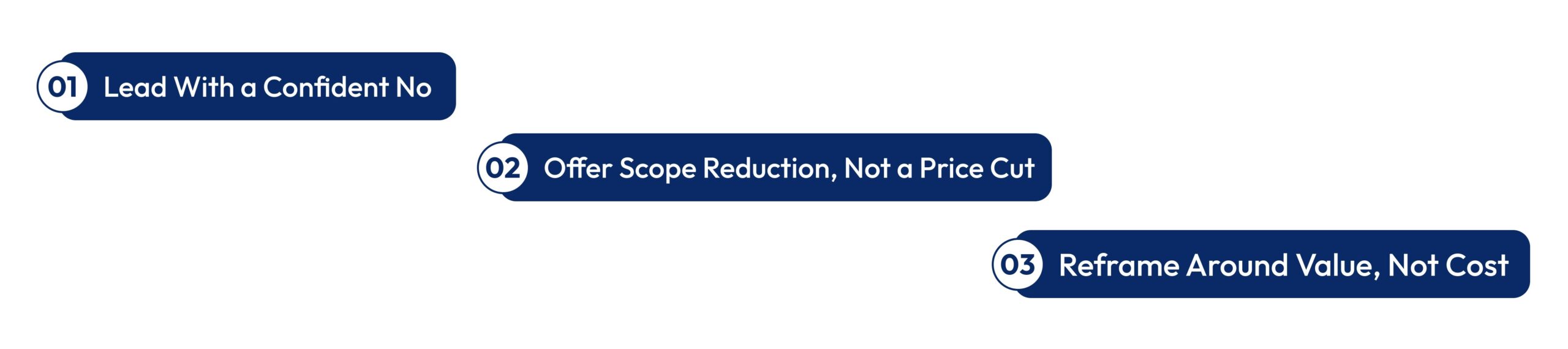
1. Lead With a Confident No
| Situation | What to Say | Why It Works |
|---|---|---|
| Prospect asks for a lower price | “None at all, but I don’t blame you for asking.” | Disarming, non-defensive, signals pricing confidence |
| Prospect pushes again | “Our fees reflect the outcome, not just the hours.” | Shifts focus from cost to value delivered |
| Prospect mentions a tighter budget | “Let’s look at what we can adjust in scope.” | Opens a productive conversation without touching your rate |
The confident no is not about being difficult. It is about being clear. A calm, unhurried refusal tells the prospect that your accounting proposal pricing is considered and fixed and that is reassuring, not off-putting.
After the no, always redirect. Restate what the proposal delivers in outcomes, not features. What will change for this client once they are working with your firm? Ground the conversation there.
2. Offer Scope Reduction, Not a Price Cut
If budget is a genuine constraint, the right move is to reduce what is included, never the price for the same scope.
Here is how to frame it:
“We can start with X and Y, which brings the monthly fee to £Z. When you are ready to add [service], we can revisit the full package.”
This approach:
- Protects your per-service rate completely
- Gives the prospect a workable entry point
- Creates a natural path to grow the relationship at full value
- Avoids the trap of discounting accounting services to win a client you then undercharge indefinitely
The key principle: same rate, less scope. Never same scope, lower rate.
3. Reframe Around Value, Not Cost
If the prospect continues to push, the conversation needs to shift. Ask directly:
“What is it about the pricing that concerns you the total, or uncertainty about what you are getting for it?”
This question does two things. It uncovers the real objection. And it signals that you are willing to clarify, not capitulate.
More often than not, the issue is not the money. It is unclear value. When a prospect cannot see precisely what they are paying for, their instinct is to question the price.
A well-structured, itemised accounting proposal resolves this before the conversation begins.
Why Discounting your Accounting Proposal is the Wrong Move?
It is tempting to view a discount as a small concession to win a client. In practice, the cost runs far deeper than the reduced fee.
When a prospect asks for a discount at the accounting proposal stage, they have already decided they want your services. They are testing whether your pricing is firm. If you fold, the message they take away is not gratitude. It is that your original price was not real.
The long-term consequences of discounting accounting services:
| What Happens? | The Impact on Your Firm |
|---|---|
| Client receives an upfront discount | Expects the same at every renewal |
| Price is reduced for the same scope | Your effective hourly rate drops permanently |
| Client questions future invoices | Relationship becomes adversarial over fees |
| Discount becomes a habit across the firm | Margins erode firm-wide, not just on one client |
The moment that does lasting damage is the one that follows the discount. The client thinks: “Why didn’t they just charge that from the start?” That doubt, once formed, does not go away.
Strategies to Protect Your Margins Without Discounting
Rather than reducing your fee, these approaches give prospects flexibility while keeping your pricing intact.
Tiered Pricing Packages
Present good, better and best options in the proposal itself. Prospects self-select based on budget rather than negotiate against a single price. The conversation shifts from “can you charge less?” to “which level suits us?”
Value-Added Upgrades
Offer something extra instead of cutting the price. Faster onboarding, a priority response commitment, or a quarterly review call can shift the perceived value meaningfully without affecting the fee.
Payment Flexibility
Spreading the cost monthly rather than annually addresses cash flow concerns without reducing the total fee. Many prospects who hesitate on price are actually hesitating on upfront commitment.
Phased Onboarding
If a prospect wants the full service but cannot commit to the whole scope now, offer a phased plan at full rates with a clear timeline for expanding. This keeps the relationship growing at the right value from the start.
How a Well-Structured Proposal Reduces Discount Requests?
Most discount requests are not really about money. They happen because the prospect is not sure what they are paying for.
When your proposal is clear, itemised and shows exactly what each service delivers, there is very little left to question. Prospects are not pushing back on the price. They are reading a document that already answers their concerns.
Offering tiered options within the proposal helps too. Instead of challenging a number, prospects are simply choosing the option that works for them.
Firms that use tools like Outbooks Proposal, built specifically for UK accounting practices, find this process becomes much faster and more consistent.
When prospects can see exactly what they are getting, price stops being the focus of the conversation.
Conclusion
A discount request is not a threat to the deal. It is a test of your confidence in your own value. The firms that handle it best are not the ones with the cleverest scripts. They are the ones who have already done the work, building proposals so clear, so structured and so evidently valuable that the question barely arises.
When it does arise, you now know what to do. Stay calm, hold your rate and let the value speak for itself.
Want to send proposals that make pricing conversations easier? Try Outbooks Proposal free for 6 months, no card required.
FAQs
Should accountants ever offer discounts to prospects?
Rarely, reducing scope at the same rate is far more effective than cutting the fee for the same work.
What is the best way to respond when a prospect asks for a discount on an accounting proposal?
A calm reply such as “None at all, but I don’t blame you for asking” signals confidence and keeps the conversation focused on value.
How do tiered accounting pricing packages reduce discount requests?
They give prospects a choice based on budget rather than a single price to negotiate against, shifting the dynamic entirely.
What are the best alternatives to discounting accounting services?
Tiered packages, phased onboarding, payment flexibility and value-added upgrades all protect your margins without reducing your fee.
How do I justify my accounting fees to a prospect who thinks the price is too high?
Reframe around outcomes. Ask what specifically concerns them as often the objection is about unclear value, not the amount itself.
Does discounting once set a precedent with accounting clients?
Yes, clients who receive an upfront discount consistently expect the same at renewal and scrutinise future invoices more closely.
How can proposal automation help accounting firms handle pricing discussions more confidently?
Structured proposals remove inconsistency from quoting so pricing feels deliberate and considered across every team member.
What should I do if a prospect says a competitor is cheaper?
Acknowledge it, then shift focus: “That may be the case, the difference is in what you get for that fee.” Let your proposal make the distinction visible.
How do I protect my accounting firm’s margins during fee negotiations?
Hold the rate and offer scope flexibility instead. That boundary, kept consistently, protects long-term margins across the firm.
Can a well-structured accounting proposal template reduce price objections?
Significantly, when services are itemised and outcomes are clear, prospects have fewer reasons to question the price before saying yes.

Parul is a content specialist with expertise in accounting and bookkeeping. Her writing covers a wide range of accounting topics such as payroll, financial reporting and more. Her content is well-researched and she has a strong understanding of accounting terms and industry-specific terminologies. As a subject matter expert, she simplifies complex concepts into clear, practical insights, helping businesses with accurate tips and solutions to make informed decisions.