
For professional services businesses such as accounting firms, the client onboarding process marks the beginning of a successful partnership.
A well-structured approach helps build trust early, sets clear expectations and delivers a smooth experience. When done properly, it leads to improved client satisfaction, better retention rates and fewer operational challenges.
Key benefits of effective client onboarding
Increased operational efficiency
Using Client intake forms allows you to gather key details upfront. This approach helps your team start projects faster and avoid unnecessary back-and-forth communication. It also prevents bottlenecks that can slow down project delivery.
Proactive scope management
A structured Client onboarding checklist sets clear expectations for deliverables and timelines. By defining roles, responsibilities and boundaries early, you reduce the risk of Scope creep. This clarity helps maintain project profitability and client satisfaction.
Stronger client relationships
Clients prefer working with teams that demonstrate preparedness, proactivity and professionalism. A smooth Onboarding experience builds confidence from the first interaction. This positive start improves Customer satisfaction and can boost your Net promoter score significantly.
Enhanced growth through referrals
When you Onboard new clients with excellence, you create advocates for your business. Satisfied clients become more likely to provide referrals and consider additional services. This organic growth reduces Customer acquisition costs and strengthens your market position.
Improved compliance standards
A repeatable Onboarding process embeds compliance into your operations from the initial meeting. This systematic approach reduces legal risks and ensures consistency across all client engagements.
The 8 steps for client onboarding success
Every professional service business needs a defined, repeatable method to onboard new clients effectively.
With the proper steps in place, you start relationships on the right foundation. You also gather essential information upfront and demonstrate competence to your clients.
These client onboarding best practices apply across various industries and business models.
Step 1: Secure the signed contract or engagement letter
The first rule is simple: never begin work until your client has signed the Contract or Engagement letter. Without a legally binding agreement, there is no shared understanding of terms or responsibilities. Starting work prematurely puts your time, resources and client relationship at unnecessary risk.
Using proposal tools and accounting software
Modern Accounting proposal tools streamline this critical first step significantly. These platforms automate proposal creation and optimise Client agreements to accelerate approvals.
Many systems include Professional services proposal templates with built-in Electronic signature capabilities. This technology supports remote sign-offs and eliminates printing and scanning delays.
Manual approach alternative
If you are not using automated systems, follow this manual workflow:
- Create your proposal and send it to the potential client
- Draft the contract separately and forward it for review
- Issue an invoice using your preferred Accounting software
- Follow up to collect signed documents and any outstanding payment
While this manual approach functions, it is time-consuming and increases the risk of errors. Once payment is received and all documents are signed, you are ready to proceed.
Step 2: Collect key information and documents
Gathering comprehensive information at the start prevents delays and misunderstandings later. Client intake forms serve as your primary tool for collecting this essential data. When designed properly, these questionnaires help you understand client needs, preferences and challenges.
Essential information to gather
Most effective intake forms cover these core areas:
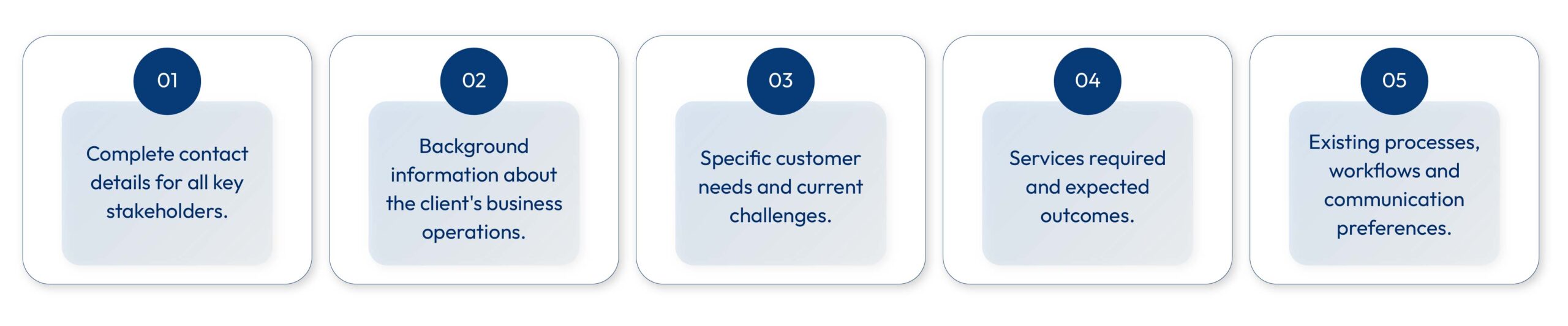
Creating effective client intake forms
Structure your forms to be clear, on-brand and simple to complete. Digital form builders create interactive experiences that keep users engaged throughout the process.
Consider including multimedia elements and dynamic questions based on previous answers. Many modern Proposal tools allow you to include questionnaire links in acceptance emails. This automation ensures forms are sent at precisely the right moment in the workflow.
Step 3: Assign the client and launch the project
After collecting all required information, assign the client to the appropriate Account manager or team. Whenever possible, match clients with team members who share common ground or relevant experience. This strategic assignment strengthens the working relationship from the outset.
Preparing your team for success
Before launching the project, conduct a team briefing that covers:
- A comprehensive summary of the project scope and objectives
- Clear definition of what success looks like for this client
- Detailed project timeline with key milestones
- Relevant research, background information, or industry context
- Specific items needed from the client to maintain progress
Include all previous communication in your handoff documentation. Clients find it frustrating to repeat information they have already provided.
Step 4: Conduct a client kickoff meeting
By this stage, your client onboarding process is progressing well and everyone should feel confident. Client kickoff meetings build trust, align expectations and establish the tone for successful collaboration. These meetings represent a critical touchpoint in the Customer onboarding journey.
Meeting agenda essentials
Structure your kickoff meeting to cover these key elements:
- Introduce the client to all project team members
- Review responses from the Client intake form together
- Discuss business goals and expected outcomes in detail
- Cover major deliverables, responsibilities and the project timeline
- Clearly outline any items that fall outside the agreed scope
- Walk through the immediate next steps
- Allocate sufficient time for questions and answers
By the meeting’s conclusion, address all outstanding questions. Your goal is to make the client feel supported, informed and excited about moving forward.
Choosing the right meeting format
If you are local to your client, an in-person meeting often proves ideal. For remote engagements, video conferencing tools work perfectly well for professional meetings. Consider integrating your scheduling and video tools to eliminate coordination hassles. When a client books a meeting, video links can generate automatically and distribute to participants.
Sending a welcome package
After the meeting concludes, send a Welcome package to reinforce value and make clients feel valued.
Your Welcome package can include both digital and physical materials:
- A business reference sheet with support hours, contact information and frequently asked questions
- Relevant setup guides, reporting explainers, or instructional videos
- Case studies showcasing Customer success stories from similar clients
- A personalised Welcome video to add a human touch
Even small gestures create significant positive impressions during the Customer onboarding phase. The more supported clients feel initially, the more confident they become in your processes.
Step 5: Define metrics for client success
To track the impact of your services effectively, establish Key performance indicators early in the engagement.
Use insights from the intake form and kickoff meeting to determine what success means for this specific client. From there, set up measurable goals that reflect your services and align with client expectations.
Industry-specific success metrics
Success metrics vary considerably by industry and service type:
| Industry | Example success metrics |
|---|---|
| Accounting firms | Reduced tax liability, audit completion, financial reporting accuracy |
| Digital marketing | Website traffic growth, conversion rates, return on investment |
| Social media management | Engagement rates, follower growth, content share metrics |
| Bookkeeping services | Transaction accuracy, reporting timeliness, reconciliation completion |
| Consultancy services | Process improvement results, cost savings achieved, implementation success |
The more specific and relevant your performance indicators, the easier it becomes to demonstrate value. Clear metrics also help you stay accountable and adjust strategy as circumstances evolve.
Step 6: Provide training or knowledge transfer
In certain situations, onboarding involves helping clients understand tools or processes used during the engagement. This training component strengthens the Client onboarding experience and reduces future support requests. It also positions your firm as a trusted partner invested in client success.
When training adds value
Training does not always mean teaching software functionality. Sometimes it simply involves explaining how clients can contact your team effectively. By keeping clients informed about processes, tools and industry developments, you reinforce your expertise.
Step 7: Schedule a follow-up check-in
After delivering services for approximately 30 days, schedule a check-in call with your client. This touchpoint confirms everything is progressing as expected and nothing has been overlooked. The first 90 days are particularly important for creating strong first impressions.
Conducting effective check-ins
Hold your check-in by phone or video conference whenever possible. Email communications are easier for busy stakeholders to miss or postpone responding to.
This meeting also provides an opportunity to gently request any outstanding information or documents. Address any concerns or questions that have emerged since the kickoff meeting. Early identification and resolution of issues improves client satisfaction significantly.
This proactive approach also increases long-term retention rates and strengthens the client relationship.
Step 8: Continuously improve your onboarding process
Your approach to Onboarding customers should evolve based on feedback and performance data. Collecting both quantitative and qualitative information helps you refine your procedures over time.
This commitment to improvement ensures your onboarding remains effective as your business grows.
Gathering client feedback
Consider sending surveys that ask clients about their onboarding experience:
- How would you rate your overall satisfaction with the onboarding process?
- How clear and timely was our communication during onboarding?
- How would you rate the efficiency of our onboarding process?
- How easy was it to understand and complete required tasks?
- How would you rate the support you received during onboarding?
- How likely are you to recommend our services based on your onboarding experience?
- What suggestions do you have for improving our onboarding process?
Use this feedback to make informed decisions based on actual client experiences rather than assumptions.
Regular reviews of your onboarding process help identify bottlenecks and opportunities for enhancement.
Client Onboarding Checklist: Your Step-by-Step Guide
A comprehensive Client onboarding template serves as your roadmap for consistent, high-quality onboarding.
Checklists systematise your workflow, minimise errors and give your team clear tasks to follow. They ensure every step is intentional and contributes to the ultimate goal of client satisfaction.
12-point client onboarding checklist
| Step | Task | Purpose |
|---|---|---|
| 1 | Send Welcome email with proposal attached | Initiate formal relationship and set expectations |
| 2 | Distribute onboarding questionnaire | Collect essential client data and preferences |
| 3 | Secure signed contract and payment | Establish legal agreement before work begins |
| 4 | Assign team based on skills and availability | Match client needs with appropriate team members |
| 5 | Set up project in management system | Create organised workspace for project tracking |
| 6 | Conduct internal team meeting | Share client information and align team on approach |
| 7 | Send team introductions via email | Establish personal connections with client |
| 8 | Schedule and conduct kickoff meeting | Align expectations and build relationship foundation |
| 9 | Send follow-up thank-you email | Reinforce positive experience and share resources |
| 10 | Deliver physical welcome package | Create memorable touchpoint and brand impression |
| 11 | Complete 30-day check-in call | Address concerns and ensure satisfaction |
| 12 | Continue regular progress reviews | Maintain communication and identify improvement areas |
This checklist might appear extensive initially, but it becomes streamlined once established. A repeatable process makes onboarding significantly easier to manage at scale.
Enhancing Customer Onboarding with Technology
The Client onboarding experience shapes the relationship trajectory from the very beginning. When your process is smooth, clear and consistent, clients are more likely to remain engaged long-term.
Early trust also facilitates future conversations around scope changes, billing adjustments, or service renewals.
Benefits of automated onboarding
Modern Proposal tools and Accounting software streamline multiple aspects of client onboarding:
- Industry-specific templates reduce proposal creation time dramatically
- Electronic signature capabilities eliminate printing and scanning delays
- Automated payment collection ensures you receive funds upfront
- Integration with Practice management systems creates seamless workflows
These integrations reduce manual back-and-forth communication considerably.
They also free your team to focus on delivering excellent work rather than administrative tasks.
Key technology integrations
Consider these technology connections to optimise your onboarding workflow:
| Integration type | Purpose | Benefit |
|---|---|---|
| Accounting software | Automate invoicing and payment tracking | Faster payment collection and reduced admin time |
| Project management | Organise tasks and track progress | Enhanced Workflow efficiency and accountability |
| Proposal tools | Streamline agreement creation and signing | Accelerated deal closure and professional presentation |
| Form builders | Create interactive intake questionnaires | Better data collection and client engagement |
| Scheduling software | Automate meeting coordination | Eliminated back-and-forth email scheduling |
When these systems work together, your entire Client onboarding process becomes significantly more efficient.
This efficiency allows Accounting firms and other professional services businesses to scale without proportionally increasing overhead.
Common Client Onboarding Challenges and Solutions
Even with a solid process, challenges can emerge during the onboarding phase. Understanding common obstacles helps you prepare solutions in advance. This proactive approach minimises disruption and maintains positive client relationships.
Challenge 1: Delayed contract signing
Problem: Clients delay signing contracts, preventing work from beginning on schedule.
Solution: Use Electronic signature tools to make signing simple and convenient. Follow up promptly with friendly reminders and offer to address any questions or concerns.
Challenge 2: Incomplete information from clients
Problem: Clients fail to provide all necessary information, causing project delays.
Solution: Make your Client onboarding questionnaire as clear and specific as possible. Break complex questions into smaller, manageable parts that are easier to answer.
Challenge 3: Misaligned expectations
Problem: Clients expect services or outcomes not included in the Engagement letter.
Solution: Clearly define scope, deliverables and timelines during the kickoff meeting. Provide written documentation that clients can reference throughout the engagement.
Conclusion
The journey from proposal to successful partnership depends heavily on your client onboarding approach. A structured, repeatable process creates confidence, eliminates confusion and demonstrates professionalism from day one.
For Accounting firms and other professional services businesses, excellent onboarding is not optional it is essential for growth. By following these eight Steps for client onboarding, you establish strong foundations for lasting relationships. You also position your firm as organised, responsive and committed to client success.
The initial investment in creating robust onboarding procedures pays dividends through improved retention and increased referrals. Start by documenting your current process, identifying gaps and implementing improvements systematically.
Use technology to automate repetitive tasks and free your team to focus on relationship building. With the right approach, your client onboarding experience becomes a competitive advantage that sets you apart in the marketplace.
Frequently asked questions about client onboarding
What is client onboarding and why does it matter?
Client onboarding is the process of welcoming new clients and integrating them into your service delivery workflow. It matters because it sets the foundation for your entire client relationship. A positive onboarding experience increases retention rates and encourages referrals significantly.
How long should the client onboarding process take?
The duration varies based on service complexity and client needs. Most professional services complete core onboarding within 30 to 45 days. However, relationship building and ongoing communication continue well beyond this initial period.
What should be included in a client onboarding checklist?
Your checklist should include contract signing, information collection, team assignment, kickoff meetings and follow-up touchpoints. It should also specify responsible parties and completion timelines for each task. A comprehensive template ensures consistency across all client engagements.
How can accounting firms improve their client onboarding?
Accounting firms can enhance onboarding by using Proposal tools specifically designed for their industry. Automating contract signing, payment collection and document gathering saves significant time. Integration with Accounting software ensures seamless data flow between systems.
Should we provide training during client onboarding?
Training should be included when clients need to use specific tools or understand new processes. This investment reduces future support requests and empowers clients to engage more effectively. It also demonstrates your commitment to their success beyond simply delivering services.
How often should we check in with newly onboarded clients?
Schedule your first check-in approximately 30 days after the kickoff meeting. Continue regular touchpoints at 60 and 90 days to ensure satisfaction and address concerns. After the initial 90-day period, adjust frequency based on engagement type and client preferences.
What are the benefits of using a client onboarding template?
Templates create consistency across all client engagements, reducing the risk of missing critical steps. They also accelerate the onboarding process by providing pre-built structures and content. This standardisation makes it easier to train new team members on your procedures.
How can we measure client onboarding success?
Track metrics such as time to first deliverable, client satisfaction scores and retention rates. Collect feedback through surveys sent after the onboarding period concludes. Use this data to identify improvement opportunities and refine your process continuously.
What technology should we use for onboarding customers effectively?
Essential technology includes Proposal tools, Electronic signature platforms and Accounting software. Project management systems help organise tasks while form builders streamline data collection. Choose tools that integrate with each other to create a seamless workflow across platforms.

Parul is a content specialist with expertise in accounting and bookkeeping. Her writing covers a wide range of accounting topics such as payroll, financial reporting and more. Her content is well-researched and she has a strong understanding of accounting terms and industry-specific terminologies. As a subject matter expert, she simplifies complex concepts into clear, practical insights, helping businesses with accurate tips and solutions to make informed decisions.