
Disputes with accounting clients usually do not start because the accountant did something wrong. In most cases, they begin because the accounting proposal did not clearly define what is included, what is excluded and how responsibilities are shared.
For UK accounting firms, this creates unnecessary back-and-forth. Time gets spent on clarifications, rework and fee discussions. In some cases, firms end up writing off time simply because the accounting proposal did not set expectations clearly from the start.
This is why accounting proposal clarity matters. A well-structured accounting proposal reduces disputes, controls scope creep, protects accounting fees and supports smoother accounting engagement.
This guide covers:
- Why unclear accounting proposals lead to disputes
- Common accounting proposal mistakes that create proposal scope issues
- How an engagement letter reduces disputes and scope creep
- A simple checklist to improve proposal clarity
Why Do Unclear Proposals Create Disputes?
Unclear accounting proposals increase disputes because key details are left open to interpretation. In accounting, this typically leads to disagreement later, especially around deadlines, fees and responsibility for record quality.
Below are the main reasons disputes occur when accounting proposals are not clearly defined.
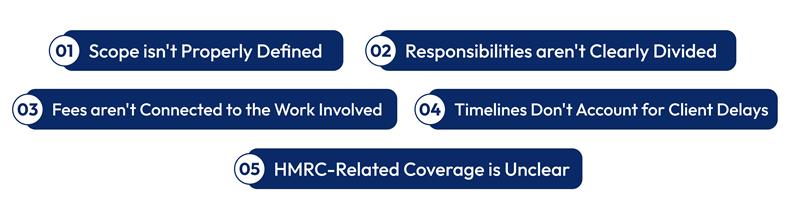
Scope isn’t Properly Defined
An accounting proposal may mention “monthly bookkeeping + VAT”, but the client may assume it includes:
- cleanup of previous records
- VAT corrections
- support for HMRC queries
- fixing errors from earlier periods
If the accounting scope is not defined clearly, work expands. The client assumes it is included. The accounting firms treat it as additional.
That difference leads to:
- proposal scope issues
- repeated clarification calls
- delays in delivery
- disputes around value and fees
This is also where scope creep starts.
Responsibilities aren’t Clearly Divided
Disputes often arise when an accounting engagement does not state clearly:
- what the client must provide
- what the accountant will prepare
- what depends on receiving timely and complete records
Examples include:
- who supplies bank statements and sales data?
- who confirms records completeness?
- who approves numbers before submission?
- what happens if records arrive late?
When responsibilities are not stated, the accounting clients may expect the firm to “make it work” regardless of missing documents.
An accounting proposal should clearly define:
- what is required from the client
- timelines for document submissions
- what the firm cannot proceed with until inputs are received
This improves the overall working relationship and reduces disputes.
Fees aren’t Connected to the Work Involved
In many accounting proposals, fees are included, but the link between fees and scope is not clearly explained. This lack of pricing transparency creates confusion.
Accounting clients often assume:
- monthly fee covers everything
- corrections and clean-up are included
- additional work is part of standard support
Common gaps seen in accounting firms include:
- no clear definition of what triggers additional fees
- no mention of historical cleanup as separate work
- no workload assumptions (transactions, payroll count, VAT scheme complexity)
If accounting fees are not linked to workload assumptions through clear accounting pricing, disputes become more likely. This price confusion undermines trust and can lead to pricing trust issues between the firm and client.
Timelines Don’t Account for Client Delays
Accounting clients often expect:
- urgent work will be done quickly
- deadlines will always be met
- submissions will happen even if records are late
In practice, timelines depend on:
- when records are provided
- how complete the documents are
- how quickly approvals are given
When the accounting proposal does not define this, the firm may be blamed for delays even when the main cause is late client input.
A clear accounting proposal should include:
- realistic turnaround times
- client submission deadlines
- review and approval timelines
HMRC-Related Coverage is Unclear
This is a major trigger for disputes in UK firms.
Clients often assume:
- preparing returns = dealing with HMRC queries = representing them if HMRC raises questions
But these are different activities.
An accounting proposal should define clearly:
- what HMRC compliance work is included
- what is outside scope
- whether HMRC correspondence support is included
- what the client must approve or sign
This is essential for HMRC compliance accounting proposals, especially where clients may be unsure about their responsibilities.
Common Accounting Proposal Mistakes that Lead to Disputes
Even good accountants can face disputes if accounting proposals are inconsistent or incomplete.
Below are common accounting proposal mistakes that lead to disagreements.
Mistake 1: Overly Broad Wording Without Clear Limits
Phrases like:
- “complete support”
- “full coverage”
- “end-to-end service”
These can sound reassuring, but they are not measurable.
They often result in:
- unclear service coverage
- unclear responsibility boundaries
- unclear fee assumptions
For accounting firms, it is better to use clear scope wording such as:
- “monthly bookkeeping up to X transactions”
- “VAT return preparation and filing (quarterly)”
- “Year-end accounts and corporation tax return”
Mistake 2: No Exclusions Section
A well-prepared accounting proposal should include exclusions. It prevents misunderstandings later.
Common exclusions can include:
- company secretarial work
- payroll (if not included)
- personal tax returns (if business-only engagement)
- historical cleanup beyond X months
- bookkeeping for additional entities
Even one short exclusions paragraph reduces disputes significantly and improves pricing transparency.
Mistake 3: No Transaction or Complexity Assumptions
Scope changes based on:
- number of transactions
- number of invoices
- number of employees (payroll)
- VAT scheme complexity
- multi-currency transactions
Without assumptions in the proposal pricing, the accounting clients expect stable pricing even when workload increases sharply.
This is where scope creep usually becomes unavoidable. A clear pricing strategy that accounts for complexity helps accounting firms manage expectations from the start.
How an Engagement Letter Helps?
An accounting proposal outlines the service. The engagement letter sets the formal terms.
A clear engagement letter helps by:
- confirming accounting scope and limitations
- defining responsibilities
- stating how scope changes will be handled
- supporting fee clarity and pricing transparency
For accounting firms, the engagement letter is the document that protects the practice when questions arise later. It ensures that both the firm and accounting clients understand the boundaries of accounting services being provided.
Conclusion
Unclear accounting proposals increase disputes because scope, responsibilities, timelines and accounting fees are not clearly defined. Most disputes are not about the quality of the accounting services. They arise when client expectations and engagement terms are not aligned.
For UK accounting firms, improving accounting proposal clarity and supporting it with a clear engagement letter reduces disputes, protects fees and improves client relationships. The result is fewer misunderstandings and smoother delivery.
FAQs
Why do unclear accounting proposals increase disputes?
Because scope and fees are not clearly defined, leading to different expectations between the client and firm.
How can accounting firms reduce scope creep?
Define inclusions, exclusions, responsibilities and workload assumptions clearly in accounting proposals and engagement letters.
What should be included in an accounting engagement letter?
Accounting scope, responsibilities, fee terms, exclusions and how additional work will be priced and approved.
How do proposal scope issues impact accounting fees?
When scope is unclear, extra work is seen as included, which leads to fee pushback and write-offs.
Can proposal tools reduce disputes?
Yes, a structured accounting proposal process improves consistency and reduces missing details.

Parul is a content specialist with expertise in accounting and bookkeeping. Her writing covers a wide range of accounting topics such as payroll, financial reporting and more. Her content is well-researched and she has a strong understanding of accounting terms and industry-specific terminologies. As a subject matter expert, she simplifies complex concepts into clear, practical insights, helping businesses with accurate tips and solutions to make informed decisions.