
Most accounting proposals do not fail because the service is wrong. They fail because the pricing stage creates uncertainty. The prospect cannot see what they are paying for, what is included, and how future changes will be handled. In many UK firms, proposal pricing clarity directly influences approval speed and client confidence.
For UK accounting firms, this often shows up in the same way: the client is interested, the call goes well, the proposal is sent, and then the proposal sits without approval or gets rejected. In many cases, pricing is the reason mentioned, but the real issue is how pricing is presented.
Pricing needs to feel clear, fair, and consistent with scope. When pricing clarity is missing, it creates fee confusion, pricing trust issues, and objections that slow down conversion.
This guide covers:
- Why accounting proposals fail at proposal pricing stage
- What creates price confusion and pricing trust issues
- How unclear accounting scope impacts accounting fees
- How accounting firms can improve pricing transparency without over-explaining
- A pricing checklist for proposal acceptance
Main Reasons Accounting Proposals Fail on Price
When prospects reject proposals, they rarely say “your scope is unclear”. They usually say, “it’s too expensive” or “we need to think”.
That is why the pricing stage matters the most. Pricing is the moment the client decides whether they trust the value.
Below are the most common reasons accounting proposals fail at this stage.
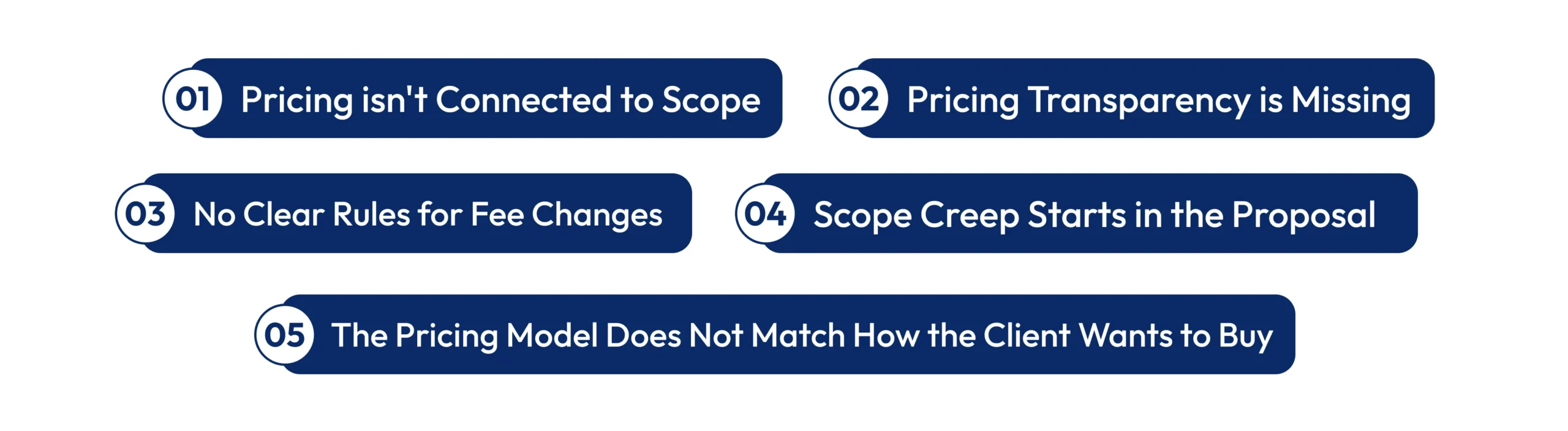
Pricing isn’t Connected to Scope
If a proposal shows a price without clearly linking it to scope, clients struggle to evaluate it.
Example:
- “Monthly accounting services: £400”
- But no clarity on: bookkeeping volume, VAT coverage, payroll handling, reporting level and timelines and review process
This creates price confusion and increases pushback on accounting fees.
It also affects proposal pricing because the client compares it to:
- Another firm’s cheaper number
- Their past accountant’s fee
- An online “starting from” price
Without scope context, pricing loses its meaning.
Pricing Transparency is Missing
Pricing transparency does not mean showing every internal detail. It means the client understands what the price includes.
Pricing transparency is usually missing when:
- pricing is bundled with no breakdown
- “extras” are not explained
- assumptions are not stated
- scope limits are missing
This leads to:
- uncertainty during approval
- delays
- a higher rejection rate
In proposal terms, transparent pricing is pricing that can be explained in one sentence.
No Clear Rules for Fee Changes
Many prospects accept the idea of a monthly fee. What they do not accept is surprise charges.
So if your proposal does not explain what triggers fee changes, clients assume:
- fees will increase unexpectedly
- additional items will be charged frequently
- the scope will keep changing
That increases pricing trust issues, even if your service is good.
Clear triggers usually include:
- transaction volume increases
- payroll headcount changes
- additional entities or VAT registrations
- clean-up or catch-up work required
The Pricing Model Does Not Match How the Client Wants to Buy
Some clients prefer fixed fees.
Some prefer a base + add-on structure.
Some prefer a quote linked to volume.
Proposals fail when the pricing strategy does not fit the prospect’s decision-making style.
For example:
- an owner-managed SME often prefers fixed-fee clarity
- a growing business often accepts variable pricing if it is predictable
So the issue is not only accounting pricing. It is pricing fit.
This is where many accounting firms lose momentum.
Scope Creep Starts in the Proposal
Some proposals create scope creep before onboarding even begins.
Example:
- prospect asks “can you also handle…?”
- proposal says yes, but without pricing clarity
- proposal includes it vaguely, or “included where required”
The prospect assumes all extras are included.
The firm assumes it will be billed later.
That gap causes pricing objections immediately.
So scope creep is not only a delivery problem. It can start inside the proposal.
Why Clients Reject Accounting Proposal Fees?
Pricing pushback usually happens for one of these reasons:
1. They Cannot Compare Your Proposal Easily
Clients compare proposals quickly.
If your proposal is:
- too long
- too vague
- too complex
…they cannot evaluate it confidently.
A clear fee page often wins over a detailed proposal.
2. They Do Not See the Difference Between Service Levels
Many prospects assume:
- all accountants offer the same service
- they are buying compliance only
If your pricing includes more value (review, reporting, support), you must name it clearly.
Otherwise your fee feels high, even when it is fair.
3. They Worry About Hidden Charges
If additional work pricing is not defined, the client assumes it will be charged later.
That increases rejection risk.
How Accounting Firms Can Improve Pricing Acceptance?
Accounting firms can improve proposal success by adding clear pricing summaries, stating scope assumptions upfront and explaining when fees might change. A short pricing summary that covers what is included, what is not and how prices adjust saves time and reduces pushback.
Quick Pricing Clarity Checklist
Before sending a proposal, make sure it includes:
- Clear scope definition: State what is covered and what is not
- Pricing assumptions: List expected volumes or service limits
- Fee-change triggers: Explain what causes price adjustments
- Additional work rates: State how extras are charged
Conclusion
Accounting proposals fail at the pricing stage when clients cannot clearly understand what they are paying for. The issue is rarely the number alone. It is the combination of unclear scope, low pricing transparency and unclear triggers for additional fees.
For UK accounting firms, improving pricing presentation does not require longer proposals. It requires clearer scope assumptions, a structured pricing summary and better alignment with engagement letter terms.
Firms using structured proposal templates and automated pricing workflows often see faster approvals because pricing remains consistent, transparent and easy for clients to evaluate. When pricing feels clear and predictable, proposals move faster and disputes reduce.
FAQs
Why do accounting proposals fail at the pricing stage?
Because pricing is not linked clearly to scope and inclusions, which creates uncertainty for the prospect.
Why do clients push back on accounting proposal fees?
They usually push back when they cannot see what is included, or they expect extra charges later.
Is price the main reason accounting proposals get rejected?
Not always. In many cases, rejection happens due to unclear scope and low pricing transparency.
How does unclear scope affect accounting proposal pricing?
Unclear scope makes pricing feel unpredictable. Clients worry they will be charged later for “extras”.
Why do clients question accounting fees after receiving a proposal?
They question fees when assumptions, inclusions, and scope-change rules are not clearly stated.
Are fixed-fee accounting proposals more likely to fail?
Fixed fees work well when scope is clear. If scope is unclear, fixed fees still create confusion.
How does poor pricing clarity impact proposal acceptance?
It slows approvals, increases follow-up, and increases rejection, even when the service is suitable.

Parul is a content specialist with expertise in accounting and bookkeeping. Her writing covers a wide range of accounting topics such as payroll, financial reporting and more. Her content is well-researched and she has a strong understanding of accounting terms and industry-specific terminologies. As a subject matter expert, she simplifies complex concepts into clear, practical insights, helping businesses with accurate tips and solutions to make informed decisions.