
Most accounting firms in Galway list the same services on their websites. Bookkeeping, VAT returns, payroll, year-end accounts. The language is similar, the service pages look familiar and it is genuinely difficult to tell them apart before you have worked with any of them.
The way Irish businesses manage their finances has changed significantly. According to the CSO’s Information Society Statistics published in February 2026, 52.9% of Irish enterprises now use cloud computing for finance or accounting software. More than half of Irish businesses are managing their finances on live systems throughout the year. That means the accounting firm you choose does more than file your returns. It determines how your financial data is handled throughout the year.
The real difference between firms is not in what they offer. It is in how they are structured to deliver it, how consistently they perform and how well their model fits the way your business actually operates.
Choosing the right one starts long before you compare fees or read reviews.
Key Takeaways:
- Most accounting firms offer similar services. The real difference is how those services are structured and delivered.
- Defining what your business needs before approaching any firm is the only way to evaluate which one is actually suitable.
- A firm’s internal processes and consistency matter more than its service list.
- Always request a full written breakdown of scope before agreeing to any fee.
The Problem with Choosing an Accounting Firm
The challenge with selecting among accounting firms in Galway is that most present themselves in a way that makes direct comparison very difficult. Services are broadly the same. Websites use similar language. Fees are rarely published upfront.
What is harder to see from the outside is how a firm actually operates. Whether it follows a structured process or works reactively. Whether it has the capacity to handle your volume of work. Whether the person you meet is the person who will work on your account.
These are the things that determine whether the relationship works and they are rarely visible until you are already a client.
Understanding Your Own Business First
Before approaching any firm, be clear on what your business actually requires. This sounds obvious but most businesses skip it.
A sole trader with one employee and no staff needs very little just basic compliance and a yearly self-assessment. A small business with staff, VAT and monthly reports needs an accountant working with them throughout the year.
Write down what your business needs right now and what it is likely to need in the next two years. That list is what you take into any conversation with a firm.
Firm Structure and What it Means for You
Accounting firms in Galway are not all built the same way and the differences matter in practice.
- Small practices operate with one or two qualified people covering a broad client base. They suit businesses with simple needs. The advantage is direct access. The limitation is capacity.
- Mid-size accounting companies have defined teams and internal workflows. More structure behind delivery and better suited to businesses with complex or ongoing requirements.
- Online accountants and outsourcing-based firms deliver services remotely with larger teams behind the client-facing relationship. This suits businesses that prefer to work digitally and need broader capacity without a physical office setup.
Each is a different operating model. The question is which one is built to handle what your business actually requires.
Service Delivery and How it Works
This is where firms differ most and where it is hardest to get a clear picture before signing.
A well-run firm follows a defined process. Deadlines are tracked internally. Work is reviewed before it reaches the client. There is a clear point of responsibility when something needs correcting.
A firm without a defined process handles work as it comes in. The output may be fine but the experience is unpredictable.
Before committing, ask how deadlines are tracked, whether there is a review process and what happens when something is delayed. The answers tell you whether the firm runs on a system or on goodwill.
Fees, Scope and Pricing
Most confusion around accountant fees comes from not understanding how firms structure their pricing.
A base fee typically covers year-end accounts and CT returns. Services such as bookkeeping, payroll and VAT return service are usually priced separately. Two firms quoting different headline fees may be covering entirely different scopes of work.
Ask for a full written breakdown of what is included and what is charged on top before agreeing to anything.
Consistency, Continuity and Accountability
The true value of a firm is reflected in how reliably it delivers not just once, but over time.
Consistency is essential when a business has regular obligations. Deadlines such as VAT3 returns or payroll submissions come up frequently and missing them can create unnecessary stress. A reliable firm manages these tasks on schedule, without the need for reminders or follow-ups.
Continuity becomes important when there are changes within the firm. Staff may move on, but the quality of service should remain steady. Strong internal systems and clear processes ensure that knowledge stays within the firm, so the client experience does not suffer.
Accountability becomes important when something goes wrong. Ask for references and check how the firm handles problems, so you know what to expect if issues arise.
What to Verify Before You Sign?
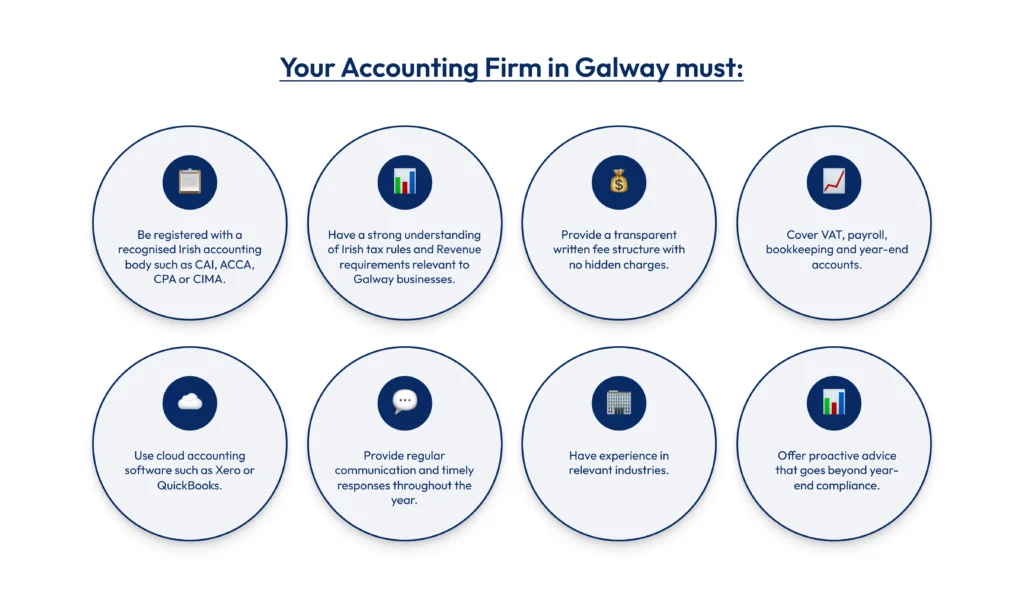
Here are five things worth checking before committing to any accounting firm.
Qualifications
The firm should hold a current practising certificate from Chartered Accountants Ireland, CPA Ireland, ACCA or CIMA. In Ireland anyone can legally call themselves an accountant so this check is not optional.
Irish tax knowledge
Staff should be current on VAT, PAYE Modernisation and the 2026 changes under Finance Bill 2025. Ask directly and expect a confident answer.
Cloud software
The firm should work on a platform such as Xero or QuickBooks, supporting real-time access to your figures.
Written engagement letter
Any credible firm puts the scope, fees and responsibilities in writing before work begins.
References
Ask other business owners who they use and check Google reviews for consistent patterns around responsiveness and communication.
Conclusion
Choosing the right accounting firm in Galway is about alignment. Not the best-known name or the lowest fee but the firm whose structure, processes and service model fit the way your business actually operates.
Before deciding, step back and ask a few practical questions. Does the firm’s delivery model match how your business operates? Is the pricing structure clear? Can the firm support where your business is heading, not just where it is now?
The firms that look similar on paper are often very different in practice. Understanding how a firm is built and how it delivers work consistently is what makes the difference.
Need a firm that fits the way your business works? Outbooks provides outsourcing bookkeeping, VAT, payroll and year-end services across Ireland with ACCA-qualified staff, Irish working hours and ISO 27001:2022 certified data security. Visit outbooks.com/ireland/ or call +353-212069255.
FAQs
What services do accountants in Galway City provide?
Most accounting firms cover bookkeeping, VAT returns, payroll, self-assessment tax returns, year-end accounts and CT returns. Some also provide management accounts and tax and accountancy services on an ongoing basis.
When does a business need a tax accountant?
A business needs a tax accountant as soon as it has tax obligations, such as VAT registration, PAYE employees or filing CT1 or Form 11. They are also needed when planning a sale, restructure or major investment.
How much do accountants in Galway charge for small business services?
Accountants in Galway usually structure their fees in layers. A base fee covers year-end compliance and services such as VAT, payroll and bookkeeping are priced separately. Always request a full written breakdown before agreeing.
Do businesses need a local accountant or does an accounting outsourcing service work?
Both work effectively. Accountants operating remotely handle bookkeeping, VAT, payroll and year-end returns to the same standard as a local firm. Many businesses already use online accountants without issue.
What does outsourcing bookkeeping include?
Outsourcing bookkeeping covers transaction recording, bank reconciliation, supplier and customer reconciliation and VAT return preparation delivered remotely through shared cloud platforms such as Xero or QuickBooks.
What do payroll services in Galway cover?
Payroll services cover payslip preparation, employee deductions and real-time PAYE Modernisation submissions to Revenue on or before each pay date. Payroll services Ireland-wide now also include Auto-Enrolment pension obligations under My Future Fund, which came into effect from 1 January 2026.
How do accounting firms manage VAT returns?
Most firms file VAT3 returns through ROS on their clients behalf. VAT3 returns are due by the 23rd of the month following each two-month period for ROS filers, which is now the standard filing method.
Do accounting firms file personal tax returns as well as business returns?
Yes, most firms handle Form 11 returns for self-employed individuals, directors and anyone with non-PAYE income. A personal tax return accountant within the same firm ensures both are filed correctly and on time.
Can a business switch accounting firms mid-year?
Yes, the incoming firm requests professional clearance from the outgoing firm under professional body rules. Records transfer with the business and the process typically takes one to three weeks.
How does Outbooks deliver accounting services for businesses?
Outbooks provides outsourcing bookkeeping, VAT return services, payroll outsourcing services, management accounts and year-end services remotely with ACCA-qualified staff, Irish working hours and ISO 27001:2022 certified data security. Businesses engage on a staff augmentation or fixed fee basis.

Parul is a content specialist with expertise in accounting and bookkeeping. Her writing covers a wide range of accounting topics such as payroll, financial reporting and more. Her content is well-researched and she has a strong understanding of accounting terms and industry-specific terminologies. As a subject matter expert, she simplifies complex concepts into clear, practical insights, helping businesses with accurate tips and solutions to make informed decisions.