The Irish accounting software market has never been more crowded or more confusing.
With over 30+ cloud accounting software solutions available, Irish businesses spend more time evaluating tools than using them. The wrong choice means hours in manual corrections, VAT filing errors and missed bank reconciliations. This guide cuts through the noise, validated, updated for 2026 and written from real-world Irish accounting experience.
Key Takeaways
- Ensure accounting software fully supports Irish VAT and Revenue compliance, as many UK-based solutions need careful setup.
- Xero and QuickBooks Online lead for cloud-native design, integrations and ease of use when paired with outsourced bookkeeping services.
- Local Irish options like Surf Accounts, Sort My Books and Bullet offer tailored VAT, bank feeds and Revenue ROS integration.
- Match software to your business size and growth: simple plans for sole traders; advanced features for growing firms.
- Bank feed compatibility with Irish banks (Bank of Ireland, AIB, Revolut) is vital for accuracy and time savings.
- Use free trials and consult your accountant, such as those through Chartered Accountants Ireland, to ensure correct VAT setup and smooth adoption.
- Prioritise GDPR compliance, automated backups and ISO 27001 certification, refer to the Data Protection Commission for data privacy best practices.
- Avoid the three most common mistakes: overly complex software, ignoring Irish-specific requirements and skipping onboarding.
Why Irish Businesses need specialised Accounting Software?
A tool that works perfectly in the UK may create significant compliance headaches in Ireland. Irish businesses face a distinct set of requirements, VAT compliance, Revenue Online Service (ROS) submissions, CRO filing, PAYE Modernisation and the upcoming EU ViDA e-invoicing mandate. Generic bookkeeping software simply isn’t built with these in mind.
As outlined in Revenue’s guidelines for electronic records, maintaining proper accounting records is a legal requirement for all Irish businesses. Software that shortcuts this creates real liability.
Cloud-based automated accounting software gives you real-time financial visibility, when your accountant, bookkeeper and financial director access the same live data, decision-making gets faster and errors get caught earlier.
Accounting Software Trends in Ireland (2026)
Irish accounting software is increasingly focused on automations like:
- AI-Assisted Bookkeeping: Automated transaction categorisation, anomaly detection and smart reconciliation are now standard in leading platforms, no longer a premium add-on.
- Real-Time Reporting: Live dashboards that update continuously are becoming the baseline expectation for any serious business accounting software in Ireland.
- E-Invoicing Readiness: Ireland is implementing phased mandatory B2B e-invoicing under the EU ViDA Directive by 2030 via the PEPPOL network.
What to Look for in Accounting Software in Ireland
- Support for Irish VAT rates and VAT3 returns
- Compatibility with Revenue Online Service (ROS)
- Cloud-based access for real-time collaboration
- Automated bank feeds from Irish banks (AIB, Bank of Ireland, Revolut)
- GDPR-compliant data storage and processing
- Integration with Dext (receipts) and Fathom HQ (reporting)
- Transparent pricing, no hidden per-user fees
The UK Software Warning Irish Businesses Overlook
Many popular accounting software solutions originate in the UK and simply extend their service to Ireland. This is not the same as being purpose-built for the Irish market.
Without proper configuration, you risk:
Incorrect VAT rate mapping · Bank feed failures with Irish institutions · Non-compliant ROS submission formats.
Popular UK options like Xero and QuickBooks require manual VAT tweaks. True Irish accounting software like Surf Accounts and Sort My Books offers seamless ROS and CRO compliance from day one.
The Most Popular Accounting Software in Ireland: Top 8 Options
Below are some of the top accounting software options for Irish businesses:
1. Xero: Best overall Cloud Accounting Solution
When people talk about the most popular accounting software in Ireland, Xero consistently tops the list. Built cloud-first from day one, not adapted from legacy desktop software, it delivers a level of intelligent automated accounting software functionality that materially reduces manual reconciliation time.
Key Features:
- Unlimited users on all plans – no per-seat surprises
- Intelligent transaction matching and bank reconciliation
- Advanced expense tracking with mobile receipt scanning
- 1,000+ third-party app integrations
- Direct feeds: AIB, Bank of Ireland & Revolut confirmed
- Other Irish banks may require manual CSV import
Pricing:
Starter $29/month, Standard $50, Premium $75 – billed in USD. Check current euro-equivalent pricing as exchange rates apply. Many accountants offer discounted subscriptions to clients.
Irish market considerations:
As a VAT accounting software option, Xero requires manual VAT rate entry, straightforward with proper setup. The Starter plan caps at 20 invoices and 5 bills/month; Standard or Premium removes these limits. Xero meets Revenue’s digital record-keeping requirements.
AIB and Bank of Ireland direct feeds are confirmed as available. Revolut also supports a direct connection. For all other Irish banks, verify feed availability at xero before committing, as CSV import may be needed.
Best For: Small–medium businesses
Irish VAT: Manual Setup
Bank Feeds: AIB, BoI, Revolut direct
Users: Unlimited
See related post : Bookkeeping Solutions for Business Growth – Sage VS Xero
2. QuickBooks Online: Best for E-Commerce & Sole Traders
QuickBooks is the world’s most widely used accounting software for small business and it earns that position through a genuine balance of power and accessibility. For Irish businesses, it stands out as one of the few platforms offering live bank feeds for all major Irish banks without manual CSV workarounds.
Key features:
- Live bank feeds for all major Irish banks
- 750+ integrations – payroll, CRM, inventory
- Multi-currency support on higher tiers
- Excellent multichannel customer support
- Excellent multichannel customer support
- Plus tier: expense, time tracking & inventory
Pricing:
From ~€15–20/month for Simple Start. Prices have risen significantly, verify current Irish pricing before committing. 30-day free trial available.
As a tax accounting software tool, QuickBooks handles Irish VAT filings with proper configuration and meets Irish GDPR requirements for financial data protection.
Best for:
E-commerce & sole traders
Irish VAT: Automated
Bank Feeds: All Irish banks
Users: Varies by plan
See related post : How does QuickBooks work for your Business
3. Sage Accounting: Best Accounting Software for Growing Businesses
Sage has been a cornerstone of Irish accounting for decades. Sage Business Cloud Accounting is the best accounting software for growing businesses that want established reliability in a modern, accessible format with a clear upgrade path as needs evolve.
Key features:
- Quote and invoice management with professional templates
- Direct bank linking and automated VAT handling
- Project tracking on desktop and mobile
- Optional payroll add-on for growing teams
- 30-day free trial on all plans
- Updated with latest Revenue VAT legislation
Pricing:
Start from €17/month (ex. VAT); full from €34/month (ex. VAT). 90% off for first 3 months currently available. Check current pricing at sage.com/en-ie.
Sage stays updated with the latest Revenue VAT legislation. Verify Irish-specific VAT configuration during your trial before going live.
Best For: Growing businesses
Irish VAT: Automated
Bank Feeds: Yes
Users: 1+ additional
4. Surf Accounts: Best Dedicated Irish Accounting Software
If you want bookkeeping software in Ireland built specifically for Irish businesses not adapted from a UK or US product, Surf Accounts is the strongest option. As a genuinely local company, they understand Revenue requirements, Irish banking behaviour and CRO filing in a way international providers simply can’t replicate.
Key features:
- Free unlimited telephone & email support
- Stylish invoicing & bank reconciliation
- Inventory management included as standard
- Payroll features available
- Direct bank feeds for all Irish banks
- Real-time accountant collaboration built-in
Surf Accounts is designed specifically to meet CRO filing requirements and supports Irish VAT from day one, no manual configuration needed. As effective accounting software for banks in the Irish context, it connects to all major Irish institutions directly.
Best For: Irish small businesses
Irish VAT: Built-In
Bank Feeds: All Irish banks
Users: Multiple
5. Sort My Books
Sort My Books is purpose-built small business accounting software in Ireland and it doesn’t try to be anything else. It focuses on doing the fundamentals exceptionally well for small Irish operations, without the feature bloat that confuses owners who just need clean books and accurate VAT returns.
Key features:
- Local VAT report settings for Ireland
- Built-in receipt capture – no extra tool needed
- Online bank feeds for all Irish banks
- Designed for small business simplicity
- Direct ROS integration for VAT submissions
- Irish banking system compatibility
Why choose Sort My Books?
Sort My Books integrates directly with Revenue’s ROS, simplifying VAT submissions in a way that requires workarounds on international tools. As dedicated bookkeeping software in Ireland, it understands Irish banking nuances better than any international alternative.
Best For: Very small businesses
Irish VAT: Local Settings
Bank Feeds: All Irish banks
Users: Multiple
6. KashFlow
KashFlow is a UK product thoughtfully adapted for the Irish market. For businesses using cash accounting for VAT purposes, it fills a specific gap that other platforms don’t address as cleanly. Its clean, intuitive interface makes it one of the easiest platforms to adopt with minimal training.
Key features:
- Bank feeds for majority of Irish banks
- Irish cash accounting for VAT
- Manages Irish Return of Trading Details
- Integrated payroll features
As an integrated bookkeeping and payroll solution, KashFlow reduces the number of tools a small business needs, both systems work within the same platform seamlessly.
Best For: Cash accounting users
Irish VAT: Built-In
Bank Feeds: Most banks
Users: Multiple
7. AccountsIQ
AccountsIQ is business accounting software for organisations that have outgrown standard SME platforms. As an Irish-developed solution with multi-jurisdictional capabilities, it occupies a category of its own in the Irish market.
Key features:
- Multi-entity and multi-currency accounting
- Sophisticated financial and non-financial reporting
- Intuitive dashboard despite complex functionality
- Robust VAT reporting across jurisdictions
AccountsIQ is particularly useful for companies receiving Enterprise Ireland funding, grant reporting requirements often exceed what standard platforms can handle. Premium pricing, but for complex organisations, the alternative is multiple disconnected accounting software solutions with significant manual overhead.
Best For: Large / complex businesses
Irish VAT: Robust
Bank Feeds: Yes
Users: Multiple
8. Bullet
Bullet holds a genuinely unique position in the market for Irish accounting software: it’s the only automated accounting software solution authorised by both the Central Bank of Ireland and the European Central Bank, a level of regulatory scrutiny most software platforms simply don’t go through.
Key features:
- Invoicing in seconds with professional templates
- Automated VAT and tax calculations
- Instant payment options built into invoices
- Simplified payroll processing
- Expense tracking and categorisation
- Live support – real people, no AI chatbots
Bullet automatically handles Irish PAYE Modernisation requirements, a compliance area where many international tools fall visibly short. As effective tax accounting software for micro-businesses, it covers VAT and PAYE in an interface simple enough for non-accountants to use confidently.
Best For: Irish startups & micro-biz
Irish VAT: Automated
Bank Feeds: Major banks
Users: Multiple
Comparison table: Top Accounting Software features
| Software | Monthly Cost | Irish VAT | Bank Feeds | Users | Best For |
|---|---|---|---|---|---|
| Xero | From $29/month (USD), see xero.com/ie for current euro pricing | Manual setup | AIB and Bank of Ireland confirmed, others via CSV | Unlimited | Small to medium businesses |
| QuickBooks | ~€15–20/mo – verify at quickbooks.intuit.com/ie | Automated | All Irish banks | Varies by plan | E-commerce & sole traders |
| Sage | From €17/mo (ex. VAT); 90% off first 3 months | Automated | Yes | 1+ additional | Growing businesses |
| Surf Accounts | Custom pricing | Built-in | All Irish banks | Multiple | Irish small businesses |
| Sort My Books | Contact for pricing | Local settings | All Irish banks | Multiple | Very small businesses |
| KashFlow | Contact for pricing | Built-in | Most banks | Multiple | Cash accounting users |
| AccountsIQ | Premium pricing | Robust | Yes | Multiple | Large or complex businesses |
| Bullet | Free trial available | Automated | Major banks | Multiple | Irish startups |
Three Integrations that transform Irish Accounting Workflows
Your accounting software in Ireland is only as powerful as the ecosystem surrounding it. These three integrations consistently deliver the biggest time return for Irish accountants and businesses.
Dext: Automated Receipt Processing
Works with Xero and QuickBooks Online. Uses OCR technology to extract data from receipts, invoices and bank statements automatically, eliminating manual data entry from the bookkeeping process. Saves 3–5 hours per week for businesses with high invoice volumes.
Cin7 Core: Stock Management (formerly DEAR Inventory)
For product-based businesses, inventory management becomes the bottleneck standard bookkeeping software can’t solve alone. Cin7 Core handles multiple SKUs across multiple warehouse locations and integrates with all major accounting platforms.
Fathom HQ: Advanced Business Reporting
Standard business accounting software tells you what happened. Fathom tells you what it means. Plugs directly into Xero for customisable KPI dashboards, variance analysis and client-ready reports, essential for advisory-focused accounting.
How to choose the right Accounting Software for your Irish Business
Five questions that will narrow your decision significantly:
- What’s your actual business size? Basic bookkeeping software suits one or two employees. Once you’re managing payroll, VAT returns, inventory and project tracking simultaneously, you need automated accounting software that handles routine accounting tasks without manual intervention.
- What does your Irish bank support? Verify accounting software for banks compatibility before anything else. If your business account doesn’t connect directly, you’re doing manual CSV imports indefinitely.
- Does it handle Irish VAT correctly out of the box? Test Irish VAT compliance during your free trial, don’t rely on marketing copy. The difference between “we support VAT” and “we support Irish VAT3 returns with correct rate mapping” is significant.
- What integrations will you need in 12 months? Plan the full ecosystem, payroll, inventory, receipt capture, reporting. A platform with 1,000 integrations that doesn’t connect to your payroll provider is less useful than it appears.
- What does your accountant use? If you work with an outsourced accounting partner, ask for their recommendation. Many practices offer discounted subscriptions and collaboration is far smoother when both parties use the same platform.
Still unsure? Contact Outbooks Ireland and let our team guide you to the right accounting software solutions for your specific situation.
Getting Started: A Practical Onboarding Checklist
Most businesses underestimate how much the setup phase determines long-term success with any accounting software platform. Follow these five steps:
- Use the Free Trial Properly: Use it for real tasks, import actual invoices, connect your actual bank account, run your actual VAT rates. Don’t evaluate small business accounting software in Ireland on demo data that doesn’t reflect your transaction volume.
- Consult with your Accountant: Find qualified accountants through Chartered Accountants Ireland and discuss your shortlist before committing. Their experience with accounting software in Irelandis invaluable.
- Configure Irish VAT Correctly from Day One: Incorrect VAT setup creates reconciliation problems that compound over time. Whether you’re using VAT accounting software with built-in Irish rates or a platform requiring manual configuration, have your accountant verify this first.
- Connect Your Bank Accounts Immediately: Live bank feeds save enormous time on data entry and reduce human error. Set up on day one, not week three. This is where accounting software for bankscompatibility truly matters in daily practice.
- Import historical data: Most accounting software solutions can import transaction history from CSV files or directly from other platforms. Complete financial history in one place makes VAT returns, year-end accounts and Revenue queries significantly easier.
Security and data backup checklist
Cloud accounting software means trusting a third party with your most sensitive financial data. Before signing any contract, verify all of the following:
- ISO/IEC 27001 certification for information security management
- GDPR compliance – data stored and processed under Irish data protection law
- Automated daily backups with documented disaster recovery procedures
- End-to-end encryption for data in transit and at rest
- Regulatory authorisation, bullet is authorised by the Central Bank of Ireland
- Multi-factor authentication available across all user accounts
Cloud storage, when properly implemented, is significantly more secure than local desktop bookkeeping software or paper records. But “cloud” is not automatically “secure”, verify the specifics with every provider you evaluate.
New in 2026: Revenue & Digital Trends
The Irish accounting sector is undergoing four critical shifts that will dictate software viability over the next three years:
- Mandatory E-Invoicing (ViDA Compliance): Ireland is implementing phased mandatory e-invoicing for B2B transactions under the EU ViDA Directive by 2030. Your business accounting software needs to support PEPPOL network standards now, not in 2029 when migration becomes urgent.
- Automated accounting is the baseline: Platforms requiring manual transaction categorisation are falling behind. In 2026, automated accounting software with intelligent matching and anomaly detection is an expectation, not a premium feature.
- Cloud adoption is accelerating: Irish SME cloud adoption has grown significantly year-on-year. Businesses still on desktop bookkeeping software are increasingly isolated from the integration ecosystem that makes modern accounting efficient.
- GDPR enforcement is intensifying: Accounting software solutions that can’t demonstrate clear data residency and processing transparency are becoming a compliance risk, not just a software choice. Refer to the Data Protection Commission for current guidance.
Common Mistakes that cost Irish businesses time and money
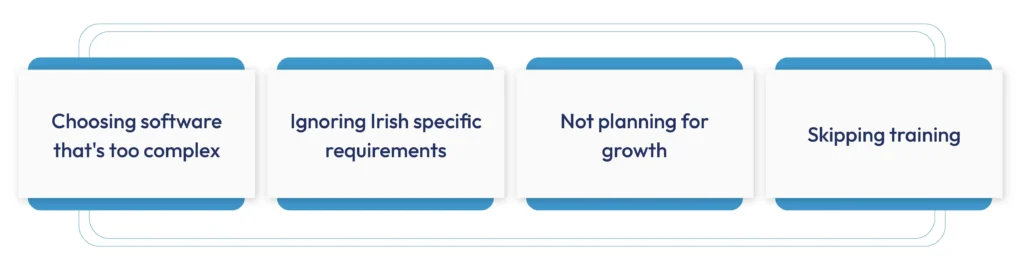
- Choosing software that’s too complex: Overly sophisticated software wastes time if you don’t need advanced features. Start simple and upgrade as your business grows.
- Ignoring Irish-specific requirements: International software might not handle Irish VAT or banking correctly. Always verify local compliance before making your choice.
- Not planning for growth: Software that works today might not suit your business next year. Choose platforms that can scale with your operations.
- Skipping training: Even user-friendly software requires some learning time initially. Take advantage of training resources and support offered.
Conclusion
There’s no single best accounting software for every Irish business and anyone who tells you otherwise is oversimplifying.
Xero and QuickBooks Online lead on integrations, cloud functionality and ecosystem breadth. True Irish accounting software like Surf Accounts, Sort My Books and Bullet delivers compliance confidence that international tools require careful configuration to match. Sage is the best accounting software for growing businesses that want enterprise-grade support with a proven track record. AccountsIQ serves complex multi-entity organisations that have genuinely outgrown standard small business accounting software in Ireland.
What matters is choosing accounting software solutions that support Irish compliance, save time through automation, integrate with your existing tools and can scale with your business, not just today, but through the e-invoicing changes ahead by 2030.
For practices managing multiple clients, pairing the right bookkeeping software in Ireland with professional accounting outsourcing services is how leading Irish firms scale capacity without proportionally scaling headcount.
Pair the right software with professional accounting outsourcing services to maximise efficiency and stay ahead of the curve. Contact us today via call +353 212069255 or mail at info@outbooks.com.
Frequently Asked Questions
What is the best online accounting software for small business in Ireland?
Xero is the top recommendation for most Irish small businesses as accounting software for small business needs, unlimited users, strong integrations and a genuinely cloud-native architecture. QuickBooks Online is equally strong, particularly for e-commerce operations. The right choice depends on your banking setup, accountant’s preference and growth trajectory.
What is the cheapest bookkeeping software in Ireland?
QuickBooks Online starts from approximately €15/month for Simple Start, making it one of the most accessible options for small business accounting software in Ireland. Xero’s Starter plan is $29/month (USD), check xero.com/ie for the current euro equivalent. Both offer 30-day free trials. Free tools exist but typically have significant limitations around transaction volumes, bank feeds or VAT filing that make them impractical for most Irish businesses.
What is the simplest accounting software to use?
Bullet is specifically designed for simplicity, it’s the most accessible starting point as dedicated Irish accounting software for micro-businesses. Xero and QuickBooks Online are both highly intuitive once configured. Surf Accounts offers simplicity combined with strong local support, which is genuinely valuable when Irish compliance questions arise.
What is the best bookkeeping software for sole traders?
QuickBooks Online Simple Start covers invoicing, expense tracking and income tax estimates from approximately €15/month. Xero works well for sole traders anticipating growth. Sort My Books is an excellent bookkeeping software in Ireland option for sole traders who want localised support without the learning curve of larger platforms. Learn more about sole trader obligations directly from Revenue.
Can I switch accounting software later?
Yes, most modern accounting software solutions support data migration. Xero offers dedicated conversion services from competing platforms. Your accountant can typically assist with the transition. Plan the switch carefully, mid-year migrations require significantly more reconciliation work than end-of-year switches.
Do I need an accountant if I use accounting software?
Accounting software handles daily bookkeeping tasks automatically. However, professional accountants provide valuable tax advice and strategy. Medium-sized businesses often use both software and accountant services. Accountants can also help you get more value from your software.
How secure is cloud accounting software?
Reputable providers follow strict security and data protection guidelines. Cloud storage is often more secure than paper records or local computers. Bullet is the only accounting and payroll product authorised by both the Central Bank of Ireland and the European Central Bank. Always choose established providers with strong security credentials.
What integrations are most important?
Receipt capture tools like Dext save enormous time on paperwork. Inventory management becomes essential as product businesses grow, Cin7 Core (formerly DEAR Inventory) is a leading option that integrates with major accounting platforms. Reporting tools like Fathom HQ provide better business visibility. Payroll integrations simplify staff payments, taxes and compliance with PAYE modernisation.
What is the best accounting software for small business in Ireland?
Xero and QuickBooks Online are top choices for Irish small businesses. Xero suits growing firms with unlimited users and integrations, while QuickBooks is budget-friendly and connects to Irish banks. Irish-built options like Surf Accounts and Bullet offer strong local VAT and Revenue compliance.
What features should small business accounting software have in Ireland?
Key features include Irish VAT calculation and VAT3 support, bank feeds (AIB, BOI, Revolut), cloud access, GDPR compliance, payroll integration, and receipt capture. Missing these can lead to manual work and compliance risks.
Is there free business accounting software for small businesses in Ireland?
Free tools exist but often lack VAT support, bank feeds, or scalability. Most Irish businesses benefit more from free trials (14–30 days) offered by Xero, QuickBooks, Sage, and Bullet.
What is the best accounting application software for Irish startups?
Bullet is ideal for Irish startups with built-in payroll, PAYE Modernisation, and regulatory approval. Xero is better for scaling startups needing advanced integrations and flexibility.
How much does business accounting software cost in Ireland?
Prices range from €15 to €75 per month depending on features. QuickBooks starts around €15–20, Sage from €17, and Xero from $29 (USD). Irish providers may offer custom pricing.
Can accounting software handle VAT returns in Ireland?
Yes, most platforms support VAT returns. Irish tools like Bullet and Surf Accounts handle VAT3 natively, while Xero and QuickBooks require proper setup. Always verify VAT configuration with an accountant.
Accounting Popular Posts
- How does QuickBooks work for your Business & its comparison with other software’s
- Modern Bookkeeping: Techniques for Accountants in Ireland
- 5 Essential tools to make filing your Self-Assessment easier
- Xero Accounting & Bookkeeping Services in Ireland
- Accounting Technology Trends Reshaping Industry in Ireland
- How to add accountant to Quickbooks online
- How can Accounting services benefit business start up Ireland?
- Structure and Organisation of Accountancy Profession
- Benefits of Outsourcing Accounting Services for Small Businesses in Ireland
- Online Accountants: Simplified Bookkeeping and Accounting in Ireland
- Accounting in Ireland – Choosing the Right Tax Accountant

Parul is a content specialist with expertise in accounting and bookkeeping. Her writing covers a wide range of accounting topics such as payroll, financial reporting and more. Her content is well-researched and she has a strong understanding of accounting terms and industry-specific terminologies. As a subject matter expert, she simplifies complex concepts into clear, practical insights, helping businesses with accurate tips and solutions to make informed decisions.