

Two Irish companies can report exactly the same €40,000 profit and still end up with very different corporation tax bills. One pays tax at 12.5%, while the other pays 25%. The difference isn’t how much they earned. It’s the type of income they generated.
The challenge is not just the tax rate but the timeline. Corporation tax follows two separate deadlines within the same accounting year, with the first falling before the year has even ended. Losses, reliefs and nil returns add further complexity to the process.
By the end, you will know which rate applies to your company, when both deadlines fall, how to file and what to do if your company made no profit at all.
Key takeaways
- Under Revenue’s “basis of charge” rules, trading income is taxed at 12.5%, while non‑trading income and excepted trades are taxed at 25%.
- Preliminary tax is due before the accounting period ends, not after it.
- The CT1 return and balance of tax are due nine months later, by the 23rd (when filing and paying via ROS).
- A company with no profit still must file a return, known as a nil return.
- Late filing adds a surcharge of 5% or 10% on top of the tax due.
Who pays Corporation Tax in Ireland?
Many business owners assume corporation tax only becomes relevant once a company starts making a profit. In reality, a limited company comes within Ireland’s corporation tax system from the day it begins trading, even if its first tax payment comes later.
Whether corporation tax applies depends on how the business is structured. Limited companies pay corporation tax on their taxable profits, while sole traders and partnerships remain within the income tax system.
- Irish resident company: Taxed on worldwide profits, whether incorporated here or simply run from here by its directors, per Revenue’s corporation tax overview.
- Non-resident company: Taxed only on profits from an Irish branch, agency or Irish rental property.
- Sole trader or partnership: Pays income tax through self-assessment, not corporation tax at all.
Two owners can report the same €60,000 profit and end up in two different systems. The sole trader pays income tax on it directly.
The director’s company pays corporation tax on it first and the director still has to decide how to take money out afterwards, as salary or as dividends.
What are the Corporation Tax Rates in Ireland?
There is no single corporation tax rate. Two companies reporting identical profits can owe very different amounts, because the rate follows the type of income, not the size of the business.
| Income type | Rate | Covers |
|---|---|---|
| Trading income | 12.5% | Profit from the business’s actual activity |
| Passive income | 25% | Rent, interest, most foreign dividends |
| Excepted trade | 25% | Land dealing, mineral or petroleum extraction |
Qualifying IP income also has its own rate. Under the Knowledge Development Box, profits from patented inventions or copyrighted software created through qualifying R&D are taxed at an effective rate of 10%, and this relief has been extended to accounting periods commencing before 1 January 2027.
Trading income
Trading income is the profit generated from the company’s core business activities, such as selling products, providing services, consulting, manufacturing or software development. Most Irish SMEs fall into this category.
Passive income
The 12.5% corporation tax rate does not apply to every type of company income. Income generated from investments or assets is generally treated differently from trading income for corporation tax purposes.
A change took effect on 1 January 2026 that affects some of these foreign dividends directly. Where a company claims the participation exemption to remove qualifying foreign dividends from this 25% charge.
Revenue’s guidance on the exemption for foreign distributions sets a five-year look-back period on the subsidiary’s tax residency for distributions made during 2025, but only a three-year look-back for distributions made from 1 January 2026 onward.
A dividend paid on 15 January 2026, for example, is tested against the subsidiary’s residency from January 2023 onward rather than January 2021, per Revenue’s Tax and Duty Manual on the participation exemption.”
When a company has both:
Many companies earn both trading and passive income during the same accounting period. In these cases, Revenue taxes each income stream separately rather than applying a single corporation tax rate to the company’s total profit.
Here’s how the two rates work in practice:
A consultancy that also rents out an office. It does not pay 12.5% on its full profit. Say the company earned €40,000 in trading profit and €10,000 in rental income:
- €40,000 trading profit × 12.5% = €5,000
- €10,000 rental income × 25% = €2,500
- Total tax due: €7,500
Applying one flat rate to the total profit shown in the accounts, instead of separating trading and passive income first. A company that does this typically under-provisions for its tax bill and only finds the shortfall at filing time.
Understanding the tax rates is only one part of the process. Once the type of income has been identified and the correct rate applied, every company follows the same corporation tax journey, from calculating its liability to paying preliminary tax and filing the CT1 return.
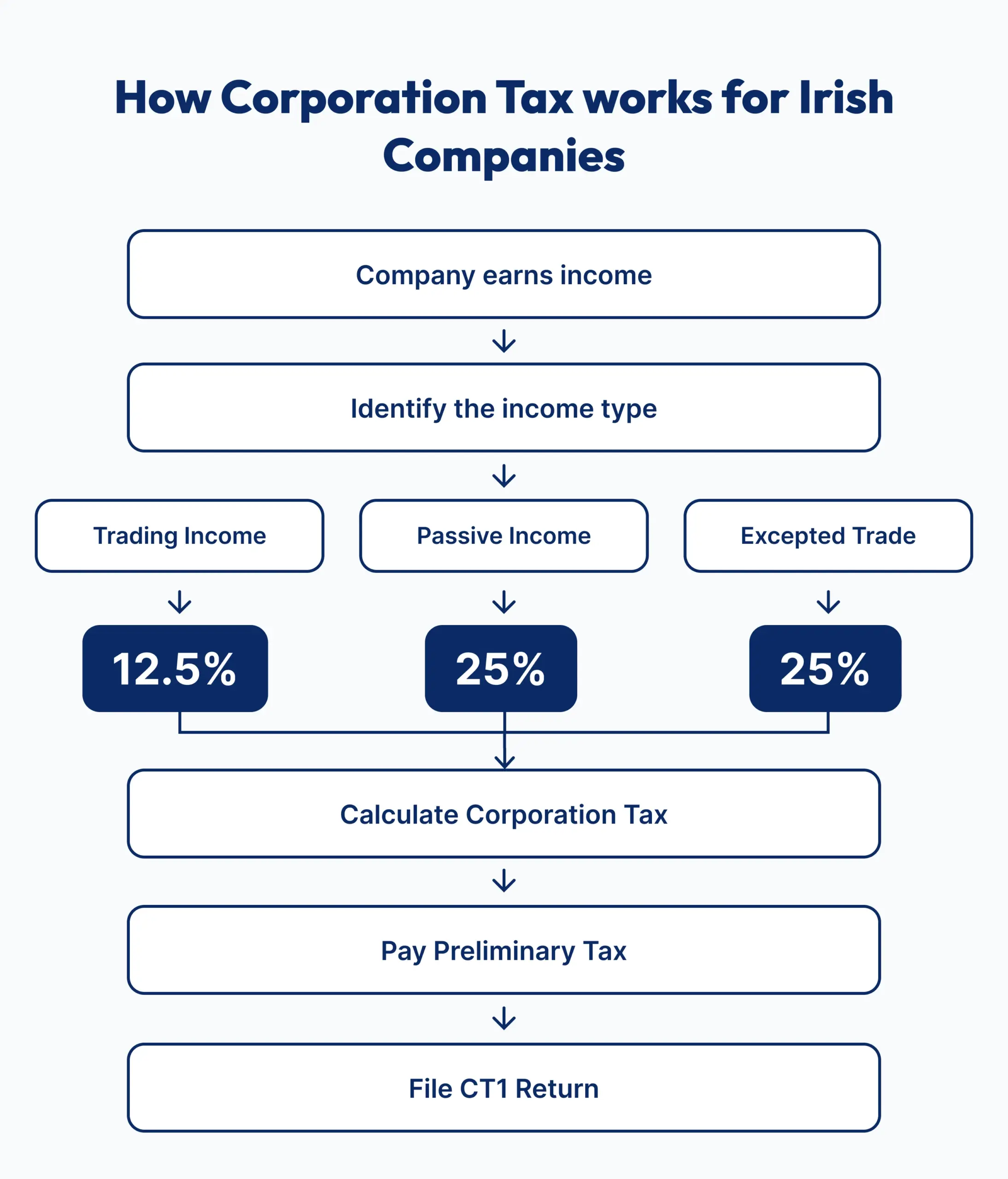
While the process itself is straightforward, the timing of each step is what often causes confusion. Preliminary tax is paid before the accounting period ends, whereas the CT1 return and any remaining corporation tax are submitted months later. Understanding these deadlines is essential to avoid interest and late filing penalties.
When is Preliminary Tax Due?
Preliminary tax is paid before the year it relates to has finished. How much is due, and when, depends on the size of the company’s prior-year bill.
| Requirement | Small company (prior-year CT ≤ €200,000) | Large company (prior-year CT > €200,000) |
|---|---|---|
| Instalments | One | Two |
| First payment | 23rd of the month before year end | 23rd of the 6th month, 50% of last year’s CT or 45% of this year’s |
| Second payment | Not applicable | 23rd of the 11th month, brings total to 90% |
| Minimum | Lower of 100% of last year’s CT or 90% of this year’s | 90% of the current year’s liability |
Quick tip: Many companies only start thinking about corporation tax once the year-end accounts are ready. By then, preliminary tax may already be overdue. Building the payment into cash flow planning early avoids a last-minute scramble.
New (start-up) companies do not have to pay preliminary corporation tax for their first accounting period if their corporation tax (CT) liability for that first period is less than €200,000. This threshold excludes any surcharge, but includes any Income Tax payable under Section 239 of the Taxes Consolidation Act (TCA) 1997.
Instead, the company pays the final CT charge for the first accounting period when submitting its corporation tax return (CT1).
Corporation Tax Payment Dates and Filing Deadline
Once preliminary tax has been paid, businesses still have another important compliance deadline to meet. For companies with a 31 December year-end, the timeline looks like this:
- Second preliminary tax instalment due: 23 November, a month before the year even closes
- CT1 return and balance due: 23 September of the following year, nine months after the accounting period ends
According to Revenue’s page on Corporation Tax payment and filing, the second preliminary instalment falls before the year ends, while the CT1 deadline falls nine months into the following year. The two dates that look close together on paper are actually separated by most of a year.
A company can file its CT1 exactly on time and still owe interest because the preliminary tax deadline runs on its own separate clock. Interest on a late or short preliminary payment runs at 0.0219% a day, roughly 8% a year, counted from the original due date.
According to Revenue’s Guidelines for Charging Interest on Late Payment, interest on late or underpaid corporation tax is charged at a daily rate of 0.0219% (about 8% a year).
Both dates, along with the accounts work between them, come down to five checkpoints across the year:
| Corporation tax checklist | When |
|---|---|
| Calculate preliminary tax | Before year end |
| Pay preliminary tax | 23rd of the relevant month |
| Prepare year-end accounts | After year end |
| File Form CT1 | Within 9 months of year end |
| Pay balance due | Same day as CT1 |
The last two checkpoints, filing the CT1 and settling the balance, only happen on time if the return itself is ready and that depends on how it’s filed.
How to File a Corporation Tax Return
Filing a corporation tax return is an entirely digital process. Revenue requires almost every company to submit its CT1 electronically through the Revenue Online Service (ROS), together with any supporting financial statements.
- Register the company: A new company needs a Companies Registration Office number first, then registers for corporation tax with Revenue using Form TR2, which also covers PAYE, VAT and RCT registration in one submission if the company needs those too. Revenue issues a Tax Reference Number once this is processed and every return afterward runs through ROS.
- Prepare year-end accounts: The tax-adjusted profit for the period gets calculated here, trading and passive income kept separate, since that split decides which rate applies to each part.
- Complete Form CT1: File through ROS, claiming any reliefs, credits or losses due for the period.
- Submit financial statements: These go in iXBRL format, where required, alongside the CT1.
- Pay the balance due: Settle by the same nine-month filing deadline used for filing.
A return filed through anything other than ROS carries a real cost. Revenue’s rules on mandatory electronic filing make e-filing of corporate tax returns compulsory for almost all corporate taxpayers, with a fixed penalty of €1,520 per transaction for companies that skip the system.
The same €1,520 penalty for late filing of corporation tax returns applies separately if financial statements aren’t filed in iXBRL format within three months of the requirement applying, so incorrect tagging or a missed iXBRL submission can get an otherwise correct return penalised on its own.
Filing when the Company made No Profit
No corporation tax bill doesn’t mean no corporation tax return. Even companies that haven’t traded, remained dormant or made a loss usually still have a filing obligation.
There is no separate nil-return form. The same CT1 is submitted, with the profit and tax fields showing zero, alongside dormant or nil-profit accounts. This applies to:
- Companies that haven’t started trading
- Dormant companies
- Companies that made a genuine loss for the year
A nil return filed late has no surcharge, since the surcharge is a percentage of tax due and there is none.
It can still cost the company later: loss relief and other claims made in a future profitable year can be restricted by reference to a return filed late, even a zero one.
Filing a final Corporation Tax Return
Closing the business does not close the filing obligation on its own. Revenue’s guidance on cancelling a tax registration requires any outstanding returns or payments to be submitted for every period up to the date trading ceased and late filing or payment at that stage still brings the usual penalties and interest, company closed or not.
Corporation Tax Losses and Relief
A loss is not simply money the company failed to make. It can reduce tax due in a different year entirely, sometimes years later.
Loss relief
| Relief | What it does | Time limit |
|---|---|---|
| Current or prior-period use | Reduces other profits or chargeable gains | Claim within 2 years of the loss period |
| Loss used against future profit | Stays available against future profits of the same trade | No time limit |
Losses can also reduce tax on chargeable gains, but only at the trading rate value, 12.5%, not directly, per Revenue’s guidance on trading losses.
A company with a €100,000 trading loss and a €100,000 chargeable gain owes €33,000 in tax on the gain; the loss reduces that by €12,500, not the full €100,000.
For instance, a business with a €15,000 trading loss one year and a €25,000 trading profit the next reduces its taxable profit to €10,000, cutting the tax due from €3,125 to €1,250.
Start-up relief
Section 486C reduces corporation tax to nil where the liability is €40,000 or less, with partial relief up to €60,000, for a company’s first 5 years of trading, under Revenue’s rules for new start-up companies.
The relief is capped by the amount of employer’s PRSI paid, up to €5,000 per employee. It does not apply to trades taken over from another person, land dealing or mineral/petroleum extraction trades, service company trades (professions, professional services, or services to professionals), or certain other excluded categories.
The relief applies to qualifying trades set up and commenced between 1 January 2009 and 31 December 2026, according to Revenue’s Tax and Duty Manual on start-up relief.
R&D Tax Credit
The R&D tax credit rate rises from 30% to 35% for accounting periods for which the corporation tax return is due on or after 23 September 2027, according to PWC’s summary of Ireland’s corporate tax credits and incentives. This covers accounting periods ended on or after 23 December 2026.
The credit applies on top of the normal 12.5% trading deduction already available on R&D spend, giving a combined effective benefit of 47.5%.
Corporation Tax Penalties
Revenue does not ask why a return is late before calculating what it costs. Only the delay itself matters.
| Delay | Surcharge | Cap |
|---|---|---|
| Within 2 months of the deadline | 5% of tax due | €12,695 |
| More than 2 months late | 10% of tax due | €63,485 |
These figures sit on Revenue’s payment and filing page. Daily interest of 0.0219% applies on top, counted from the original due date regardless of when the surcharge itself is paid.
A late return also limits loss relief by reference to how late the filing was, set out in Revenue’s Tax and Duty Manual on late filing surcharges. A company can owe nothing extra on the tax itself and still lose part of a loss claim, purely because the paperwork was filed after the deadline.
Conclusion
Two dates decide most of what goes wrong with Irish corporation tax: the preliminary payment and the CT1 deadline nine months later. Between the rate that applies, the reliefs available and what a genuine loss year does for future tax, the mechanics are not especially complicated once laid out in order.
Where businesses usually get caught out is not the arithmetic. It is treating corporation tax as something that starts once the year-end accounts are ready. By then, the preliminary payment has often already passed and two deadlines that looked a month apart on paper have already collided in practice.
Keeping track of preliminary tax, CT1 filing deadlines and available reliefs becomes increasingly difficult as a business grows. Outbooks helps companies across Ireland manage the entire corporation tax process, from year-end accounts to CT return preparation, helping reduce the risk of missed deadlines and unnecessary penalties.
Ready to simplify your corporation tax obligations? Contact our team on +353 21 2069255, info@outbooks.com or see the year-end accounts and CT returns service for what’s included.
FAQs
What is Corporation Tax in Ireland?
Corporation tax is charged on the taxable profits earned by companies operating in Ireland. The amount payable depends on the type of income, available reliefs and the tax rules that apply during the accounting period.
Who is liable to pay corporation tax in Ireland?
Irish-resident companies pay CT on worldwide profits. Non‑resident companies pay CT on certain Irish-source profits (for example, from an Irish branch).
How do I register a company for Corporation Tax in Ireland?
A business usually registers once it begins trading. The process is completed with Revenue, after which returns can be filed and payments managed through the Revenue Online Service (ROS).
How is Corporation Tax calculated in Ireland?
The calculation starts with the profit shown in the financial statements before making the adjustments required under Irish tax rules. Any allowable expenses, reliefs and losses are then taken into account to work out the final tax liability.
What expenses can a company claim to reduce its tax bill?
Businesses can generally deduct costs that are incurred wholly and exclusively for trade. Common examples include wages, rent, utilities, insurance and professional fees, provided they meet Revenue’s conditions.
What is an accounting period?
An accounting period is the timeframe used to calculate taxable profits and determine when a return is due. While it often matches the company’s financial year, it can be shorter in situations such as starting or ending a trade.
What interest applies if corporation tax is paid late?
Revenue charges interest daily on late/underpaid CT. The CT daily rate listed in Revenue’s guidance is 0.0219% per day.
Can a tax return be amended after it has been submitted?
Yes, a return can usually be amended if an error or omission is identified within Revenue’s permitted time limits. Making corrections promptly helps keep the company’s tax position accurate.
How long should business tax records be kept?
Businesses should keep accounting records, invoices, receipts, bank statements and other supporting documents for the period required by Revenue. Good record-keeping makes future filings and any reviews much easier.
What is the difference between accounting profit and taxable profit?
Accounting profit is the figure shown in the financial statements, while taxable profit is the amount used to work out the tax due after applying the adjustments required under Irish tax legislation. As a result, the two figures are often different.

Parul is a content specialist with expertise in accounting and bookkeeping. Her writing covers a wide range of accounting topics such as payroll, financial reporting and more. Her content is well-researched and she has a strong understanding of accounting terms and industry-specific terminologies. As a subject matter expert, she simplifies complex concepts into clear, practical insights, helping businesses with accurate tips and solutions to make informed decisions.