
Switching accountants in Ireland does not disrupt your business when the process is managed correctly. Most transitions complete in two to four weeks with no gap in VAT filings, payroll or Revenue compliance. Professional regulations place obligations on both firms and the new accountant leads the process from start to finish.
What delays most businesses is not doubt about the decision. It is the assumption that switching is more complicated than it is that records may go missing, that Revenue will take notice or that the previous accountant will resist. None of these reflect how the process works.
This blog covers how to recognise when a change is genuinely needed, how to assess whether the timing is right, the full step-by-step process from written notice to Revenue authority, the most common mistakes that slow transitions down and what good accounting looks like once the switch is complete.
Key takeaways
- Switching accountants does not trigger a Revenue audit or affect your compliance history.
- Request a disengagement letter to clarify completed filings, outstanding work and upcoming deadlines.
- Check your Annual Return Date before switching. Under current rules, audit exemption is only lost if a company files its annual return late more than once in a five-year period.
- Ensure Revenue authority is set up early, otherwise returns may be prepared but cannot be submitted on time.
- Avoid changing accounting software and accountants simultaneously to reduce the risk of errors during the transition.
- Outsourced accounting firms follow the same procedures as traditional firms, but provide support from a wider team rather than a single accountant.
Signs your current Accountant is no longer the right Fit
Most businesses do not switch accountants in Ireland because of a single issue. The decision is usually driven by recurring problems that affect communication, reporting or compliance.
Common warning signs include:
- Responses take days rather than hours and routine questions require repeated follow-ups.
- Filing deadlines are missed or communicated after the event.
- Fees increase during the year without prior discussion.
- Tax liabilities arrive as a surprise because there is little proactive planning.
- Financial records remain paper-based despite cloud accounting options.
- The business has grown but the accountant’s service has not evolved with it.
- Key contacts change frequently and continuity is lost.
For accountants small business owners often rely on timely information and practical support. If obtaining basic information about tax obligations, deadlines or business performance becomes difficult, it may be time to review the relationship.
The right time to change Accountant in Ireland
The standard advice is to wait for year-end. This costs another quarter or more of a service that is not working.
The timing windows that genuinely matter are narrower than most businesses assume.
When to wait:
Situation | Why it matters? |
| Two weeks before a major filing deadline | VAT return, payroll period close, CT1 or year-end accounts records are mid-process and a change at this point creates a gap |
| During an active Revenue compliance check | The file must not change hands while a query is unresolved the new accountant needs a complete picture before taking on the file |
When Mid-Year is fine:
There is no requirement to wait until year-end to change accountant. A new accountant can take over from the latest reconciled period and continue managing bookkeeping, payroll, VAT returns and tax filings without disruption.
Many businesses assume year-end is the safest point to switch accountants in Ireland. In practice, filing deadlines have a greater impact on timing than the month in which the transfer takes place.
Avoid changing accounting software during the same period as the accountant switch. Completing one change before beginning another helps reduce the risk of data and reconciliation issues.
How switching Accountants affects your Revenue record?
Changing accountant does not affect your Revenue compliance record. Revenue treats it as a routine business decision and does not create additional reporting requirements or trigger a review of previous filings.
If a Revenue query or compliance check is already in progress, ensure the new accountant receives full details before the transfer takes place. This helps maintain continuity and prevents delays in responding to Revenue requests.
Before you begin the process, run through this checklist. Each item maps to a step covered in detail below confirming these in advance is what keeps a two-to-four-week transition on track.
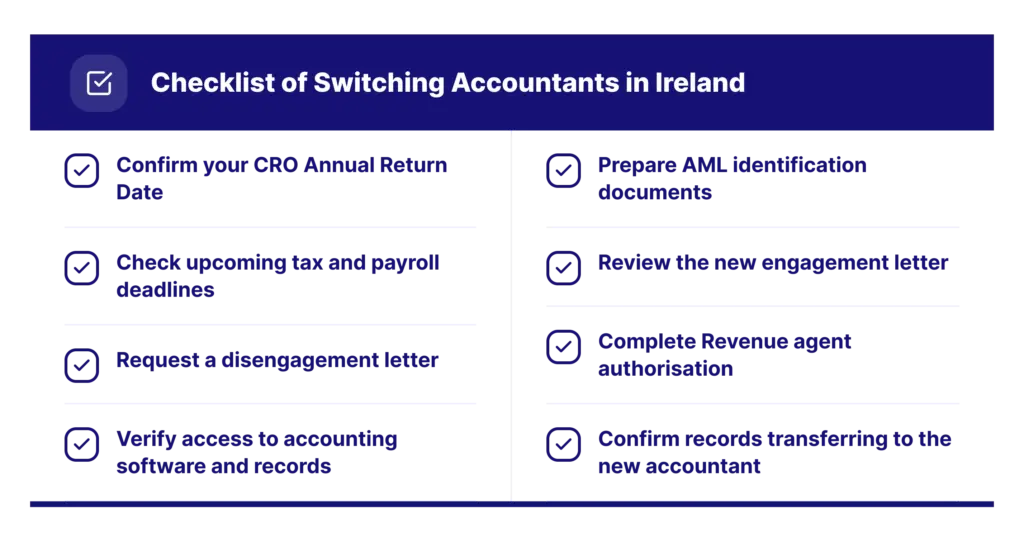
With those checkpoints confirmed, here is exactly how each stage of the switch works from written notice to Revenue authority.
How to change your Accountant in Ireland?
Your involvement in this process is limited to a small number of actions at specific points. The new accountant manages the rest.
Step 1: Notify your current Accountant
Tell your current accountant in writing that you are ending the engagement. The notice should confirm:
- The date the change takes effect
- The name and contact details of your new accountant
- Permission for both accountants to correspond directly about the records transfer
A direct phone or in-person conversation is professional practice and reduces the chance of delays during the records transfer.
Step 2: Request a Disengagement letter
Before the switch completes, request a disengagement letter from your current accountant.
This document confirms:
- What has been filed to date
- What work is currently in progress
- Any upcoming deadlines the new accountant must be aware of
- Any open Revenue correspondence
Many businesses skip this step. Consider what happens when they do. A limited company changes accountant without requesting this letter. The new firm begins work in good faith. No one flags that the CRO Annual Return Date is three weeks away and the previous accountant had not started the filing. The return is missed. The company loses its audit exemption for two financial years. Requesting the disengagement letter costs nothing and prevents exactly this.
Step 3: Check your Annual Return Date
If your business is a limited company, confirm your Annual Return Date with the Companies Registration Office before the switch.
If it falls within six to eight weeks, factor it into your timing. Your new accountant needs enough lead time to receive your records, review them and prepare the filing.
A missed Annual Return Date can in some cases be remedied by making a District Court application for an extension of time under Section 343 of the Companies Act 2014.
The Registrar of Companies must receive a minimum of 21 days notice of the application. This option is only available before the return has been filed late and is not guaranteed. Acting before the deadline is always the safer position.
Step 4: Register with your new Accountant
Your new accountant will ask for identification documents as part of their obligations under the Criminal Justice (Money Laundering and Terrorist Financing) Acts. This is a legal requirement for all regulated accounting firms in Ireland.
You will typically need:
- A government-issued photo ID (passport or driving licence)
- A recent utility bill or bank statement confirming your address
This applies to every new client at every regulated firm. It is not specific to your circumstances.
Step 5: Receive and sign an Engagement letter
Your new accountant will issue an engagement letter defining the scope of work, the fee structure and the responsibilities of both parties.
Read this before signing and pay particular attention to:
- What is included in the monthly or annual fee?
- What would be charged separately and under what circumstances?
- Which deadlines the accountant takes responsibility for meeting?
Ambiguity in an engagement letter is easier to resolve before work starts than after the first invoice arrives.
Step 6: Professional clearance and records transfer
Your new accountant writes formally to your previous accountant requesting professional clearance. The previous accountant confirms there is no professional reason to object and transfers your financial records.
The documents that typically change hands:
| Document | Notes |
|---|---|
| Prior year financial statements | Last two to three years |
| Corporation Tax returns (CT1) or Form 11 | Depends on business structure |
| VAT return history | Full period history |
| Payroll records | P30 submissions and employee records |
| Trial balances and bookkeeping records | Current period and prior year |
| CRO annual return filings | Limited companies only |
| Open Revenue correspondence | Any active queries or notices |
Your previous accountant is not entitled to withhold these records. Professional regulations require full cooperation. If a previous accountant delays or refuses, your new accountant can escalate through Chartered Accountants Ireland or the Association of Chartered Certified Accountants.
Step 7: Assign Revenue authority
Your new accountant must be registered as your tax agent with Revenue before they can file returns or correspond with Revenue on your behalf. Your new accountant manages this process.
Since March 2025, Revenue uses a digital e-linking system. Your accountant initiates the agent-link request through ROS and you will receive an email notification from Revenue. You must then log into ROS or myAccount and approve or reject the request from your inbox. A paper authority form is only used where the business is not registered on ROS or myAccount.
If Revenue authority is not in place before a filing deadline, your new accountant may have the return prepared in full but be unable to submit it. The return is ready but cannot go through. This is one of the most common causes of a last-minute delay in an otherwise smooth transition. Confirm this step is complete well before the first deadline after the switch.
A typical switch: Week by week
| Week | What happens? |
|---|---|
| Week 1 | Written notice issued to current accountant. Engagement letter signed with new accountant. AML documents submitted. |
| Week 1–2 | Professional clearance letter issued by new accountant. Disengagement letter requested from previous accountant. |
| Week 2–3 | Financial records transferred. Software access confirmed or data migration agreed. |
| Week 3 | Revenue authority assigned. New accountant confirmed as tax agent on ROS. |
| Week 4 | New accountant fully operational. All upcoming deadlines visible and planned. |
Transitions that take longer than four weeks almost always do so because the previous accountant is slow to respond to the clearance request or because financial records are not immediately available. Knowing the timeline makes it easier to avoid the decisions that most commonly extend it.
Mistakes that slow down an Accountant switch
Most transition problems are not caused by the process itself. They come from decisions made or not made before the process begins.
- Starting the switch too close to a VAT return, CT1 filing or CRO Annual Return Date, leaving insufficient time for the new accountant to review records.
- Not requesting a disengagement letter, which can result in missed deadlines, unfinished filings or undisclosed Revenue queries.
- Changing accounting software during the same period as the accountant switch, increasing the risk of data migration and reconciliation issues.
- Assuming financial records will be immediately available without confirming software ownership, access rights and data transfer arrangements in advance.
- Waiting until a filing deadline is approaching before assigning Revenue authority to the new accountant.
- Beginning the transfer without checking which records, documents and software access will be required by the new accountant.
For some businesses, the decision at this stage is not simply which accountant to move to. It is whether to continue with the same type of service model altogether.
Choosing your next Accountant
Changing accountant is not only about leaving a provider that no longer meets your needs. It is also an opportunity to assess what level of support your business requires going forward.
Some businesses only need year-end accounts and tax compliance. Others require ongoing bookkeeping, payroll support, VAT returns and regular management accounts. The right choice depends on the complexity of the business, reporting requirements and the level of financial visibility management expects throughout the year.
When comparing providers, consider:
- Response times and communication standards
- Experience with your industry and business size
- Cloud accounting software expertise
- Availability of bookkeeping, payroll and management accounts support
- Fee transparency and engagement terms
- Capacity to support future growth
It is also worth understanding how support will be delivered. Some firms provide assistance on a project or ad-hoc basis, while others offer ongoing managed support or dedicated accounting resources. The most suitable arrangement depends on the volume of work, reporting requirements and the level of involvement your business expects from its accounting provider.
Whether you choose a traditional accounting practice or one of the many outsourced accounting firms operating in Ireland, the objective should be the same: reliable compliance, timely reporting and access to the financial information needed to make business decisions with confidence.
Conclusion
Most businesses delay changing accountant because they assume the process is more disruptive than it is. In practice, the transition follows a regulated framework that places obligations on both firms and allows the change to happen without affecting Revenue compliance, payroll, VAT filings or financial reporting. The two to four week timeline is the standard outcome when the process is prepared correctly.
Outbooks manages the full transition for businesses and accounting practices moving to accounting outsourcing. Our team covers bookkeeping, VAT returns, payroll, year-end accounts and management accounts under flexible engagement models built for both businesses and accountancy firms across Ireland.
To discuss switching to Outbooks, contact us on +353 21 206 9255 or email us at info@outbooks.com.
FAQs
Can I switch accountants mid-year in Ireland?
Yes, mid-year switches complete without issue in most cases. The new accountant picks up from the last reconciled date. Avoid the two weeks before a major filing deadline and any period with an active Revenue compliance check.
Will Revenue flag my account if I change accountant?
No, Revenue treats changing accountant as a routine business decision. It does not flag your account, add any reporting requirement or affect your compliance record in any way.
What is a professional clearance letter?
It is a formal letter your new accountant sends to your previous accountant confirming the change and requesting your financial records. Your previous accountant is professionally obligated to respond and cannot withhold your records.
What is a disengagement letter and why does it matter?
A disengagement letter confirms what has been filed, what is in progress and what deadlines are approaching. Without it, the new accountant begins work without visibility of what is pending, including any approaching CRO or Revenue deadlines.
What documents change hands when switching accountants?
Prior year accounts, Corporation Tax or income tax returns, VAT return history, payroll records, trial balances and CRO filings. If your books are held in cloud software, confirm data ownership before the transfer begins.
Why does a new accountant need ID documents from me?
All regulated accounting firms in Ireland must complete Anti-Money Laundering checks on every new client under the Criminal Justice (Money Laundering and Terrorist Financing) Acts. A photo ID and proof of address are standard requirements for every new engagement.
What happens if Revenue authority is not assigned before a filing deadline?
Your new accountant may have the return prepared and ready but be unable to submit it until authority is confirmed. Confirm Revenue authority is in place before the first deadline after the switch not on the deadline itself.
What is the Annual Return Date and why does it matter?
The Annual Return Date is the CRO deadline for a company’s annual filing. If it falls within six to eight weeks of your switch date, the new accountant needs enough lead time to file before it falls due. A missed Annual Return Date removes audit exemption for two financial years with no retrospective remedy.
How long does an accountant switch take in Ireland?
Most switches complete in two to four weeks from the point the professional clearance letter is issued. Transitions that take longer almost always do so because the previous accountant is slow to respond or because records are not immediately available.
What is the difference between switching to an outsourced accounting firm and a traditional one?
The process is the same. The difference is structure: an outsourced firm provides a team rather than an individual, removing the single point of failure that a sole practitioner or small firm creates and allowing capacity to increase without permanent hiring.

Parul is a content specialist with expertise in accounting and bookkeeping. Her writing covers a wide range of accounting topics such as payroll, financial reporting and more. Her content is well-researched and she has a strong understanding of accounting terms and industry-specific terminologies. As a subject matter expert, she simplifies complex concepts into clear, practical insights, helping businesses with accurate tips and solutions to make informed decisions.