

Pricing accounting and bookkeeping services for fixed-price contracts can be challenging for many accounting firms. This issue is common and important to address.
Customer expectations are changing. Clients now want clear, upfront pricing. This shift is leading accountants to move away from hourly rates. However, this change can cause confusion about how to set fees for services.
This post explores how to price bookkeeping and accounting services for fixed-price contracts. It outlines four simple steps to help establish fair prices. Let’s begin.
Why is pricing your accounting services difficult?
Pricing accounting services has long relied on the billable hour method. This approach is straightforward for many accountants. They can easily track their time and calculate their earnings based on the hours worked.
However, this method has its drawbacks. Many accounting firms are now reconsidering how they set their prices. The current trend favours providing UK small business clients with clear, upfront pricing before services are rendered. This shift presents challenges for accountants. Many firms have struggled with fixed pricing and value pricing strategies.
The difficulty lies in the fact that this new approach requires a different mindset. It demands more planning and understanding of pricing concepts. In accounting, not all hours are equal. When combining basic bookkeeping with CFO guidance, financial reports, technology implementation, tax preparation, and strategic advice, the range of services varies significantly. This complexity can complicate pricing strategies for firms.
Additionally, regulatory changes such as HMRC’s Making Tax Digital (MTD) programme are encouraging firms to adopt subscription-based pricing models aligned with digital reporting cycles.
Fixed vs. Value-based pricing
There are two main strategies to think about when deciding how much an accountant charges upfront: fixed pricing and value pricing. Each approach has its own way of setting fees, and the choice will affect how the accountant works with clients.
Fixed pricing
Fixed pricing involves creating a service menu with set prices for each service. For example, the fee for preparing year-end tax returns will be the same for all clients.
The main advantage of fixed pricing is simplicity. Once a price is set, it can be used repeatedly whenever a small business client requests a service. This approach makes it faster to provide quotes and can help businesses grow more quickly and manage cash flow better, especially when there are many sales enquiries.
Value-based pricing
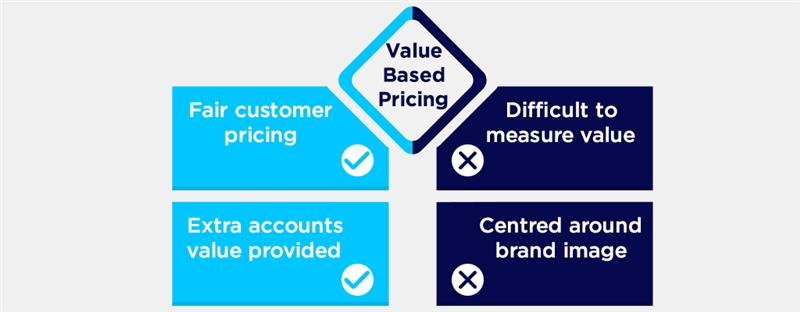
Value pricing involves setting prices based on each client’s specific needs. This approach can take more time, as it requires understanding the unique aspects of each small business. However, it often allows for higher fees compared to fixed pricing models. When implemented correctly, value pricing can lead to better profit margins.
Firms may also consider a hybrid approach. For example, they could use menu pricing for common services like tax preparation or basic bookkeeping while applying value pricing for more specialised advisory services such as cash flow forecasting or financial statement reviews.
With this foundation in place, here are some straightforward steps for pricing accounting and bookkeeping services effectively.
4 steps for pricing accounting services
Step 1 – Talk to the client
After using effective marketing strategies, the next step is to talk to the potential client.
Before setting prices for accounting services, it is important to have a detailed conversation with the client. This helps to understand their financial and business needs. It is essential to see things from their perspective as small business owners and find solutions that fit their requirements.
Ask open-ended questions and avoid making assumptions. Every business owner has different challenges. Some may dislike managing accounts payable, while others might struggle with accounts receivable or reconciling bank statements. Identifying their specific pain points helps provide the best support.
Step 2 – Define your scope
Once the client’s needs are clear, it’s important to outline the scope of work before setting prices.
With a billable hour model, the price is based on time spent. In contrast, upfront pricing requires careful planning. A fixed price means every task must be agreed upon in advance. If new tasks arise that were not discussed, it can lead to losses. Therefore, clearly defining the scope of work is essential.
Example of monthly bookkeeping services
Scope one: Basic monthly bookkeeping
The first option is basic monthly bookkeeping for a set fee. This service costs £300 each month but does not specify the number of transactions or accounts included.
Scope two: Detailed monthly bookkeeping
The second option also costs £300 per month and includes monthly reconciliation of bank and credit card transactions (up to 100 each month), operating on a cash basis and ensuring a four-week month-end close.
Providing clear expectations helps avoid misunderstandings and ensures smoother service delivery.
Step 3 – Setting prices
When setting prices for accounting services, it is important to know your costs first. Before giving a fixed price, you must understand how much it costs to provide the service.
Modern accounting firms increasingly use workflow automation, cloud accounting tools, and AI-assisted bookkeeping to reduce delivery costs, which should be reflected when calculating fixed-price service margins.
Price setting – Fixed pricing
This method relies less on each client’s unique needs and more on standardised service pricing. A price menu for recurring services can help estimate monthly costs and apply a desired profit margin.
Price setting – Value-based pricing
Value pricing considers the specific situation of each client and recognises that different businesses may pay different amounts for the same service. The goal is to understand what a client is willing to pay based on the value delivered.
In 2026, many advisory-focused firms combine value pricing with subscription-based service packages, allowing clients to select service tiers aligned with their growth stage.
Step 4 – Finalise an agreement
Once the price for a service is decided, the next task is to create an agreement clearly stating the scope of work and the monthly price.
Many modern accounting firms now use proposal and engagement letter software to streamline this process and maintain a professional client onboarding experience.
Conclusion
This guide helps accounting firms set prices for services and offer clear fixed-price options. While these methods may require practice, they can enhance the client experience and help firms avoid common issues linked to hourly billing.
As accounting firms continue shifting towards automation, advisory-led services, and subscription pricing models in 2026, adopting structured fixed or value-based pricing strategies is becoming essential for sustainable growth.
This guide was updated in 2026 to reflect evolving UK accounting pricing models, automation trends, and subscription-based service structures.
FAQ
1. What is fixed pricing in accounting services?
Fixed pricing is a model where accounting firms charge a predefined fee for specific services such as bookkeeping, payroll, tax preparation, or monthly reporting, regardless of the time required to complete the work.
2. What is value-based pricing in accounting?
Value-based pricing involves setting fees based on the value delivered to the client rather than the number of hours worked. The price depends on the complexity of the client’s business, expected outcomes, and the advisory support provided.
3. Which pricing model is better for accounting firms?
There is no single best model. Many firms use a hybrid approach- fixed pricing for routine compliance services and value-based pricing for advisory, financial planning, and strategic consulting services.
4. Why are accounting firms moving away from hourly billing?
Accounting firms are moving away from hourly billing because clients increasingly prefer predictable, transparent pricing. Fixed and subscription-based pricing also allows firms to scale services more efficiently using automation and cloud accounting tools.
5. How do accountants calculate fixed service pricing?
Accountants calculate fixed pricing by defining the service scope, estimating the time and resources required, calculating internal costs, and adding a target profit margin to determine the final monthly or annual fee.
6. Can accounting firms offer subscription-based pricing?
Yes. Many accounting firms now provide subscription-based pricing packages that bundle bookkeeping, tax compliance, reporting, and advisory services into monthly service tiers, making budgeting easier for clients.
7. When should a firm use value-based pricing instead of fixed pricing?
Value-based pricing works best for complex advisory services, business consulting, forecasting, and strategic financial planning where the value delivered varies significantly between clients.

Parul is a content specialist with expertise in accounting and bookkeeping. Her writing covers a wide range of accounting topics such as payroll, financial reporting and more. Her content is well-researched and she has a strong understanding of accounting terms and industry-specific terminologies. As a subject matter expert, she simplifies complex concepts into clear, practical insights, helping businesses with accurate tips and solutions to make informed decisions.