

Pricing complex accounting work is no longer just about covering costs, it’s about aligning value, transparency and client expectations. Business owners today demand clear, predictable fees that mirror the expertise and outcomes they receive. Yet, many accountants still find it difficult to capture their real worth without underpricing time or causing client friction.
In 2025, clients expect upfront clarity on deliverables, automation’s effect on costs and how advisory value translates into tangible results. Meanwhile, accounting firms face rising costs, efficiency-driven billing pressure and the challenge of balancing profitability with perceived value.
To overcome these challenges, firms must shift from time-based billing to value-centered, industry-aware pricing models. Effective strategies now consider client type, service complexity and technological transformation, all vital to sustainable growth and strong client relationships.
In this guide, we’ll explore:
- Why pricing remains complex in accounting and what drives that complexity.
- Core pricing models- fixed fee, value-based, hourly and retainer- and their best applications.
- How to adapt pricing by industry and client type, from startups to enterprises.
- Cost, overhead and margin calculations for accurate, profitable pricing.
- Proven tips for implementing modern, client-aligned pricing strategies.
By the end, you’ll have a framework to price accounting services confidently, by understanding your costs, your client’s value and your industry’s expectations.
Why is pricing complicated in Accounting?
There are multiple reasons why pricing is complicated in accounting. Multiple factors affect the choice of pricing a service correctly, doing fair justice to its value.
- Dynamic pricing pressures and market competition: Accounting prices vary widely based on firm location, expertise and client type. For example, rates can range from £25 to £250 per hour depending on service complexity and region. This uneven market makes standardising pricing difficult and adds pressure to balance competitiveness with profitability.
- Different Client Needs, Create Different Costs: One client might reconcile just thirty transactions monthly, while another processes that daily volume. A mobile hairdressing client requires minimal bookkeeping, but a seaside cafe needs complex transaction management. Your customised accounting pricing must adjust for these significant variations in workload and complexity.
- Evolving Industry Standards: Cloud accounting software has fundamentally changed how accountants work and should price services today. Automation now handles what once required manual data entry and hundreds of billable hours. Making Tax Digital requirements accelerate this transformation and change traditional pricing strategies for accountants.
- Shift to automation and subscription-based billing: As automation reduces manual workloads, more firms are moving toward subscription or tiered packages—linking fees to outcomes instead of hours. This approach offers predictability for clients and smoother revenue streams for firms.
- Client expectations continue to evolve: Modern clients expect clear pricing information before engaging your accounting services each month. They want transparency about what they pay for and how much advisory support is included. No surprises in bills this is what contemporary business owners demand from accounting firms today.
- Value perception and advisory focus: Clients now judge pricing by the results achieved, cost savings, compliance confidence and proactive advisory insight. Accounting pricing is therefore shifting from transactional billing to performance-based pricing, where expertise and measurable impact determine value.
What are some of the core pricing models?
There are multiple models to decide pricing for the services you offer. Some of the common models are listed below:
Fixed Fee Pricing structure
Fixed fees establish a flat rate for each service that your practice offers consistently. This model works by combining service delivery costs with your desired profit margin percentage. If your bank reconciliation costs £100 monthly, adding £25 profit margin gives £125 pricing.
What’s new in 2025: More firms create tiered fixed-fee packages (basic, standard, and premium) to offer different value levels and easily scale recurring clients. Automation through cloud bookkeeping tools also improves margins while keeping pricing stable.
Advantages of Fixed Fees
- Fixed pricing eliminates client uncertainty about what they’ll pay for accounting services monthly.
- Clients receive clear quotes before work begins, preventing billing surprises or payment disputes later.
- Improved efficiency directly increases profit margins without raising client fees or reducing service quality.
Disadvantages of Fixed Fees
- Sometimes accounting work takes longer than anticipated, eroding your expected profit margin significantly.
- Complex situations may require additional work that fixed fees don’t adequately compensate you for.
- You must define service scope precisely to avoid providing free work beyond the agreed fee.
Value-Based Pricing Model
Value-based pricing aligns costs with the actual worth of your services to each client. Rather than charging for your time, you charge for the financial results you help clients achieve. A client might pay different fees for similar services based on the value delivered.
What’s emerging: In 2025, many firms adopt ROI-based pricing language (e.g., “£4,000 fee expected to save £15,000 in tax exposure”) to justify premium pricing. Hybrid value models—fixed for compliance, value-based for advisory—are now industry standard.
Implementation of Value-Based Pricing
- Meet clients face-to-face to understand what they value most about accounting services.
- Ask detailed questions about their business challenges, goals and what outcomes matter most.
- Develop custom pricing packages based on each client’s unique situation and specific needs.
When Value-Based Pricing works best?
Advisory services where you help clients make strategic financial decisions over extended periods.
Tax planning work where you might save clients thousands through clever deductions and strategies.
Business consulting where your expertise directly impacts client profitability and financial stability metrics.
Hourly Billing Model
Still used for undefined-scope or forensic projects, hourly billing charges clients based on actual time spent working on their accounts. You track billable hours using timesheets and multiply by your set hourly rate.
Why it’s fading: As automation shortens work time, hourly billing undercuts profitability and discourages efficiency. Leading firms now phase out this model for transactional or recurring work.
Monthly Retainer Pricing
Monthly retainers charge clients a consistent fee for guaranteed services delivered each month. This model provides predictable revenue and consistent client budgeting.
Modern adaptation: Most retainers now operate under subscription-style pricing, combining recurring compliance and advisory support. Tiered pricing with fair-use limits ensures balance and scale.
Subscription-Based and Transaction-Based Pricing (2025 Additions)
Subscription pricing bundles bookkeeping, payroll, advisory, and tax planning at a recurring monthly rate, enhancing client loyalty through continuous partnership.
Transaction-based pricing links fees to volume (e.g., per invoice or payroll run), offering scalability for growing or seasonal businesses.
| Fee type | Best for | Profit control | Client predictability |
|---|---|---|---|
| Fixed fee | Compliance work | Medium | Excellent |
| Value-based | Advisory services | High | Variable |
| Hourly | Undefined scope | Low | Poor |
| Monthly retainer | Ongoing services | Medium | Excellent |
| Subscription-based | CAS/advisory blends | High | Excellent |
| Transaction-based | Outsourced or scalable services | High | Good |
What are the pricing considerations for a small business owner?
Pricing considerations for small business owners depend on numerous factors—business structure, financial complexity, and regulatory requirements are the most influential. Sole traders require basic tax and bookkeeping, while limited companies need compliance, payroll, and in-depth reporting. Small businesses especially value simple, clear reporting, proactive tax advice, and transparency in pricing, with costs ranging broadly based on needs and location.
Key Pricing Considerations
- Business Structure & Complexity: Sole traders pay less due to simpler needs; limited companies and growing businesses require more extensive compliance and reporting, increasing fees.
- Service Scope: The volume and variety of transactions (bookkeeping, payroll, reporting) directly impact costs. Frequent and in-depth services cost more.
- Regulatory Compliance: Required statutory filings, payroll compliance, and sector-specific mandates drive costs higher for limited companies and regulated industries.
- Client Budget Constraints: Small businesses often operate with tight budgets—pricing must balance affordability with the necessary level of support.
- Frequency of Services: Monthly, quarterly, or annual engagement levels affect overall fees—the more frequent, the higher the total cost.
- Location & Market Fluctuations: Accountants in big cities may charge higher fees than those in smaller towns; local market conditions influence the rate.
- Value Perception: Small businesses prioritize practical gains; clear, actionable financial advice and visible ROI justify premium pricing.
- Accountant’s Expertise: More experienced accountants usually charge higher fees but often deliver strategic insights and better tax outcomes.
Common challenges in determining pricing strategies:
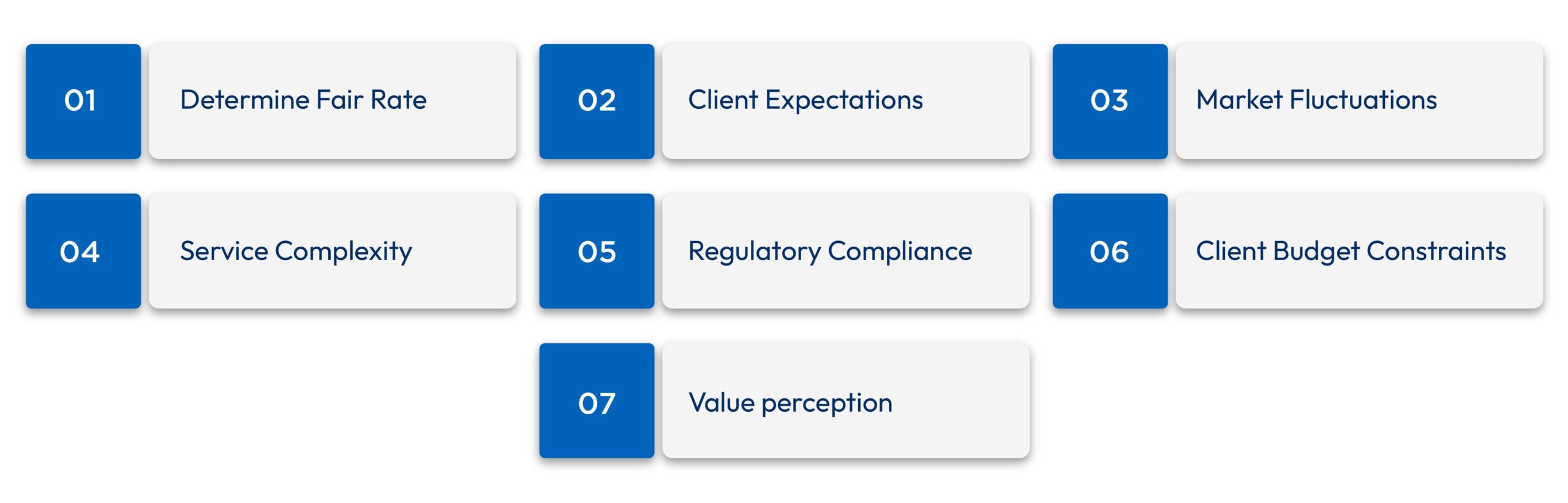
These reflect industry best practice and summarize the essential drivers for pricing accounting work for small businesses
- Communicating true value to clients and justifying fees.
- Handling clients with inconsistent record keeping or unclear expectations, which can lead to scope creep.
- Reviewing prices regularly to stay competitive and profitable as business needs evolve.
For small business owners, understanding how these factors interplay will help secure transparent, fair, and valuable accounting solutions in line with operational realities and growth ambitions.
Does pricing differ from industry to industry?
Yes, for each industry there are different pricing strategies that fit. For your ease, we have written down some common and most popular industry and the type of pricing which will fit the most.
Healthcare Practice Accounting
Medical practices need specialised accounting handling unique revenue and billing complexities.
Why healthcare accounting commands premium pricing:
- Insurance billing reconciliation involves tracking different reimbursement rates and denials carefully.
- Patient payment collection requires monitoring accounts receivable and managing payment plans.
- Regulatory compliance for healthcare billing demands expertise that costs more to provide.
Increasing demand for bundled compliance plus advisory packages, with tiered fees based on patient volume and claims complexity, is driving new subscription models in healthcare accounting.
Technology and Startup Accounting
Tech companies need specialised knowledge about equity compensation, venture funding and runway calculations.
Startup accounting services justify higher fees because of complexity:
- Understanding stock options, vesting schedules and equity accounting requires specialist knowledge and expertise.
- Investor reporting requirements demand detailed financial statements that venture capitalists specifically require.
- Cash runway calculations and burn rate analysis help founders understand their financial position.
Startups are now prioritizing monthly subscription packages that include fractional CFO services, regular investment readiness reviews, and rapid-response advisory support.
Real Estate Business Accounting
Property businesses involve depreciation, lease accounting and complex capital asset management.
Real estate requires premium pricing due to:
- Detailed tracking of property improvements and their depreciation across decades of ownership.
- Lease accounting under modern standards creating complex liability and asset recognition requirements.
- 1031 exchange calculations for deferring capital gains taxes on property sales strategically.
- Remote accounting for multi-location real estate groups has surged, with firms adopting hybrid billing (fixed plus transaction-based) for scalable asset management.
Professional Services Firms
Law firms, consulting practices and other professional service businesses need billable hour tracking.
These industries require specialised accounting for:
- Client matter profitability analysis showing which clients and matters generate the most revenue.
- Work-in-progress tracking ensuring all staff time gets properly recorded and billed to clients.
- Time-based invoicing requiring detailed support records for billing and collections purposes.
2025 trend: Firms increasingly use cloud-driven, real-time dashboards with retainer and value-based pricing, replacing legacy hourly models.
Retail and E-Commerce
Retail businesses need inventory accounting, point-of-sale integration and sales analysis capabilities.
Retail accounting complexity includes:
- Multi-location accounting consolidation across dozens of shops requiring centralised record keeping.
- Inventory reconciliation ensuring perpetual inventory systems match physical stock counts quarterly.
- Sales analysis by product line, location and season identifying performance trends and issues.
E-commerce firms now demand integrated transaction-based and data analytics packages, with pricing reflecting sales volume and platform integration complexity.
Manufacturing
Cost accounting, production tracking, and cost analysis are central. Manufacturers in 2025 often adopt outcome-based pricing models, where fees align with efficiency improvements and regulatory compliance outcomes.
| Industry | Key pricing drivers | Typical service scope | Pricing level |
|---|---|---|---|
| Healthcare | Insurance billing complexity | Claims management, payroll, tax | Premium |
| Technology | Equity complexity | Cap table, funding, tax | Premium |
| Real Estate | Asset depreciation | Property tracking, tax planning | High |
| Professional Services | Time tracking | Matter billing, WIP tracking | High |
| Retail | Inventory complexity | Stock management, sales analysis | Standard |
| Manufacturing | Cost accounting | Production tracking, cost analysis | High |
Across all sectors, remote and hybrid accounting services are rapidly expanding and tiered, subscription-based pricing models have become mainstream, offering scalability and value differentiation for clients in every major industry.
How to calculate your cost for pricing?
There are certain components of pricing which are considerable and are listed below:
Direct costs of service delivery:
- Direct costs include everything specifically required to deliver each accounting service to clients.
- Fixed direct costs might include software subscriptions you purchase on behalf of client companies.
- Variable direct costs include staff salaries, wages and additional resourcing needed per client.
In 2025, you should also account for technology-related costs, including automation tools, cybersecurity solutions, and real-time client portals, as these are now integral to service delivery.
Tracking direct costs properly:
- Use timesheets capturing labour hours spent on each service and client engagement monthly.
- Record all software, tools and materials purchased directly for specific client services.
- Calculate average costs by dividing total hours or costs by volume of services delivered.
Track costs not only per service, but also per client segment to identify profit drivers and loss leaders. Leading firms use cloud-based practice management software for this purpose.
Overhead allocation:
- Overheads are fixed costs that don’t vary with service volume rent, rates, general insurance.
- Administrative staff time, office utilities and professional subscriptions are overhead expenses.
- You must allocate overheads fairly across services to understand true profitability of each.
Calculating overhead rate:
- If your practice has £100,000 annual overheads and delivers 1,250 service hours yearly, your overhead rate is £80 per hour.
- Add this £80 rate to your direct service costs ensuring overheads are properly covered.
- Without proper overhead allocation, you might underprice services thinking they’re profitable.
Benchmark your overhead allocation against market standards to stay competitive. Adjust for region, firm size, and service specialization.
Profit margin expectations:
After covering all costs, you need sufficient margin for business profit and growth investment.
Most accounting practices target 20-40% profit margins depending on their target market positioning.
Luxury advisory-focused practices might achieve 50%+ margins, whilst compliance-focused practices see lower margins.
Test and refine your margin assumptions periodically, as client technology adoption and automation can change true service costs quickly.
Calculating your pricing:
Cost £2,000 plus 20% profit margin equals £2,500 final fee for that service.
Cost £1,500 plus 30% profit margin equals £1,950 for a different service delivery.
Your profit margin percentage varies by service type and target client segment appropriately.
Finally, always research competitor rates, industry benchmarks, and evolving client willingness to pay—aligning your pricing with both internal costs and external market realities.
Tips to Price Accounting Services Effectively
- Calculate all direct costs including staff time, software subscriptions and overhead allocations.
- Account for hidden costs like administrative time, technology infrastructure and professional development.
- Track actual time spent on each service to identify gaps between estimates and reality.
- Recognize different clients perceive value differently based on their business complexity.
- Research what outcomes matter most to your target clients.
- Price services based on problems you solve rather than just time invested.
- Specialist knowledge, qualifications and market reputation justify premium pricing.
- Niche industry expertise and advanced certifications support higher fees.
- Clients pay more for accountants who understand their specific business challenges.
- Price services to cover costs plus generate reasonable profit for business growth.
- Avoid pricing at cost recovery which provides no sustainability or reinvestment capacity.
- Target profit margins of 30-50% depending on service complexity and market positioning.
- Start with new clients to test pricing models before transitioning existing relationships.
- Monitor client acceptance rates and pushback patterns on proposed fees.
- Adjust pricing quarterly based on profitability data and market feedback.
- Research what similar firms charge for comparable services in your market.
- Identify pricing gaps where you can compete on value rather than being cheapest.
- Understand the typical price ranges clients expect for each service level.
- Define exact deliverables, timelines and limitations for each priced service.
- Specify what triggers additional fees to avoid scope creep eating profits.
- Document assumptions about transaction volumes, complexity and client responsiveness.
- Leverage client discovery calls to tailor pricing proposals based on explicit needs, creating personalized, value-driven offers.
- Incorporate hybrid pricing models (fixed plus value-based or subscription components) especially for advisory and high-complexity services.
- Use clear, client-friendly communication materials explaining the pricing structure, value delivered, and ROI to build trust and reduce objections.
- Regularly update pricing benchmarks with industry data and technological changes that affect service delivery costs.
- Emphasize long-term client value relationships instead of one-off transactions to foster loyalty and sustainable revenue.
Making Tax Digital impact on Pricing
Automation reduces manual work
MTD requirements mean more cloud accounting automation handling what once required manual entry.
Your costs delivering certain services decrease as automation handles routine transaction processing.
Some firms reduce pricing as they become more efficient; others maintain fees and increase margins.
New service opportunities emerge
Advisory services become more valuable as compliance work becomes increasingly commodified.
Cash flow forecasting, business planning and financial strategy work become more important to clients.
Pricing for advisory services should reflect their higher value and strategic impact.
Client expectations about technology
Clients expect seamless technology integration, automated reporting and real-time financial visibility.
Providing these expectations justifies premium pricing compared to traditional manual accounting approaches.
Technology investments must be recovered through pricing that reflects the enhanced service quality.
Additional considerations
MTD introduces more frequent quarterly submissions replacing the annual filing, increasing the volume of compliance work that must be accurately priced. This requires pricing models to account for setup, ongoing compliance, client training, and support related to MTD software adoption.
Transparency in communicating how MTD affects pricing is essential to manage client expectations and reduce resistance. Firms that clearly articulate the value of digital compliance and advisory insights tend to sustain or improve client acceptance of pricing changes.
Flexible pricing packages including modular or tiered MTD-related services—for example, separating charges for software maintenance, training, and quarterly updates—can enhance client choice and profitability.
MTD accelerates the need for value-based and outcome-oriented pricing models, emphasizing the financial benefits clients derive beyond pure compliance.
Conclusion
Pricing strategies for complex accounting work require a deep understanding of your costs, market positioning, and the value you deliver to clients. Industry and client type significantly influence the appropriate pricing models and fee levels. Customized accounting pricing that reflects individual client circumstances builds stronger relationships and maximizes profitability. Moving toward value-based and fixed-fee pricing aligns with modern client expectations and technological advancements. Transparent communication about pricing builds trust and strengthens your accounting service relationships, setting the foundation for long-term success.
For expert guidance tailored to your accounting firm’s pricing strategy and to explore efficient, reliable accounting outsourcing solutions, contact Outbooks today.
Email: info@outbooks.co.uk
Phone: +44 330 057 8597
Let Outbooks help transform your pricing approach and drive sustainable growth. Reach out now to start the conversation.
Frequently Asked Questions
What is the optimal pricing strategy for accountants?
The optimal pricing strategy depends on your practice’s focus, target market and service type.
Fixed-fee pricing works best for compliance and well-defined services where scope is clear.
Value-based pricing suits advisory-focused practices with industry expertise and strategic client relationships.
Monthly retainers provide consistency for ongoing services, appealing to both accountants and clients.
Most successful practices use a blend of pricing models appropriate to different service types.
How much should accountants charge per hour in the UK?
UK hourly rates for accountants vary significantly based on experience, location and specialisation.
Junior accountants typically charge £25-£35 per hour for basic bookkeeping and administrative work.
Experienced accountants generally charge £50-£150 per hour for core accounting and tax services.
Specialist services including tax planning and financial advisory might command £200+ hourly rates.
London practices typically charge more than regional firms reflecting higher operating costs.
What factors determine accounting fees for different client types?
Business size significantly impacts accounting fees larger businesses require more complex accounting.
Industry type determines complexity; healthcare and tech require premium pricing over simpler trades.
Growth stage matters; startups need different services than established mature businesses.
Regulatory environment affects complexity; highly regulated industries command higher fees justly.
Transaction volume directly impacts workload; high-volume businesses require more accounting support.
How should I price accounting services for small businesses differently?
Small businesses often cannot afford premium pricing that large corporations pay routinely.
Package smaller core services at affordable fixed fees rather than using hourly models.
Consider value delivered to small businesses perhaps £150-300 monthly for comprehensive bookkeeping.
Market positioning towards small businesses emphasises affordability, accessibility and straightforward transparent pricing.
Growth-focused small businesses might pay premium fees for advisory support helping them scale.
Should I offer flexible pricing based on client requirements?
Yes, absolutely flexibility enables capturing clients across different budget and requirement levels.
Create tiered service packages allowing clients to select options matching their specific needs.
Build flexibility into engagement terms permitting service level adjustments as business circumstances change.
Communicate clearly how changes affect pricing, so no surprises occur when clients modify services.
Flexible pricing broadens your addressable market significantly increasing potential client base and revenue.
What is client-based pricing in accounting services?
Client-based pricing customises fees for each client reflecting their unique circumstances and requirements.
Rather than standardised pricing for all clients, you adjust fees based on individual factors.
Complexity of their business, industry type, transaction volume and service requirements vary.
Value delivered varies some clients benefit more significantly from your services than others.
Willingness to pay differs across clients; some value advisory highly, others focus on compliance.
How do I handle pricing for project-based accounting work?
Project-based pricing suits well-defined engagements with clear scope, timeline and deliverables.
Calculate fixed fees by estimating hours required, multiplying by your cost rate and adding margin.
Build contingency into estimates anticipating potential complications or scope creep during projects.
Clearly document scope in engagement letters preventing disputes about what’s included or excluded.
Track actual hours and costs during projects using data to refine future project estimates.
What are industry-specific pricing considerations?
Each industry has unique accounting requirements justifying different fee levels and service focus.
Healthcare practices require specialised medical billing and insurance reconciliation expertise commanding premiums.
Technology companies need equity accounting, cap table management and startup-specific financial management.
Real estate businesses need property depreciation tracking and complex lease accounting specialist knowledge.
Professional services firms require matter profitability tracking and detailed time-based billing capabilities.
Retail businesses need inventory accounting and point-of-sale system integration expertise specifically.
Design your pricing reflecting the specialised knowledge and complexity your industry expertise provides.
Should I charge retainers or project fees?
Use monthly retainers for ongoing services like bookkeeping, payroll and compliance work.
Use project fees for well-defined engagements with clear endpoints like tax restructuring or setup.
Combine both retainers for recurring services plus project fees for occasional special work.
Monthly retainers provide revenue predictability and client cost certainty favouring both parties.
Project fees suit advisory and strategic work where value delivered significantly exceeds time spent.
How do I communicate pricing to prospective clients effectively?
Create professional service brochures clearly outlining offerings at different price points and packages.
Prepare pricing pages on your website showcasing packages, inclusions and typical monthly costs.
In meetings, discuss client needs first before presenting pricing aligned with those requirements.
Present pricing with confidence backed by knowledge of competitor rates and market positioning.
Use engagement letters documenting all pricing terms, payment methods and billing processes clearly.

Parul is a content specialist with expertise in accounting and bookkeeping. Her writing covers a wide range of accounting topics such as payroll, financial reporting and more. Her content is well-researched and she has a strong understanding of accounting terms and industry-specific terminologies. As a subject matter expert, she simplifies complex concepts into clear, practical insights, helping businesses with accurate tips and solutions to make informed decisions.