

If you run an accounting firm in the UK, you already know how much time goes into sending a single proposal. Pulling together service details, pricing and terms then chasing a signature can easily take two to three hours. Multiply that across every new enquiry each month and it becomes one of the biggest drains on your team’s time.
The problem is that slow proposals do not just cost time. Prospective clients move on quickly. If your proposal takes three days to land in their inbox, someone else has likely already got there first. Manual proposal creation issues are quietly slowing down growth for accounting firms across the UK.
This guide covers exactly how to reduce proposal turnaround time by up to 70%, from fixing the internal steps that cause the most delay to choosing the right tools for a UK accounting practice.
Key Takeaways
- The biggest delays in proposal turnaround are internal, covering drafting from scratch, inconsistent pricing and manual approval steps, not caused by the client
- Firms using proposal automation save an average of 4 hours per week on proposal creation and 10 hours per week on billing and payment collection
- Proper proposal software supports engagement letter compliance and MTD-readiness, all of which matter for UK accounting practices
- Clients can now generate their own proposals directly from a firm’s website, removing the need for a discovery call entirely
How to actually cut Proposal Turnaround Time?
To cut proposal turnaround time, firms need to be smart with their approach, especially in the age of automation and AI. Nowadays, tools like Outbooks Proposal Tool have become so advanced that they can literally build your proposal in a few minutes if prerequisites are met.
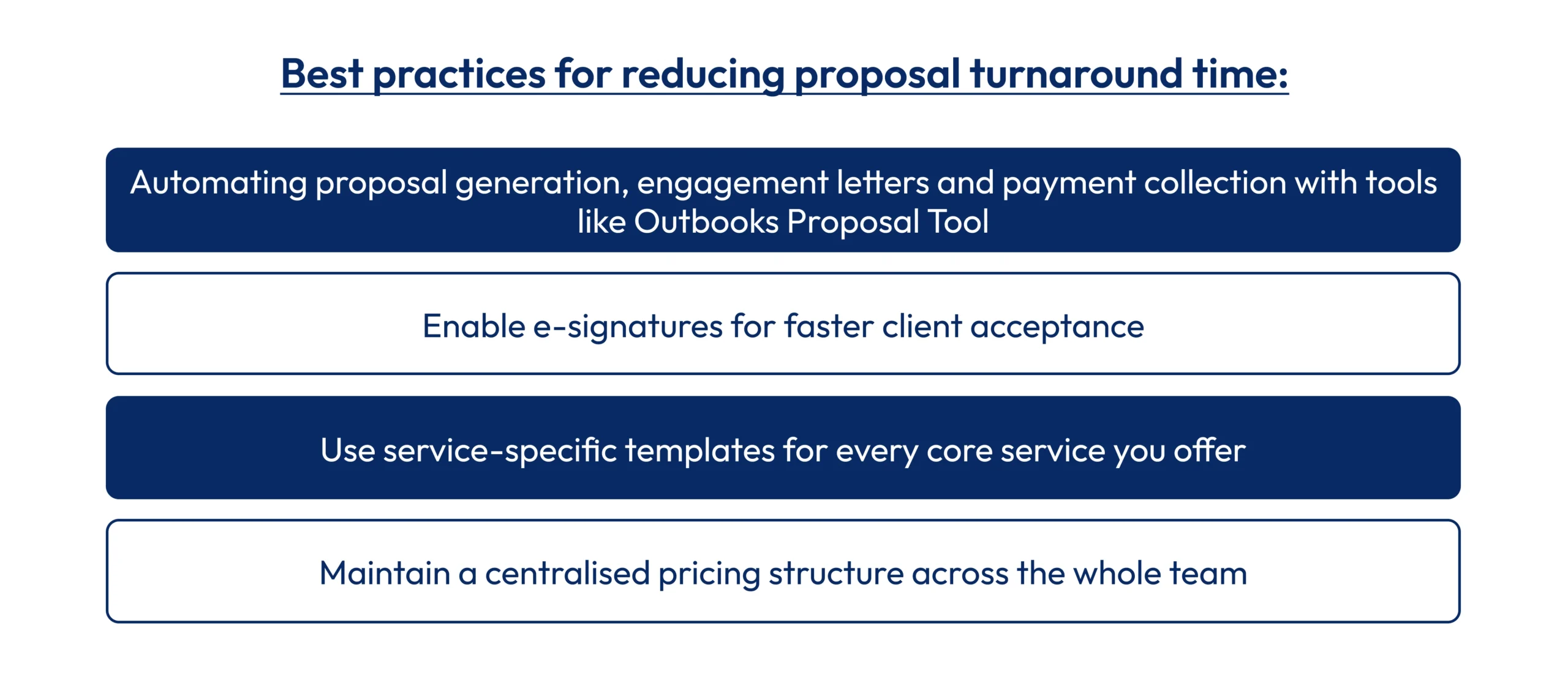
1. Stop drafting from scratch every time
This is where most of the time goes. If your team opens a blank document or digs out an old proposal to copy from every time a new enquiry comes in, the process will always be slow.
The fix is straightforward: build templates for your most common service packages bookkeeping, VAT, payroll, year-end accounts and draft every proposal from one of those templates. You only change the client name, business details and agreed scope. That single change alone significantly reduces drafting time on every proposal your firm sends.
2. Add client details before you start
A lot of proposal time is spent going back and forth to gather basic information business type, turnover, number of employees, current software. If you collect this upfront through a short intake form, your team has everything they need before the first word of the proposal is written.
Most accounting proposal software allows you to build this intake step directly into the workflow. The client fills it in, you get a summary and the proposal writes itself around those details.
3. Fix the internal approval process
One of the most overlooked causes of proposal delays is the internal review step. If every proposal needs to be emailed to a partner for approval, wait for a response and then be emailed back, that step alone can add one to two days.
Move approvals into your proposal platform. Most tools built for accounting firms include a simple sign-off workflow where a reviewer approves directly in the system no email chain needed. This brings review time from days to hours.
4. Replace PDF attachments with e-signature proposals
Sending a PDF and waiting for a client to print, sign, scan and email it back is one of the slowest parts of the whole process. Many clients mean to get to it and simply do not which means more chasing from your team.
E-signature proposals remove that friction entirely. The client receives a link, reviews the proposal online and signs with one click. You get a notification immediately. The signed document is stored automatically. No printing, no scanning, no back-and-forth.
5. Automate your follow-up reminders
Chasing unsigned proposals manually takes time and often gets delayed when your team is busy. Setting up automated reminders at 48 hours and again at five days means no proposal gets forgotten and no client feels neglected. It keeps things moving without adding anything to your team’s workload.
Why Proposal Software is important for UK compliance?
For UK accounting firms, the proposal process is not just a sales step. It is where regulatory obligations begin.
A properly structured proposal workflow supports three areas that matter under UK rules.
- Engagement letter compliance requires that firms issue a signed engagement letter before work begins, confirming scope, fees and terms. Platforms that combine proposals with engagement letter generation ensure this is created and signed automatically at acceptance, reducing risk and removing manual steps.
- Fee transparency and scope clarity are essential for maintaining professional standards and avoiding disputes. Structured proposal systems standardise pricing, clearly define services and ensure consistency across the firm, helping clients fully understand what they are agreeing to.
- MTD-readiness means that as Making Tax Digital requirements expand, firms using cloud-based, connected workflows are better positioned to manage client data, reporting timelines and digital record-keeping from the very start of the engagement.
Let clients generate their own proposals from your website
The most significant development in accounting proposal software in recent years is website integration and most UK firms are not yet using it.
With API integration, the proposal tool sits directly on the firm’s own website. A prospective client visits the page, selects the services they need such as bookkeeping, CIS, payroll or company secretarial, reviews the pricing and receives a completed, tailored proposal by email. No discovery call required. No manual input from the firm.
This means proposals are going out 24 hours a day, seven days a week, for any service request. The firm’s team only gets involved when the proposal has already been reviewed and the client is ready to proceed.
Outbooks Proposal is a tool built specifically for UK accounting firms that offers this API integration as a standard feature, allowing firms to embed the proposal tool directly into their website.
The Right Proposal Software for UK Accounting Firms
The changes above are much easier to implement when you have the right tool in place. The best accounting proposal software for UK firms handles templates, e-signatures, approvals and follow-ups in one place and connects to the practice management software you already use.
How the main options compare:
| Tool | Best For | E-Signature | UK Accounting Integration |
|---|---|---|---|
| GoProposal (now part of Sage) | UK firms already using Sage, with strong pricing controls | Yes | Xero, QuickBooks, Karbon |
| Ignition | Firms combining proposals with recurring billing and payment collection | Yes | Xero, QuickBooks |
| Outbooks Proposal | UK firms seeking a full workflow from proposal to payment, including website API integration | Yes | Xero, QuickBooks, Stripe, GoCardless |
| Cone | Smaller firms looking for an affordable all-in-one option | Yes | Xero, QuickBooks, Zoho |
| FigsFlow | UK practices with built-in AML checks and engagement letter automation | Yes | Xero, QuickBooks |
| PandaDoc | Firms requiring flexible, highly customised proposals | Yes | CRM and accounting tools |
Outbooks Proposal is built specifically for UK accounting firms and covers the full workflow from proposal creation through to signed engagement letter and collected payment in one place. It allows firms to embed the proposal process directly into their website, enabling prospects to generate their own proposals without any input from the firm.
Proposal Process Checklist
Work through this in order. The earlier steps deliver the biggest time savings.
- Map your current process and identify where delays happen most
- Define your standard service packages with clear scope and pricing
- Set up proposal software and build templates for each service type
- Create a short intake form to capture client details upfront
- Set up an internal approval workflow inside the platform
- Enable e-signature and test it before going live
- Configure automated follow-up reminders at 48 hours and 5 days
- Connect proposal acceptance to your client onboarding steps
- Track average turnaround time monthly and review what is still slowing things down
Conclusion
Proposal turnaround time is one of the easiest parts of a firm’s new business process to improve, and it does not require significant cost. Most delays are caused by internal processes. Manual drafting, inconsistent pricing, separate engagement letter workflows and lack of follow-up tracking can all be fixed with the right systems.
Firms that have improved this area are not working with more capacity. They have built a clear and consistent proposal process that reflects the quality of their service. This consistency improves how prospects respond and helps them sign more quickly.
Choose the tool that fits your firm as it is today. Try Outbooks Proposal free for a month and go live when you are ready.
Frequently Asked Questions
What is proposal automation for accounting firms?
It is using software to create, send and track proposals through templates, e-signatures and automated reminders, replacing manual drafting by email and Word documents. The best tools also automate engagement letter generation and payment collection at the point of sign-off.
How much does Outbooks Proposal cost?
Outbooks Proposal is available on four plans: Basic at £10 per month, Premium at £25 per month, Unlimited at £50 per month and Unlimited Premium at £100 per month. All plans include proposal creation, engagement letter generation and e-signature functionality. A one-month free trial is available with no card required.
How long does it take to set up proposal software?
Most firms are up and running within one to two weeks. The main tasks are building service templates, setting pricing rules and connecting to existing tools such as Xero or QuickBooks.
Will automated proposals feel less personal to clients?
Not if set up correctly. The client name, business details and scope are personalised for every proposal. Clients receive a professional, well-structured document rather than a generic form.
Can small accounting firms benefit from proposal automation?
Yes, the time savings are proportionally significant for smaller firms, particularly those handling a high volume of proposals or currently losing work due to slow response times.
Does proposal software support engagement letter compliance for UK firms?
Yes, the best tools generate a compliant engagement letter automatically when a proposal is accepted, confirming scope, fees and terms before work begins, which is a requirement for UK accounting practices.
What is the difference between GoProposal and Outbooks Proposal?
GoProposal, now part of Sage, is well established for UK firms with strong pricing controls and Sage integration. Outbooks Proposal is built specifically for UK accounting firms and adds website API integration, allowing prospects to generate their own proposals directly from the firm’s site, which GoProposal does not currently offer.
How does proposal software support MTD readiness?
Cloud-connected proposal tools help firms manage client data, engagement timelines and digital records from the point of onboarding, supporting the structured, digital workflows that Making Tax Digital requires across VAT, Income Tax and Corporation Tax reporting.

Parul is a content specialist with expertise in accounting and bookkeeping. Her writing covers a wide range of accounting topics such as payroll, financial reporting and more. Her content is well-researched and she has a strong understanding of accounting terms and industry-specific terminologies. As a subject matter expert, she simplifies complex concepts into clear, practical insights, helping businesses with accurate tips and solutions to make informed decisions.