
Choosing the right pricing strategy for your business can feel difficult. Should you offer one price for all clients? Multiple options? How do you balance affordability with profitability? For many businesses in the UK, particularly in professional services and bookkeeping services, three-tier pricing offers a practical solution.
This pricing model helps you serve different types of clients while guiding them towards options that work for both their budget and your bottom line. Let’s explore how to structure pricing tiers effectively and implement them using modern proposal tools.
Key Takeaways
- Three-tier pricing offers customers clear choices: basic, standard and premium packages.
- Most customers choose the middle tier, making it your most profitable option.
- The premium tier acts as a price anchor, making middle options feel more affordable.
- Strategic pricing gaps between tiers make upgrades feel worthwhile and justified.
- Professional proposal software streamlines tier presentation and client decision-making.
- Monitor which tiers customers select and adjust based on real conversion data.
What is Three-Tier Pricing?
Three-tier pricing (also known as the good-better-best pricing model) presents customers with three distinct packages at different price points. Each tier offers progressively more features, services, or benefits:
- Basic tier covers essential needs
- Middle tier adds popular features and better support
- Premium tier includes exclusive or advanced services
This tiered pricing model works because it addresses a simple truth: not all customers have the same needs or budgets. Some clients need basic support to get started, others want complete services, and a few are willing to pay premium prices for exclusive access and personalised treatment.
Why Three-Tier Pricing Works for UK SMEs?
According to official government data, SMEs account for 99.85% of the UK business population and employ 16.9 million people (60% of total employment) as of early 2025. With such a large and diverse market, having flexible pricing options becomes essential. Here’s why three-tier pricing works particularly well for this sector:
It Reduces Decision Fatigue
When you present clients with 10 different pricing options, you overwhelm them. Offering three choices strikes the right balance:
- Customers can quickly compare options without feeling confused
- Clear choices speed up the sales process
- Simplified decisions improve conversion rates
- Clients feel confident making informed choices
The Middle Tier Becomes Your Most Profitable Option
Most customers choose the middle option when presented with three choices. This happens because people naturally prefer options that feel balanced, neither too basic nor too expensive.
Your middle tier should be your most profitable package:
- Position it between budget-friendly and premium options
- Make it appear reasonable and valuable
- Customers compare it against the expensive top tier and see better value
- They look at the basic tier and see more benefits for a small price increase
Price Anchoring Guides Perception
The premium tier serves an important function even if few customers choose it. It acts as a price anchor, making your middle tier seem more affordable by comparison:
- A £999/month premium package makes £499/month feel reasonable
- Even price-sensitive customers see middle tier value
- Creates perception of choice rather than expense
- Positions your business as offering flexible solutions
It Simplifies Your Sales Conversations
Instead of negotiating individual prices or discussing whether to work together at all, your conversation shifts to “which option fits your needs best?” This approach offers several benefits:
- Feels consultative rather than pushy
- Focuses on finding solutions, not selling
- Reduces price objections
- Creates collaborative decision-making
How to Structure Your Pricing Tiers?
Creating effective pricing tiers requires careful thinking about features, pricing psychology, and customer needs. Let’s look at how to build tiers that convert. Here’s the process broken down into clear, practical steps:
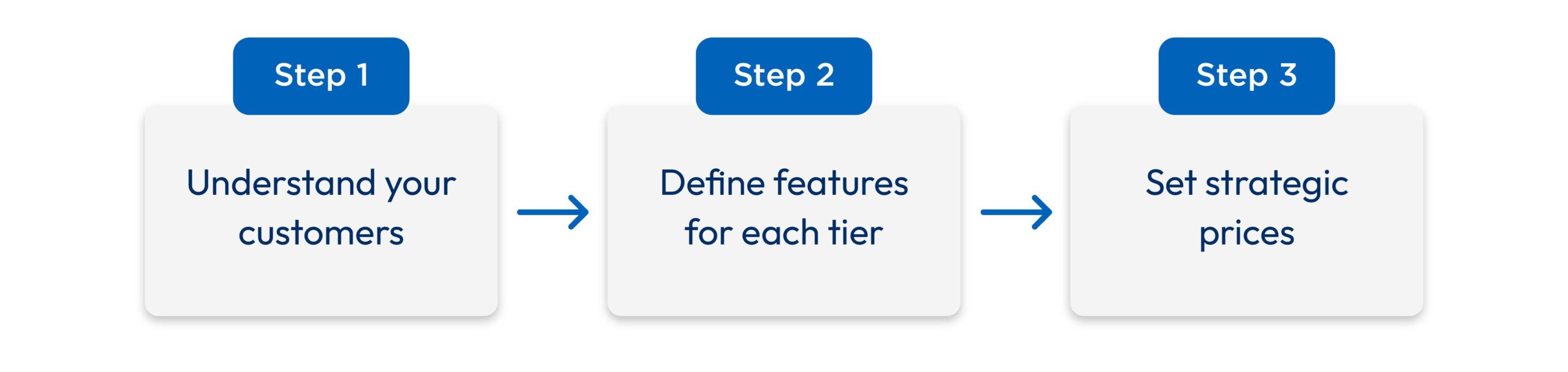
Step 1: Understand Your Customers
Before building your tiers, segment your customer base. Who are your typical clients? What do small businesses need versus medium-sized companies?
For UK SME pricing strategy, consider factors like:
- Company size and revenue
- Industry complexity
- Support needs
- Growth stage
- Budget constraints
Step 2: Define Features for Each Tier
Once you understand your customers, you can organise your services into three clear levels. Each tier should offer distinct value that makes sense for different client needs:
Basic Tier (Bronze/Starter)
- Core features that solve the basic problem
- Self-service or email support
- Essential functionality without extras
- Entry point for price-conscious clients
Standard Tier (Silver/Professional) – Your Recommended Option
- Everything in Basic
- High-demand features your research revealed
- Priority support (phone or faster response times)
- Popular add-ons included
- The tier you want most customers to choose
Premium Tier (Gold/Enterprise)
- Everything in Standard
- Exclusive or advanced features
- Dedicated account management
- Custom solutions or personalised elements
- For clients who need complete service
Step 3: Set Strategic Prices
Use charm pricing (£99 instead of £100) to make prices feel more approachable. Make sure there are meaningful jumps between tiers:
- 2-2.5x increase from basic to standard
- Another 2x from standard to premium
- Creates natural progression
- Makes upgrading feel worthwhile
Example Pricing Structure for Professional Services
| Tier | Monthly Price | What’s Included | Best For |
|---|---|---|---|
| Bronze | £199 | Core services, email support, monthly reports | Startups and small businesses needing basic support |
| Silver (Recommended) | £499 | Bronze + enhanced features, priority support, weekly check-ins, quarterly strategy sessions | Growing businesses wanting complete support |
| Gold | £999+ | Silver + dedicated manager, custom solutions, 24/7 support, personalised consulting | Established businesses requiring premium service |
Implementing Three-Tier Pricing in Your Proposals
The presentation matters just as much as the pricing itself. Using a proposal tool like Outbooks makes creating professional, clear pricing presentations easy. Here are the key visual and structural elements that make your pricing effective:
Visual Presentation Tips
Follow these guidelines to present your tiers effectively:
- Highlight Your Preferred Tier
- Use visual cues (colour, “Most Popular” badges, or “Best Value” labels)
- Draw attention to your middle tier
- Make it stand out visually
- Use Comparison Tables
- Show features side-by-side
- Clients can easily see upgrade benefits
- Clear value progression
- Keep It Simple
- Use clear language, not technical terms
- Clients should understand differences at a glance
- Avoid overwhelming with too much information
- Include Social Proof
- If your middle tier is genuinely most popular, say so
- People tend to follow what others choose
- Builds confidence in decision-making
The Proposal Tool Advantage
Modern proposal software designed for UK accountants and professional services firms makes the entire process easier. With tools like Outbooks Proposal, you can:
- Create consistent pricing across all proposals
- Automatically generate professional pricing in a proposal format
- Allow clients to select their preferred tier digitally
- Include e-signatures for immediate acceptance
- Set up automated payment collection
This automation saves hours per week while making sure every proposal maintains professional standards. Instead of recreating pricing models for service from scratch each time, you use template for accountants that applies your established tiers consistently.
Pricing Examples Across Industries
Different industries need different approaches to tiered pricing. Let’s look at real-world applications across common service sectors:
Bookkeeping Services
Starter: £150/month
- Basic bookkeeping
- Monthly reconciliation
- Email support
Professional: £350/month (Most Popular)
- Everything in Starter
- Weekly updates
- Expense categorisation
- Quarterly reports
- Priority support
Premium: £650/month
- Everything in Professional
- Dedicated bookkeeper
- Real-time updates
- Tax planning support
- Monthly advisory calls
Marketing Services
Essential: £750/month
- Social media management (3 platforms)
- Monthly reporting
Growth: £1,500/month (Recommended)
- Everything in Essential
- Content creation
- Email marketing
- Bi-weekly strategy calls
Scale: £3,000/month
- Everything in Growth
- Paid advertising management
- Weekly calls
- Dedicated account team
Common Mistakes to Avoid
Even with a solid understanding of three-tier pricing, many businesses make these common errors. Being aware of these problems helps you build a stronger pricing model from the start:
Making Tiers Too Similar
Each tier should offer noticeably more value:
- Avoid single small feature differences
- Create meaningful distinctions
- Justify price increases clearly
- Show progression of benefits
Neglecting the Premium Tier
Don’t treat your premium tier as an afterthought:
- It plays an important role in making other tiers attractive
- Include genuinely valuable exclusive features
- Appeal to high-value clients
- Support the overall pricing structure
Overcomplicating the Structure
Keep your presentation clean and clear:
- Keep feature lists short
- Long lists confuse rather than convince
- Focus on 5-7 most important differences
- Make comparisons easy
Ignoring Customer Feedback
Your initial pricing model needs ongoing refinement:
- Monitor which tiers customers choose
- Gather regular feedback
- Adjust based on real data
- Stay responsive to market changes
Testing and Optimising Your Pricing Model
Your pricing strategy for small businesses UK shouldn’t stay the same forever. Market conditions change, customer needs develop, and you learn what works through real-world results. Regular testing and adjustment helps you stay competitive and profitable:
Areas to Test
Experiment with these key elements:
- Feature placement: Which features belong in which tier?
- Pricing levels: Is £499 your optimal price, or should you test £549?
- Popular designations: Adjust based on actual data
- Presentation formats: Refine pricing in a proposal presentations based on client feedback
Using Data to Improve
Most professional proposal software allows you to track acceptance rates by tier:
- Monitor conversion rates per tier
- Identify patterns in customer choices
- Make data-driven adjustments
- Continuously optimise performance
Conclusion
Three-tier pricing offers UK SMEs a practical and proven pricing strategy that benefits both businesses and clients. By presenting three clear options, you simplify the buying decision while catering to different budgets and needs. The structure naturally guides customers towards your most profitable middle tier, while still accommodating price-sensitive clients and premium buyers.
Success with this pricing model depends on understanding your customers, defining meaningful differences between tiers, and presenting your options professionally. Modern proposal tools like Outbooks make implementation straightforward, allowing you to create consistent, professional proposals that help clients choose the right package quickly.
Start by setting up your three tiers with clear feature distinctions and strategic pricing. Use professional templates to present your options attractively, then monitor which tiers customers select. Regular testing and adjustment based on real data will help you refine your approach over time. With this structured pricing strategy, you’ll transform pricing from a challenge into a competitive advantage for your business.
Frequently Asked Questions
How do I know what to charge for each tier?
Start by calculating your costs, then research competitor pricing in your market. Your basic tier should cover costs plus reasonable profit, standard tier 2-2.5x higher, and premium tier approximately 2x the standard price.
What if most clients choose the cheapest tier?
This indicates your standard tier is overpriced, doesn’t offer compelling benefits, or isn’t properly highlighted as recommended. Review middle tier features and ensure you’re visually emphasising it as “best value.”
Should I offer discounts on tiered pricing?
Yes, but strategically. Annual payment discounts (15-20% off) encourage commitment and improve cash flow. Avoid constant promotional discounts which undermine your pricing structure.
Can I use tiered pricing if I offer custom services?
Absolutely, use tiered pricing for standard packages while offering custom pricing for unique client needs. Your tiers serve as starting points for 80% of prospects, custom quotes handle exceptions.
How often should I review my pricing tiers?
Review quarterly for minor adjustments and annually for complete evaluation. Monitor which tiers customers choose, track profitability by tier, and gather client feedback regularly.
What’s the best way to present tiered pricing to existing clients?
Keep existing clients at current rates while introducing new tiers for renewals or new clients. When transitioning, frame it positively showing enhanced value and options for their changing needs.

Parul is a content specialist with expertise in accounting and bookkeeping. Her writing covers a wide range of accounting topics such as payroll, financial reporting and more. Her content is well-researched and she has a strong understanding of accounting terms and industry-specific terminologies. As a subject matter expert, she simplifies complex concepts into clear, practical insights, helping businesses with accurate tips and solutions to make informed decisions.