
Professional services businesses- from accounting firms to management consultancies often struggle to price their work confidently. A single fixed fee can feel too rigid, whilst hourly billing creates uncertainty for clients and unpredictable revenue for the firm.
This is why many UK practices are moving towards a tiered pricing model: a structured approach that bundles services into clear packages at different price points. Research by the Association of Accounting Technicians (AAT) shows that firms using packaged pricing report higher client retention and easier upselling.
This guide explains how to design, price, and present a three-tier pricing strategy for professional services including accounting services pricing packages, proposal templates, and practical examples.
A well-designed pricing system helps businesses communicate value clearly and manage workload expectations. For accounting firms and consultancy practices, a strong pricing model supports predictable revenue and improves client decision-making.
Key Takeaways:
- How a three-tier pricing strategy works in professional services
- What to include in accounting services pricing packages
- How to present proposal pricing using a tiered pricing template
- When tiered pricing is better than hourly billing
Designing a Tier Pricing Model for Professional Services
Step 1. Identify Core Services
Start by listing all services included in the business.
For accounting firms, this may include:
- Bookkeeping
- Tax preparation
- Financial reporting
- Advisory support
The pricing model must reflect workload and expertise rather than time spent.
The trend in modern firms is moving away from hourly billing toward value-based proposal pricing.
Step 2. Build Accounting Services Pricing Packages
The accounting services pricing packages should follow service complexity.
Example pricing tier examples:
| Feature | Basic Tier | Standard Tier | Premium Tier |
|---|---|---|---|
| Monthly bookkeeping | ✔ | ✔ | ✔ |
| VAT / tax filing | Limited | Full | Full + review |
| Management reporting | – | Basic | Advanced analytics |
| Advisory sessions | – | 1 per quarter | Monthly |
| Support response time | 48 hours | 24 hours | Priority |
This structure helps clients understand what they receive at each level.
Step 3. Set Pricing Levels
When creating tiered pricing, consider:
- Labour cost
- Software subscriptions
- Expertise level
- Market competition
- Client segment
Typical UK price ranges for accounting services pricing packages (per month):
| Package | Price Range |
|---|---|
| Basic | £150 – £350 |
| Standard | £400 – £800 |
| Premium | £900 – £2,000+ |
The pricing must remain profitable even if clients use all included services.
Proposal Pricing and Presentation Strategy
Proposal Pricing Template Structure
A good proposal pricing template should include:
- Service description
- Deliverables per tier
- Pricing summary
- Optional add-ons
- Terms of service
Many firms use accounting proposal software to automate this process. Tools in the accounting proposal category help generate professional documents quickly. The tiered pricing template should visually separate packages to reduce confusion.
How to Present Tiered Pricing in a Proposal?
Follow this simple format:
- Start with client problem statement
- Show service value
- Present three pricing tiers
- Highlight recommended package
The recommended package is often the middle tier.
This improves conversion because clients feel guided rather than pressured.
Tiered Pricing vs Hourly Billing
Many firms compare tiered pricing with traditional time-based billing.
| Factor | Tiered Pricing | Hourly Billing |
|---|---|---|
| Revenue predictability | High | Low |
| Client transparency | High | Medium |
| Administrative work | Low | High |
| Growth scalability | Good | Limited |
Professional services businesses increasingly prefer tier pricing model structures.
The proposal pricing approach also reduces negotiation cycles.
Building a Three-Tier Pricing Strategy Checklist
A practical tiered pricing framework includes:
Use this checklist before launching your tiered pricing model:
- All core services listed and categorised by complexity
- Each tier has clearly defined deliverables – not just features
- Pricing is set based on value delivered, not cost-plus alone
- Middle tier is positioned as the recommended option
- Add-on services identified for upselling opportunities
- Proposal template designed with a visual tier comparison
- Terms of service and scope limitations documented per tier
- Pricing reviewed against local market benchmarks (e.g. ICAEW fee surveys)
- Software or proposal tool configured to automate delivery and client acceptance
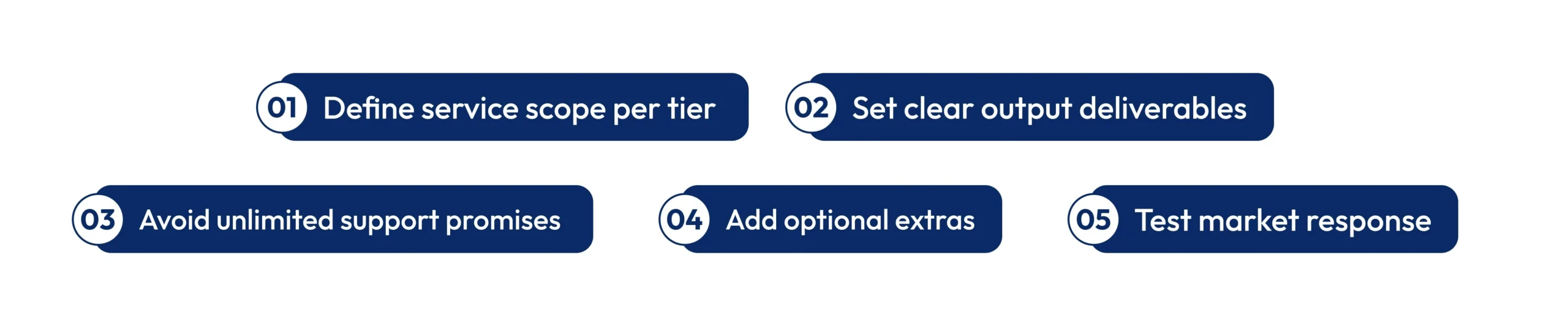
The tier pricing model should remain flexible during early implementation.
Role of Software in Proposal Pricing
Modern firms use accounting proposal software to streamline client onboarding.
Automation helps:
- Generate proposal pricing documents
- Track client acceptance
- Manage package updates
- Maintain service records
The best systems allow firms to modify tiered pricing dynamically.
Why Tiered Pricing Works in Professional Services
The tiered pricing model strategy works because it simplifies decision-making.
Clients prefer structured choices rather than complex custom quotations.
A well-designed pricing model improves:
- Client confidence
- Sales efficiency
- Revenue stability
- Service clarity
Common Mistakes When Building a Tiered Pricing Model
Many firms build their tiers based on time or effort rather than client value. This leads to underpricing premium services and overloading the basic tier.
Mistake 1- Too many tiers. More than four options causes decision fatigue. Stick to three well-defined packages. Research in behavioural economics consistently shows that three choices maximise conversion whilst minimising buyer uncertainty.
Mistake 2- Overlapping deliverables. If clients cannot clearly distinguish between tiers, they default to the cheapest. Each tier must have a distinct, named benefit that justifies the price step-up. For example, the jump from Standard to Premium should include something tangible such as a dedicated account manager or monthly advisory call rather than just “more hours.”
Mistake 3- Ignoring scope creep. Tiered pricing must include written scope limits per package to prevent clients expecting premium service at basic rates. Review our guide on avoiding scope creep in accounting projects to understand how to protect your firm.
Mistake 4- Rarely reviewing prices. UK inflation and rising software subscription costs mean pricing should be reviewed at least annually. Many firms using fixed packages find their margins erode quietly over time without a scheduled review process.
Mistake 5- Not presenting the recommended tier. Leaving clients to choose without guidance leads to unpredictable revenue. Always highlight a “recommended” or “most popular” package this simple nudge consistently increases uptake of the mid-tier option.
Conclusion
Building a strong tiered pricing strategy helps professional services businesses manage client expectations and revenue growth. The tier pricing model provides structure for proposal pricing, improves service clarity, and supports scalable operations.
Whether used in accounting services pricing packages or consultancy work, the approach reduces billing uncertainty and enhances client choice. The success of a three-tier pricing strategy depends on understanding client needs and aligning services with business value.
Speak to our team to understand how this may work for your business.
FAQs
What is a tiered pricing strategy in professional services?
A tier pricing model offers services in multiple package levels with different features and prices.
How many pricing tiers should a service business offer?
Most businesses use three tiers because the three-tier pricing strategy helps guide client choice.
What should be included in each pricing tier?
Each tier should include clear deliverables, response levels, and service scope within the pricing model.
Is tiered pricing better than hourly billing?
Many firms prefer tiered pricing because it improves revenue predictability and simplifies proposal pricing.
Why does three-tier pricing work so well?
The middle package often becomes the preferred option in a tier pricing model due to perceived value.
Can accounting firms use tiered pricing packages?
Yes, accounting services pricing packages are commonly used by modern accounting practices.
How do you present tiered pricing in a proposal?
Use a proposal pricing template with clear package comparison and a recommended option.
What are typical UK accounting pricing package costs?
UK accounting service packages typically range from £150–£350 per month for basic bookkeeping, £400–£800 for a standard package including VAT returns, and £900–£2,000+ for premium advisory packages. Prices vary based on business size and complexity.
How often should I review my tiered pricing model?
Pricing should be reviewed at least once per year, or whenever there are significant changes to software costs, staffing, or HMRC compliance requirements. Annual reviews help maintain healthy profit margins across all tiers.

Parul is a content specialist with expertise in accounting and bookkeeping. Her writing covers a wide range of accounting topics such as payroll, financial reporting and more. Her content is well-researched and she has a strong understanding of accounting terms and industry-specific terminologies. As a subject matter expert, she simplifies complex concepts into clear, practical insights, helping businesses with accurate tips and solutions to make informed decisions.