
Gone are the days of printing, posting, and waiting weeks for signed proposals. For UK accounting firms, the shift to e-signatures is no longer optional- it is a competitive necessity. Modern clients expect fast, professional service, and the right proposal e-signature tool delivers exactly that. In this guide, we explore how the Outbooks Proposal Tool helps UK accountants streamline e-signatures, accelerate approvals, and stay fully compliant with UK law.
Why E-signatures matter for UK Accounting firms?
Traditional paper-based processes create unnecessary delays for accounting firms. Clients expect swift, professional service without bureaucratic hurdles.
E-signatures have become a valuable tool for accountants, offering a wide range of benefits according to recent industry research.
Digital signatures for accountants reduce processing time from days to hours. This efficiency boost helps firms simplify client approvals whilst maintaining legal compliance. Modern clients appreciate the convenience of signing documents from any location.
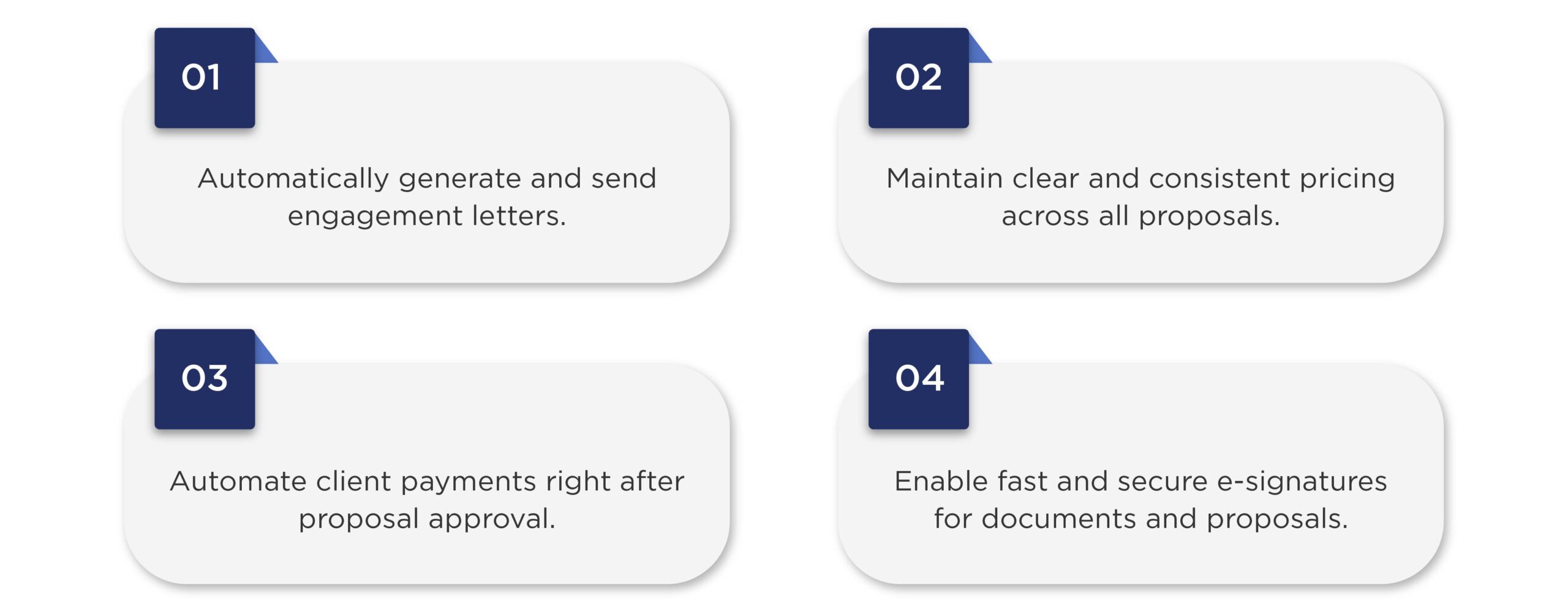
Other significant features of the Outbooks Proposal Tool and its e-signature function include:
The Outbooks Proposal Tool advantage for UK Accountants
Outbooks Proposal offers seamless integration of e-signature functionality within accounting workflows. Built specifically for UK accounting professionals, the platform understands industry requirements perfectly.Unlike generic e-signature tools such as DocuSign or Adobe Sign, Outbooks Proposal is purpose-built for accounting proposals, meaning engagement letters, service agreements, and renewal documents all flow through one platform.
Clients receive branded, professional documents that enhance your firm’s reputation. Proposal signing has never been more intuitive or user-friendly.
Key benefits of Digital Proposal Signatures
The following benefits apply specifically to UK accounting practices using a dedicated proposal e-signature tool:
1. Faster Client Onboarding: Removes postal delays entirely. Clients can sign engagement letters the same day they receive them, allowing work to begin immediately.
2. Legal Validity Under UK Law: Electronic signatures are fully recognised under the Electronic Communications Act 2000, giving firms and clients complete legal confidence.
3. Automated Tracking & Reminders: The system automatically follows up with clients who have not signed, removing the need for manual chasing emails.
4. Full Accounting Workflow Automation: From proposal creation to signed engagement letter, the entire process is automated, freeing staff to focus on billable work.
Related Post – Transform your proposal & onboarding process with accounting proposal software
Time Saving Comparison (UK Accounting Firms)
| Process | Traditional Method | E-signature Method | Time Saved |
| Document preparation | 30 minutes | 15 minutes | 50% |
| Sending to client | 2-3 days | Instant | 100% |
| Client signing | 5-10 days | Same day | 90% |
| Return processing | 2-3 days | Instant | 100% |
How to simplify client approvals with E-signatures?
Understanding how to simplify client approvals with e-signatures requires strategic implementation. Start by selecting the e-signature tool for accounting proposals that best suits your firm’s workflow.
For UK firms, the key criteria when choosing a proposal tool should include: UK legal compliance (eIDAS/ECA 2000), GDPR-compliant data storage, and integration with UK accounting software such as Xero, QuickBooks, or IRIS.
Train your team on the new digital workflow processes. Educate clients about the benefits and security of electronic signatures. Create templates for common proposal types to maximise efficiency.
Getting Proposals signed faster
Accountants can get proposals signed faster by following several key strategies.
Use mobile-optimised signature interfaces for busy clients on the go.
Send automated reminder emails to clients with pending signatures.
Provide clear instructions and support for first-time digital signers.
Implement e-signatures in accounting proposal software consistently across all client interactions.
Track signature status in real-time to follow up appropriately.
Client adoption rates
| Client Age Group | E-signature Adoption Rate | Avg. Signing Time |
| Under 35 years | 95% | 2 hours |
| 35–55 years | 85% | 4 hours |
| Over 55 years | 70% | 8 hours |
Security & UK Legal Compliance for E-signatures
Electronic signatures maintain the highest standards of security and document integrity. Modern e-signature platforms use encryption and audit trails for complete security. In the UK, e-signatures are governed by the Electronic Communications Act 2000 and the retained eIDAS regulation.
For most accounting documents, including engagement letters, service proposals, and client agreements, a standard electronic signature is entirely sufficient. Advanced Electronic Signatures (AES) or Qualified Electronic Signatures (QES) are only required for specific high-risk documents such as property transactions.
Outbooks Proposal also ensures GDPR compliance, with all document data stored on UK/EEA-compliant servers.
The Digital Signature benefits for client proposals
Enhanced client experience leads to higher satisfaction and retention rates. Professional appearance creates positive first impressions with potential clients. Immediate confirmation reduces anxiety about proposal status for both parties. Environmental benefits appeal to sustainability-conscious clients and firms. Cost savings from reduced printing, postage, and administrative overhead. Improved cash flow through faster contract execution and project commencement.
Implementation Best Practices for UK Accountants
Successful adoption requires careful planning and staff training. Choose software that integrates seamlessly with existing accounting systems and create standardised templates for consistent branding.
For UK practices, we recommend piloting e-signatures with 5–10 existing clients before full rollout. This allows your team to refine client-facing instructions and identify any issues specific to your firm’s document types.
Implementation Timeline for UK Accounting Firms
| Week | Activity | Responsibility |
| 1-2 | Software selection and setup | IT Team |
| 3-4 | Staff training and testing | Management |
| 5-6 | Template creation | Proposal Team |
| 7-8 | Client communication | Account Managers |
| 9+ | Full deployment | All Staff |
Cost benefit analysis
The financial impact of implementing e-signature solutions proves overwhelmingly positive. Reduced administrative costs offset software subscription fees within months.
For a typical 3-partner UK accounting firm processing 200 proposals per year, switching to e-signatures can save approximately 150 hours of admin time annually, equivalent to nearly £6,000 at a £40/hour admin rate.
Common challenges and solutions
Some clients may resist change from familiar paper-based processes. Provide patient support and clear instructions to ease the transition.
For older UK clients unfamiliar with digital signing, we recommend offering a 5-minute phone walkthrough the first time. In our experience, once clients sign electronically once, they rarely want to go back to paper.
Future of Digital Signatures in Accounting
The industry continues evolving towards completely digital workflows. Artificial intelligence will further streamline proposal creation and approval processes.
In the UK specifically, HMRC’s Making Tax Digital (MTD) initiative is pushing firms toward fully digital record-keeping. Firms that adopt e-signatures now will be well-positioned for future MTD requirements.
Mobile-first approaches will become standard as client expectations change. Blockchain technology may provide additional security and verification layers.
Conclusion
E-signatures have transformed how UK accounting firms handle proposals. Gone are the delays of printing, posting, and waiting weeks for client signatures.
The Outbooks Proposal Tool is purpose-built for UK accountants, offering legally compliant e-signatures under the Electronic Communications Act 2000, GDPR-compliant data handling, and seamless integration with the proposal and engagement letter process.
The benefits are clear: less paperwork, lower costs, and happier clients. As the UK accountancy industry moves toward fully digital workflows, including HMRC’s Making Tax Digital, e-signatures are no longer optional. They are essential.
Related post – From Draft to Deal: The Proposal Process for accountants
FAQs
Are electronic signatures legally binding in the UK?
Yes, electronic signatures carry full legal weight under UK law when properly implemented. The Electronic Communications Act 2000 and eIDAS Regulation provide comprehensive legal frameworks supporting digital signatures.
How secure are e-signatures compared to handwritten signatures?
E-signatures offer superior security through encryption, audit trails, and tamper-evident technology. Digital signatures are actually more difficult to forge than traditional handwritten signatures.
Can elderly clients use e-signature technology effectively?
Most elderly clients adapt well with proper guidance and support. Simple interfaces and clear instructions help overcome initial reluctance. Phone support during first-time use proves particularly valuable.
What happens if a client cannot access their email to sign?
Modern e-signature platforms offer multiple access methods including SMS links, direct portal access, and alternative email addresses. Backup processes ensure signatures can always be completed.
How long do electronically signed documents remain valid?
Electronic signatures maintain validity indefinitely when properly archived. Digital audit trails provide permanent proof of signature authenticity and document integrity.
Can e-signatures be used for all types of accounting documents?
Most accounting documents accept electronic signatures, though certain statutory filings may require specific procedures. Always verify requirements for specialised document types.
What training do staff need for e-signature implementation?
Basic training typically requires 2-3 hours covering software navigation, client support, and troubleshooting. Ongoing support ensures smooth adoption across the entire team.
How do e-signatures integrate with existing accounting software?
Leading e-signature platforms offer robust integrations with popular accounting systems. API connections enable seamless data transfer and workflow automation.
What backup procedures exist if e-signature systems fail?
Reliable platforms maintain multiple redundancies and backup systems. Service level agreements guarantee uptime, with traditional methods available as emergency alternatives.
How do clients receive and sign proposals electronically?
Clients receive email notifications with secure links to proposal documents. Simple interfaces guide them through the signing process step-by-step without requiring software downloads.
Simplify client approvals for your UK Accounting Firm
Outbooks Proposal Tool helps UK accountants streamline onboarding with secure HMRC-recognised e-signatures, faster approvals, and fully compliant workflows.
Book a Free Demo
Parul is a content specialist with expertise in accounting and bookkeeping. Her writing covers a wide range of accounting topics such as payroll, financial reporting and more. Her content is well-researched and she has a strong understanding of accounting terms and industry-specific terminologies. As a subject matter expert, she simplifies complex concepts into clear, practical insights, helping businesses with accurate tips and solutions to make informed decisions.