
An IRS rejected tax return can disrupt filing deadlines and delay refunds. For business owners and directors, this creates compliance pressure and uncertainty, especially during peak filing season. Even a minor data mismatch can trigger an IRS rejected return, preventing the return from being accepted for processing.
When a return is rejected, the IRS has not processed it. This means the filing is not complete. Delays may affect cash flow planning, estimated tax payments, and financial reporting. Understanding why the IRS rejected my tax return notice appears and how to correct it quickly is essential.
2026 IRS efile rejection procedures remain consistent with prior guidance or reference the current IRS filing season.
Key Takeaways:
- Common tax return rejection reasons and IRS rejection codes
- Step-by-step guidance on how to fix rejected tax return issues
- How to resubmit rejected tax return IRS correctly
- What happens if IRS rejects tax return multiple times
Immediate Steps After an IRS Rejected Return
When you receive notice that your IRS rejected return, act quickly. A rejection is not an audit it usually results from missing or mismatched information that’s straightforward to correct.
Step 1: Review the Rejection Notice
The IRS sends a rejection message with a specific IRS rejection code. This code explains the exact issue.
Common issues include:
- Social Security Number mismatch
- Name spelling errors
- Dependent already claimed
- Prior-year AGI mismatch
- Duplicate filing
Understanding the IRS reject return reasons is the first step toward correction.
Step 2: Correct the Error
Follow the instructions linked to your IRS rejection codes. Most software highlights the problem field.
Do not file a new return from scratch unless instructed. Instead, correct rejected IRS tax return data and prepare to refile your rejected IRS tax return electronically.
Step 3: Resubmit Promptly
After correction, resubmit IRS rejected return as soon as possible. If accepted, it is treated as filed on the resubmission date.
If you are near the filing deadline, resubmitting quickly helps avoid penalties.
What If the Filing Deadline Passes During Rejection?
If the IRS rejects your return close to the filing deadline, you may still correct and resubmit it quickly without penalty.
However, if the issue cannot be resolved before the deadline, you may file an extension using IRS Form 4868, which allows an automatic extension of up to six months for filing the return. The extension applies to filing, not tax payments, so estimated tax may still need to be paid.
Common Tax Return Rejection Reasons in 2026
Most IRS rejection tax return notices relate to identity verification or data entry errors.
The table below outlines the most common rejection reasons and how to fix them quickly.
| Rejection Reason | Description | Typical Fix |
|---|---|---|
| SSN Mismatch | SSN does not match IRS records | Verify Social Security card |
| Name Error | Legal name differs from SSA records | Correct spelling |
| Duplicate Filing | Another return already filed | Confirm identity |
| IRS return rejected AGI mismatch | Prior-year AGI does not match IRS database | Use correct AGI or request transcript |
| Dependent Claimed | Dependent already claimed by another filer | Confirm eligibility |
The IRS return rejected AGI mismatch is one of the most common issues. It occurs when the prior-year Adjusted Gross Income entered does not match IRS records.
How to Fix an AGI Mismatch Rejection?
If you see an IRS rejected return AGI mismatch how to fix message, follow these steps:
- Check your prior-year Form 1040.
- Confirm the exact AGI amount reported.
- If unavailable, request a transcript from Internal Revenue Service via IRS.gov.
- Enter the corrected figure and refile.
If your prior-year return was filed after the IRS processing deadline, try entering ‘0’ as your AGI. If rejected again, request an IRS transcript to confirm the correct amount.
What Happens If IRS Rejects Tax Return?
Understanding what happens if IRS rejects tax return submissions helps reduce stress.
- The return is not processed
- No tax assessment occurs
- No refund is issued
- Filing is considered incomplete
This differs from an audit. A rejected tax return IRS notice simply means the electronic file failed validation checks, not an investigation.
Speak to our team to understand how this may work for your business.
How to Fix Rejected IRS E-file Return?
If your IRS rejected e-file return, follow a structured process:
Checklist: Steps to Fix Rejected IRS Return
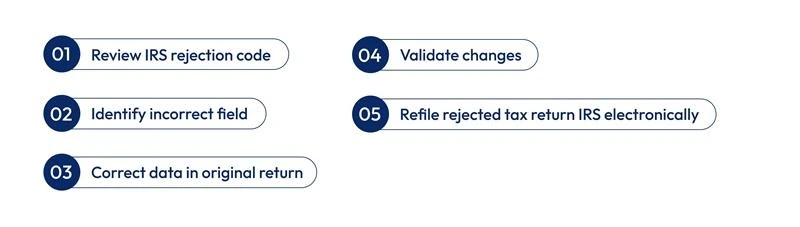
Most rejections are resolved within one or two attempts.
Can I Refile After IRS Rejection?
Yes. If you are asking, can I refile after IRS rejection, the answer is yes. You may resubmit after correcting errors.
There is no formal limit, but repeated errors may require paper filing.
Paper Filing as a Fallback Option
If your IRS efile rejected multiple times, you may submit your tax return using paper filing.
Paper returns do not go through the same electronic validation checks, which may help when technical data mismatches repeatedly prevent e-filing. However, paper processing usually takes longer than electronic filing.
How Many Times Can IRS Reject Tax Return?
There is no stated maximum. However, continuous validation errors may require switching from efile rejected IRS submission to paper filing.
If your IRS efile rejected multiple times, consult a tax professional to review the return in detail.
How Long to Fix Rejected Tax Return?
Most errors can be identified and corrected within a few hours, depending on record availability. The timeline depends on:
- Access to prior records
- Identity verification
- System availability
Once accepted, standard IRS processing timelines apply.
Penalty Implications of Rejected Returns
A rejected return itself does not automatically trigger penalties because the IRS has not yet processed the filing.
However, penalties may apply if the corrected return is submitted after the filing deadline without an extension or if taxes owed remain unpaid.
This is why correcting errors and resubmitting quickly is important.
State Tax Return Rejections
In addition to federal returns, taxpayers may also receive state tax return rejection notices.
State rejections typically occur for similar reasons, including:
- SSN mismatches
- Incorrect filing status
- Data inconsistencies between federal and state returns
Correcting the federal return usually resolves related state rejection issues as well.
Special Considerations for Business Owners
Small business owners and S corporation shareholders often see IRS reject tax return notices due to:
- EIN mismatches: When the Employer Identification Number entered on the return does not match the number registered in IRS records, the system may automatically reject the filing.
- Estimated tax payment errors: Returns can be rejected if the reported estimated tax payments do not align with the amounts recorded by the IRS during the tax year.
- Schedule inconsistencies: Differences between figures reported across forms or schedules, such as income totals not matching supporting schedules, can trigger validation errors during processing.
- Incorrect dependent or spouse data: Entering the wrong Social Security Number, name spelling, or filing status details for a dependent or spouse can cause the IRS system to reject the tax return during verification.
Before resubmitting, confirm that all business income forms – including Schedule C or K-1 – match the figures registered with the IRS.
Conclusion
This 2026 guide has explained what to do if your IRS tax return is rejected by outlining the most common IRS reject return reasons, decoding IRS rejection codes, and providing clear steps to correct rejected IRS tax return submissions.
An IRS rejected tax return does not mean penalties or audits. It simply requires correction and resubmission. By reviewing the rejection notice, fixing errors accurately, and resubmitting promptly, taxpayers can restore compliance and avoid unnecessary delays.
If you’re unsure about any rejection code, our team can review your return and guide you through resubmission quickly.
FAQs
Why was my tax return rejected?
What happens if IRS rejects tax return?
How to correct rejected IRS return?
How to refile rejected tax return?
IRS rejected return what next?
IRS rejected return AGI mismatch how to fix?
How many times can IRS reject tax return?
How long to fix rejected tax return?
Will I be penalised if my return was rejected?
Can I file a paper return after an efile rejection?
Does a rejected return affect my refund timeline?
What if I used a tax professional and my return was still rejected?

Parul is a content specialist with expertise in accounting and bookkeeping. Her writing covers a wide range of accounting topics such as payroll, financial reporting and more. Her content is well-researched and she has a strong understanding of accounting terms and industry-specific terminologies. As a subject matter expert, she simplifies complex concepts into clear, practical insights, helping businesses with accurate tips and solutions to make informed decisions.