

When you run a business on credit, collecting payments on time makes or breaks your cash flow. You send out invoices and wait for customers to pay. Some pay in 30 days, others take 60 or 90 days. This waiting period ties up your money and makes it hard to pay your own bills, cover payroll, or grow your business.
The receivables turnover ratio helps you track how fast you collect payments. This simple number shows how many times per year you turn credit sales into cash. If your ratio is 8, you collect money about eight times a year, or every 45 days. A higher ratio means you collect faster. A lower ratio means money stays stuck in unpaid invoices longer.
Understanding what is account receivable turnover ratio helps you identify whether your credit policies work effectively or if your collection efforts need immediate improvement.
Key Takeaways:
- AR turnover ratio = Net Credit Sales ÷ Average AR – it tells you how many times per year you convert credit sales into cash.
- Higher is better – a ratio of 8 means you collect every ~45 days; lower means cash is sitting stuck in unpaid invoices.
- Industry context matters – retail businesses naturally run higher ratios than B2B or manufacturing; always benchmark against your sector.
- Declining ratio = early warning sign – it may signal overly lenient credit terms, slow-paying customers, or weak collections.
- Pair it with DSO – divide 365 by your ratio to get Days Sales Outstanding; this tells you exactly how long customers take to pay.
- Use an AR Aging Report alongside it – the ratio gives you the overall picture; the aging report shows you exactly which accounts are the problem.
- Review quarterly at minimum – monthly tracking gives you faster visibility into trends before they become cash flow crises.
- Don’t game the ratio – tightening credit excessively boosts the number but can cost you good customers and reduce sales long-term.
What is the Account Receivable Turnover Ratio?
The accounts receivable turnover ratio (also called the receivables turnover ratio or AR turnover ratio) measures how many times your company collects its average accounts receivable balance during a specific period. This metric shows the efficiency of your credit and collections process.
When you extend credit to customers, you create accounts receivable on your balance sheet. The faster you convert these receivables into cash, the better your liquidity position. The receivables turnover ratio quantifies this speed, helping you understand whether your collection efforts are effective.
Understanding AR Turnover Meaning
A high receivable turnover ratio indicates that your business collects payments quickly and efficiently. This suggests you have strong credit policies, effective collection procedures, and customers who pay on time. Fast collection improves your working capital and reduces the risk of bad debts.
A low ratio signals potential problems. Your customers might be taking too long to pay, your credit policies may be too lenient, or your collection efforts may need strengthening. This situation ties up cash that could otherwise support business operations.
How to Calculate Account Receivable Turnover Ratio?
The receivables turnover calculation uses a straightforward formula that requires two pieces of information from your financial statements.
The Receivables Turnover Ratio Formula
Receivables Turnover Ratio = Net Credit Sales / Average Accounts Receivable
Let’s break down each component:
Net Credit Sales: This represents your total credit sales minus any returns, allowances, and discounts. You’ll find this figure on your income statement. Only include sales made on credit, not cash sales.
Average Accounts Receivable: Calculate this by adding your beginning accounts receivable to your ending accounts receivable for the period, then dividing by two.
Average Account Receivables Formula: (Beginning AR + Ending AR) / 2
Step-by-Step Calculation Process
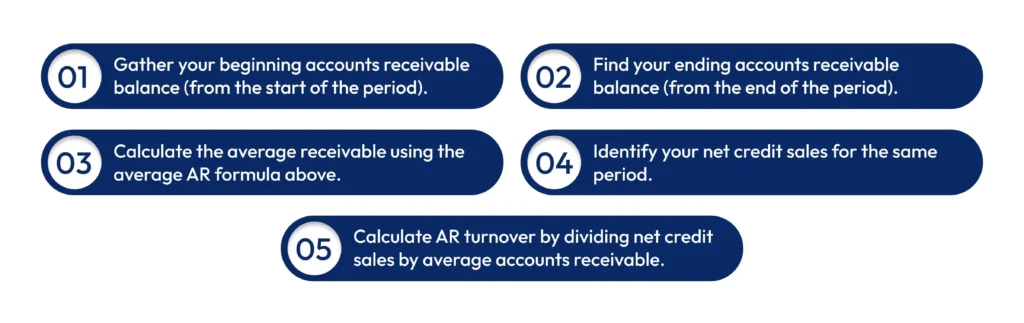
Account Receivable Turnover Ratio Example
Let’s work through a practical account receivable turnover ratio example to demonstrate the receivables turnover calculation for a small business.
Company ABC’s Annual Figures:
- Net Credit Sales: $1,000,000
- Beginning Accounts Receivable (January 1): $100,000
- Ending Accounts Receivable (December 31): $150,000
Step 1: Calculate average accounts receivable
Average AR = ($100,000 + $150,000) / 2 = $125,000
Step 2: Calculate the receivables turnover ratio
Receivables Turnover Ratio = $1,000,000 / $125,000 = 8 times
Interpretation: Company ABC collected its average receivables 8 times during the year. This means the business converted its receivables into cash roughly every 45 days (365 days / 8 = 45.6 days).
Accounts Receivable Turnover Calculation Table
| Component | Amount |
|---|---|
| Net Credit Sales | $1,000,000 |
| Beginning AR | $100,000 |
| Ending AR | $150,000 |
| Average Account Receivables | $125,000 |
| AR Turnover Ratio | 8.0 times |
| Average Collection Period | 45.6 days |
Why the Receivables Turnover Ratio is Important?
Understanding what account receivables turnover is helps business owners and accountants evaluate multiple aspects of financial health. Accounts receivable ratios provide insights into several critical business functions, from daily cash management to long-term strategic planning.
Cash Flow Management
A high receivable turnover ratio indicates faster cash conversion. When you collect payments quickly, you have more cash available for daily operations, paying suppliers, covering payroll, and investing in growth. Strong cash flow reduces the need for expensive short-term borrowing. Accounts receivable ratios serve as early warning indicators for potential liquidity problems.
Credit Policy Evaluation
The accounts receivables ratio helps you assess whether your credit policies are working. If your ratio is declining, your credit terms might be too generous or you may be extending credit to customers who pay slowly. Accounts receivable ratios provide insight that allows you to adjust credit limits, payment terms, or customer screening processes.
Operational Efficiency Assessment
The accounts receivable ratios serve as a key indicator of management effectiveness. A strong ratio shows your accounting team efficiently processes invoices, follows up on overdue accounts, and maintains strong customer relationships. Accounts receivable ratios reflect well-organized internal processes and clear communication with customers.
Benchmarking Against Industry Standards
Comparing your AR turnover with industry peers reveals your competitive position. Account turnover varies significantly across industries. Retail businesses typically have higher ratios because they conduct mostly cash transactions, while manufacturing or B2B service companies often have lower ratios due to longer payment terms.
Limitations of the Receivables Turnover Ratio
While the receivables turnover is calculated by dividing net credit sales by average accounts receivable, this metric has important limitations that business owners should understand.
Seasonal Business Challenges
The AR turns ratio uses average figures that can mask seasonal fluctuations. If your business experiences peak seasons followed by slow periods, the average receivables may not accurately represent typical collection patterns. A construction company, for example, might collect most receivables in summer months, making the annual average misleading.
Lack of Customer-Specific Details
The accounts receivable turn provides only an overall picture. It doesn’t identify which specific customers are paying late or which accounts pose the highest risk. A high overall ratio might hide problems with a few large customers whose late payments could threaten your business.
Industry Context Requirements
A high receivable turnover ratio indicates efficiency in one industry but might be normal or even low in another. Without proper benchmarking, you can’t determine whether your ratio represents strong performance.
Limited Value for Cash Businesses
This metric is less useful for businesses that primarily operate on a cash basis or have very few credit customers. If most of your sales are cash transactions, the receivables turnover calculation won’t provide meaningful insights into your overall business performance.
Potential for Manipulation
Management can artificially improve the ratio by tightening credit policies excessively, which might increase the AR turnover meaning but could also reduce sales and alienate good customers. Understanding the context behind ratio changes is essential.
Complementary Tools for Better Analysis
The receivables turnover days (also expressed as accounts receivable days turnover or AR days turnover) provides another perspective. You can use the AR turnover in days formula to calculate this by dividing 365 days by the receivables turnover ratio. This shows the average receivables days or average number of days it takes to collect payment.
Days Sales Outstanding (DSO) Formula: 365 / Receivables Turnover Ratio (or 360 for banking standards).
Using our earlier example: 365 / 8 = 45.6 days
An Accounts Receivable Aging Report complements the receivables turnover calculation by breaking down receivables by how long they’ve been outstanding (current, 30 days, 60 days, 90+ days). This report identifies specific collection problems that the overall AR ratios and accounting turnover ratio might hide. Understanding the average accounts receivable collection period helps you set realistic payment targets.
Best Practices for US Small Business Owners
Monitor your average account receivable turnover quarterly to spot trends early. You can use an account receivable turnover calculator or calculate account receivable turnover manually to track performance. Set realistic targets based on your industry benchmarks and payment terms. If you offer net 30 terms, aim for a ratio that results in collection within 35-40 days to account for processing time and achieve strong average accounts receivable days.
Review your credit policies regularly. If your ratio is declining, consider requiring deposits for large orders, shortening payment terms for new customers, or implementing early payment discounts.
Invest in efficient invoicing and collection processes. Send invoices immediately, follow up on overdue accounts consistently, and maintain clear communication with customers about payment expectations.
Conclusion
The receivables turnover ratio remains an essential tool for US small business owners, company directors, and accountants in today. Accounts receivable ratios reveal how effectively your business converts credit sales into cash, directly impacting liquidity and operational success.
Understanding what is account receivable turnover ratio and how to calculate it empowers you to make informed decisions about credit policies and collection practices.
While the accounts receivable turnover ratio calculation provides valuable insights, accounts receivable ratios work best alongside other tools like aging reports and days sales outstanding for complete financial analysis. Regular monitoring helps you identify problems early and maintain the healthy cash flow necessary for business growth and stability.
FAQs
How to calculate account receivable turnover ratio for my business?
What is a good accounts receivable turnover ratio?
How is accounts receivable turnover calculated differently from inventory turnover?
What does a high receivable turnover ratio indicate?
How often should I calculate my AR turnover?

Parul is a content specialist with expertise in accounting and bookkeeping. Her writing covers a wide range of accounting topics such as payroll, financial reporting and more. Her content is well-researched and she has a strong understanding of accounting terms and industry-specific terminologies. As a subject matter expert, she simplifies complex concepts into clear, practical insights, helping businesses with accurate tips and solutions to make informed decisions.