

Your business depends on accurate financial reporting and timely compliance. When your accounting firm fails to deliver, the consequences extend far beyond delayed reports. Errors accumulate, deadlines are missed, and strategic opportunities are lost while you wait for answers.
Poor accounting services create cascading problems. Missed tax filing deadlines trigger penalties. Unreliable financial data leads to flawed business decisions. Growth stalls when your accountant cannot scale with your needs. These issues compound over time, eroding both your financial position and peace of mind.
Key takeaways:
- Persistent communication delays and missed deadlines signal fundamental service failures
- Frequent errors and lack of industry expertise indicate your firm cannot support your business
- The optimal transition period occurs after tax season or year-end close
- A clear evaluation framework helps identify when switching becomes necessary
Critical Warning Signs you need a New Accountant
Recognizing when to switch accounting firms requires attention to recurring patterns rather than isolated incidents. These red flags indicate structural problems that will not improve without action.
Poor Communication and Responsiveness
Effective accounting relationships depend on clear, accessible communication. When emails go unanswered for days, phone calls are not returned, and your questions receive the standard “we’ll address this after busy season” response, your accountant has deprioritized your business.
Accountant not responsive behavior manifests in several ways:
- Simple questions take weeks to answer
- Your calls get routed to voicemail repeatedly
- The firm provides no proactive updates on important matters
This pattern shows your business does not receive adequate attention.
Frequent Errors in Financial Records
Accuracy forms the foundation of accounting work. Accounting errors by CPA professionals require immediate attention when they become routine.
Common problems include:
- Mistakes in tax filings
- Inconsistent financial statements
- Reports requiring constant revisions
Even a single error should be addressed with correction and explanation. Repeated mistakes across multiple periods demonstrate systemic problems. When you cannot trust the numbers your accountant provides, you cannot make sound business decisions.
Consistent Missed Deadlines
Accounting firm problems often surface through deadline failures. Late tax filings expose your business to penalties and interest charges. Delayed monthly financial statements leave you operating without current data.
Professional firms manage workload to meet commitments. When your deadlines consistently receive lower priority than other clients, the relationship has deteriorated beyond repair. According to the IRS, late filing penalties can be substantial, making deadline compliance critical.
Absence of Proactive Strategic Advice
Your accountant should function as a strategic partner, not merely a data recorder. Lack of proactive accounting advice limits your business potential.
Strong accounting firms:
- Identify opportunities and risks before they materialize
- Recommend tax strategies in advance
- Suggest process improvements
- Help you understand financial trends
An accountant who waits for you to ask every question provides minimal value.
Missing Industry-Specific Expertise
Business complexity varies significantly across industries. An outdated accounting firm that handles only general bookkeeping cannot navigate the specific requirements of specialized sectors.
Industry-specific needs:
- SaaS companies: Revenue recognition expertise
- Construction firms: Job costing knowledge
- Healthcare practices: Unique compliance demands
When your accountant lacks familiarity with your industry’s regulations, tax treatments, and operational metrics, they cannot provide relevant guidance.
Technology and Process Limitations
Modern accounting leverages cloud-based platforms, automation, and real-time reporting. Firms resistant to current technology create inefficiencies.
Warning signs:
- Manual data entry increases error rates
- Paper-based processes slow information flow
- Outdated systems prevent integration with your business software
Poor accounting services often stem from technological inadequacy.
Inability to Scale with Business Growth
Your accounting needs evolve as your business expands. When accounting firm hurts business growth, it typically happens gradually. The firm that adequately served your startup cannot handle multi-state operations, complex entity structures, or international transactions.
Signs you need a new accountant:
- Inability to handle increased transaction volume
- Resistance to adding services you now require
- Lack of expertise in areas relevant to your current scale
Unexplained Fee Increases
Accounting costs should reflect service value. When fees rise substantially without corresponding improvements in service quality, responsiveness, or scope, you are paying more for the same or lesser value.
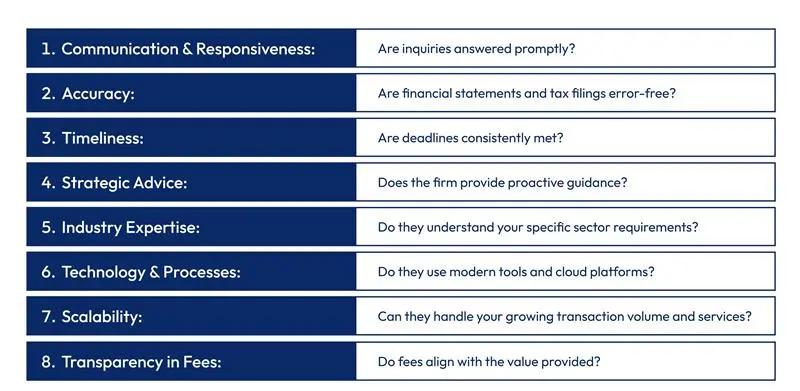
Accounting Firm Evaluation Checklist
Use this checklist to determine whether your current accounting firm meets your business needs:
When to Change CPA Firms: Optimal Timing
While you can switch CPA firms at any point, strategic timing minimizes disruption and ensures smooth transitions.
After Tax Season Completion
The period following tax season offers the cleanest break. Once your tax returns are filed and you have received final year-end reports, a new firm can take over without inheriting incomplete work. This timing allows several months before the next tax season begins.
Following Year-End Close
Switching immediately after your fiscal year-end provides another natural transition point. Your new accountant starts with a fresh annual cycle, avoiding mid-year disruptions to financial reporting.
Before Major Business Changes
Plan to switch accountant before tax season if you anticipate significant business developments. Mergers, acquisitions, new funding rounds, or expansion into new markets require capable accounting support.
How to Transition to a New Accountant Successfully?
A structured approach minimizes disruption when you change accounting firm processes.
Step 1: Evaluate and Select Your New Firm
Research firms with relevant industry experience and appropriate size for your needs. Interview multiple candidates and request references from similar businesses. Verify their technology platforms align with your requirements.
Step 2: Request All Necessary Records
Formally request your complete financial records from your current firm:
- Tax returns for recent years
- General ledgers
- Working papers
- Depreciation schedules
- All supporting documentation
Professional firms provide these materials promptly, though some may charge reasonable fees for extensive copying. The IRS Circular 230 §10.28 requires accountants to promptly return client records even if fees remain unpaid.
Similarly, the AICPA Code ET §1.400.200 requires firms to respond to record requests within a reasonable timeframe.
If your firm refuses to release records or charges unreasonable fees:
- Send a formal written request via email and certified mail, citing the IRS and AICPA standards above
- Set a clear 10-14 day deadline for compliance
- Have your new accountant send a professional records request letter if delays continue
- Challenge excessive fees beyond actual copying costs
- Escalate to your state board of accountancy or the firm’s professional body for unjustified refusals
- Document all communications for your protection
In rare cases of non-cooperation, contact the firm’s professional body (e.g., AICPA) for guidance on escalation.
Step 3: Coordinate the Handoff
Work with your new firm to establish timelines and ensure they have everything needed before critical deadlines. Introduce them to your internal team and provide access to your accounting systems.
Step 4: Document the Transition
Keep clear written records of:
- The date you ended the old engagement.
- The date the new firm took over.
- Which firm is responsible for each financial period and tax year.
- Any open items, disputes, or pending queries with tax authorities.
This documentation is valuable if questions arise later, or if a tax authority asks about historical periods.
Fire Your Accountant Professionally
Even when unhappy with accountant performance, maintain professionalism throughout the separation:
- Provide written notice according to your engagement letter terms
- Pay all outstanding invoices promptly
- Avoid detailed criticism in your termination communication
- Request a final status update on all open matters
- Document everything in writing to prevent future disputes
Conclusion
Identifying when to switch accounting firms requires recognizing patterns of poor communication, frequent errors, missed deadlines, and lack of strategic guidance. The optimal time to change accounting firm operations typically follows tax season or year-end close, allowing clean transitions without disrupting ongoing work.
Your decision should reflect accumulated evidence rather than isolated frustrations. When accounting firm red flags persist despite conversations about improvement, switching becomes necessary to protect your business. A methodical transition process ensures continuity while positioning your business for better financial management and strategic support.
Frequently Asked Questions
When is the best time to switch accounting firms?
How do I know if my accountant is not performing well?
Can I switch accountants in the middle of the tax year?
What documents should I request from my current accounting firm?
What should I do if my accountant won’t release my financial records?
Can switching accounting firms affect my business taxes?
How long does it take to transition to a new accounting firm?
Will switching accountants trigger an audit?
How can I avoid the same problems with a new accounting firm?

Parul is a content specialist with expertise in accounting and bookkeeping. Her writing covers a wide range of accounting topics such as payroll, financial reporting and more. Her content is well-researched and she has a strong understanding of accounting terms and industry-specific terminologies. As a subject matter expert, she simplifies complex concepts into clear, practical insights, helping businesses with accurate tips and solutions to make informed decisions.