
Managing your company’s financial records shouldn’t drain your resources or distract you from growth. Yet many US business owners with US operations struggle with costly in-house accounting teams, mounting compliance burdens, and limited access to specialized expertise.
Traditional accounting methods – hiring full-time staff, managing office space, and coordinating time zones create overhead costs that small businesses simply cannot sustain. The challenge intensifies when you need US-specific knowledge for subsidiary operations, cross-border transactions, or American market expansion.
This guide focuses on US companies and international businesses with US tax obligations
Key takeaways
- What virtual accountant services actually include and how they work
- Real cost versus traditional accounting (with 2026 data)
- Key benefits for US companies operating in US markets
- How to choose and implement online accountant services
- Practical steps to hire a virtual accountant USA
What is a Virtual Accountant?
A virtual accountant is a qualified professional who manages your company’s financial records, compliance, and reporting entirely online. Unlike traditional accountants working from your office, virtual accountants operate remotely using cloud-based accounting software and secure digital communication channels.
Virtual accounting services deliver the same expertise as in-house teams bookkeeping, financial reporting, tax preparation, and strategic advisory without the overhead cost of employment. These remote accountant professionals work through established virtual accounting firms or as independent consultants, providing flexible support scaled to your business needs.
How does Virtual Bookkeeping Work?
Online bookkeeping works through cloud-based platforms that connect your bank accounts, payment systems, and financial data directly to your accountant. Your virtual bookkeeper accesses this information remotely, categorizes transactions, reconciles accounts, and maintains accurate records in real time.
The process typically involves:
- Secure data sharing through encrypted cloud accounting platforms
- Regular virtual meetings via video conferencing software
- Automated transaction imports from banks and payment processors
- Real-time financial reporting accessible from any location
- Digital document storage replacing physical paperwork
Most virtual accounting companies use popular platforms like QuickBooks Online or Xero, ensuring you maintain constant visibility into your financial position while your virtual accountant handles the detailed work.
Core Virtual Accountant Services Explained
Virtual accounting firms provide comprehensive financial management covering everything from daily transactions to strategic planning. Understanding what services does a virtual accountant provide? helps you identify the right support for your business needs.
Bookkeeping and Transaction Management
Daily bookkeeping forms the foundation of virtual accounting services. Your online accountant records every business transaction, categorises expenses correctly, and maintains accurate general ledgers. This includes:
- Processing and recording all income and expense transactions
- Bank and credit card reconciliation ensuring records match statements
- Accounts receivable management tracking customer payments
- Accounts payable processing managing supplier bills and payments
Virtual bookkeeping services eliminate the tedious manual work while ensuring your financial records remain current and accurate throughout the year.
Financial Reporting and Analysis
Regular financial reports provide the insights you need for informed business decisions. Virtual accountants prepare:
- Profit and loss statements showing revenue and expense performance
- Balance sheets detailing assets, liabilities, and equity positions
- Cash flow statements tracking money movement through your business
- Management reports with key performance indicators and trend analysis
These reports arrive on schedule monthly, quarterly, or as needed giving you clear visibility into your financial health without the delay typical of traditional accounting.
Tax Preparation and Compliance
Tax compliance represents a significant burden for businesses operating across international borders. Virtual CPA services handle:
- US tax return preparation including Forms 1120, 1120-S, and 1099
- Sales tax calculations and filing across multiple state jurisdictions
- Quarterly estimated tax payments ensuring IRS compliance
- Tax planning strategies to minimize liability legally
For US companies, virtual accountants navigate the complexities of dual-jurisdiction reporting, ensuring compliance with IRS requirements.
State-Specific Tax Complexity Considerations:
Tax compliance varies significantly by state, affecting both costs and complexity:
California: Features one of the most complex tax environments with high state income tax rates (up to 13.3%), franchise tax requirements, mandatory employment training taxes, and stringent sales tax nexus rules. Businesses operating in California typically require more specialized tax expertise and face higher compliance costs.
New York: Imposes corporate franchise taxes, complex New York City business taxes for metro area operations, and aggressive sales tax enforcement. Multi-jurisdiction businesses in New York need careful nexus analysis and local tax expertise.
Texas: Has no state income tax but compensates with franchise tax (margin tax) based on gross receipts, complex sales tax rules, and various local taxes. While appearing simpler initially, Texas tax compliance requires specific expertise in franchise tax calculations and exemption certificates.
Other states with notable complexity include Illinois, Pennsylvania, and states with economic nexus thresholds that trigger filing obligations even without physical presence. When evaluating virtual accounting services, ensure your provider has demonstrated experience with your specific state’s requirements, as this significantly impacts accuracy and potential tax savings.
Payroll Administration
Managing employee payments, deductions, and reporting consumes substantial time and creates compliance risk. Virtual accounting and bookkeeping services include:
- Processing employee wages and calculating withholdings accurately
- Filing payroll taxes and submitting required government reports
- Managing benefits administration and pension contributions
- Handling contractor payments and 1099 form preparation
This removes the administrative burden while ensuring accurate, timely payment processing that keeps your workforce satisfied and compliant.
Controller and CFO services
Growing businesses need strategic financial guidance beyond basic bookkeeping. On-demand accounting services extend to:
- Financial forecasting and budgeting for planning purposes
- Cash flow management ensuring adequate working capital
- Strategic advisory supporting business expansion decisions
- Financial system implementation and process improvement
Virtual accounting firms often provide fractional CFO services, giving you access to executive-level financial expertise without full-time employment cost.
Understanding Virtual Accountant Cost
How much does a virtual accountant cost in the USA? Pricing varies significantly based on your business size, transaction volume, and service requirements. However, virtual accounting consistently proves more affordable than traditional alternatives.
Factors affecting pricing
Several variables influence what you’ll pay for virtual accounting services:
- Transaction volume: More transactions require more processing time
- Business complexity: Multiple entities, locations, or revenue streams increase cost
- Industry requirements: Specialized industries like construction or healthcare need specific expertise
- Compliance needs: Multi-state operations or international reporting add complexity
- Service scope: Basic bookkeeping cost less than full CFO advisory services
- Frequency: Weekly reporting cost more than monthly or quarterly schedules
Understanding these factors helps you obtain accurate quotes and select appropriate service levels.
Service Comparison: Virtual vs In-House vs Local CPA
Choosing the right accounting solution depends on your business size, complexity, and budget. Here’s how the three main options compare:
| Feature | Virtual Accountant | In-House Accountant | Local CPA Firm |
|---|---|---|---|
| Monthly Cost | $500-$2,500 | $4,000-$7,000+ (salary + benefits) | $1,500-$5,000+ |
| Setup Time | 2-4 weeks | 4-8 weeks (hiring + training) | 1-2 weeks |
| Scalability | Instant – add/reduce services as needed | Difficult – hiring/firing required | Moderate – may need new engagement |
| Expertise Depth | Team of specialists across tax, industry | Limited to one person’s knowledge | Varies by firm size |
| Technology | Cloud-based, real-time access | Depends on what you provide | Often traditional software |
| Availability | Business hours + some flexibility | 40 hours/week during office hours | Limited – by appointment |
| Backup Coverage | Built-in team coverage | None – vulnerable to absence | Varies by firm |
| Best For | Small to mid-sized businesses, startups, companies needing flexibility | Large businesses with complex daily needs, heavily regulated industries | Businesses wanting local relationship, complex tax situations |
| Geographic Expertise | Can specialize in multi-state | Limited to their knowledge | Strong local knowledge |
| Overhead Costs | None – service fee only | Office space, equipment, software, benefits | None – service fee only |
| Contract Flexibility | Monthly or annual, easy to change | Employment commitment, severance risk | Varies – often annual retainer |
Key Benefits of Virtual Accounting
Is a virtual accountant worth it for small businesses? The advantages extend well beyond simple cost savings, particularly for US companies managing US operations.
Significant Cost Reduction
Virtual accounting companies save businesses up to 60% on accounting costs compared to in-house teams. You eliminate salaries, benefits, payroll taxes, office space, equipment, and software expenses while accessing qualified expertise. These savings directly improve profitability without compromising financial management quality.
Access to Specialized Expertise
Virtual accounting firms employ teams of specialists rather than generalists. This means you benefit from:
- Tax professionals current with latest IRS regulations
- Industry specialists understanding your sector’s unique requirements
- Technology experts maximizing accounting software capabilities
- Compliance specialists ensuring accurate regulatory filings
This depth of expertise typically proves unaffordable for small businesses hiring individual staff members.
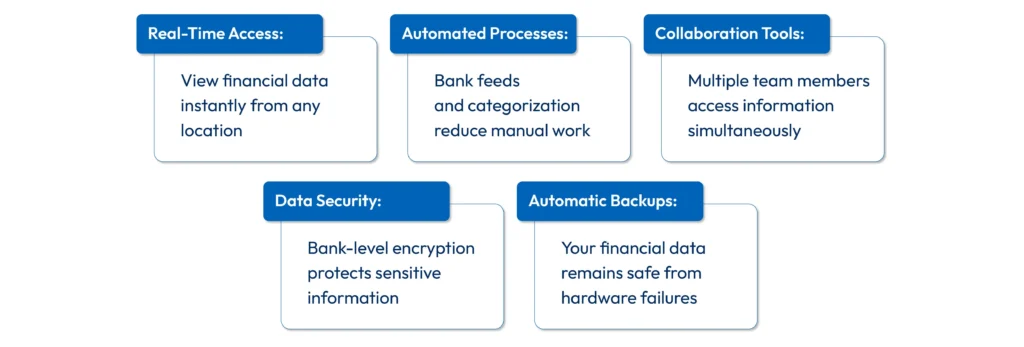
Modern virtual accounting software provides these advantages:
Scalability and Flexibility
Business needs fluctuate throughout the year and growth cycles. Online accounting services scale instantly:
- Increase support during tax season or audit periods
- Add services as your business expands
- Reduce costs during slower periods
- Access additional specialists for specific projects
You pay only for services needed without long-term employment commitments or redundancy concerns.
Cloud-Based Virtual Accounting Advantages
Modern virtual accounting software provides benefits impossible with traditional approaches:
- Real-time access: View financial data instantly from any location
- Automated processes: Bank feeds and categorisation reduce manual work
- Collaboration tools: Multiple team members access information simultaneously
- Data security: Industry-standard encryption (AES-256) and secure cloud infrastructure
- Automatic backups: Your financial data remains safe from hardware failures
Cloud technology enables efficient remote work while ensuring data accuracy and accessibility.
Time Zone Coverage
For US companies with US operations, virtual accounting teams often work American business hours, providing responsive support during your US subsidiary’s working day. This eliminates communication delays typical when US-based staff manage American accounts.
How to hire a Virtual Accountant in the US?
Selecting the right best online accounting services requires careful evaluation beyond simply comparing prices. Follow these steps to find appropriate support.
Define your Requirements Clearly
Start by documenting exactly what you need:
- Current transaction volumes and growth expectations
- Specific services required (bookkeeping, tax, payroll, advisory)
- Industry-specific needs or compliance requirements
- Reporting frequency and format preferences
- Integration requirements with existing systems
Clear requirements help providers quote accurately while ensuring you receive proposals matching your actual needs.
Research Potential Providers
Identify candidates through:
- Professional accounting associations and directories
- Referrals from other US business owners with US operations
- Online reviews and testimonials from similar businesses
- Industry-specific accounting firms with relevant expertise
Create a shortlist of 3-5 providers appearing to match your requirements and budget parameters.
Evaluate Credentials and Experience
Verify qualifications including:
- Relevant certifications (CPA, ACCA, or equivalent)
- Years of experience serving businesses your size
- Industry specialisation and knowledge depth
- Technology platform proficiency (QuickBooks/Xero/other)
- References from current clients in similar situations
Request case studies demonstrating success with businesses like yours, particularly US companies managing US operations.
Assess Communication and Responsiveness
Effective communication proves critical for successful virtual relationships. Evaluate:
- Response times to initial enquiries
- Clarity of explanations without excessive jargon
- Willingness to answer questions thoroughly
- Proactive communication style and frequency
- Video conferencing capabilities and comfort level
Schedule initial consultations with top candidates to assess compatibility and communication effectiveness.
Review Service Agreements Carefully
Before committing, understand:
- Exact services included in quoted fees
- Additional costs for extra work or consultations
- Contract length and termination provisions
- Data security measures and insurance coverage
- Service level agreements for deliverable timing
Ensure agreements address US-specific concerns like GDPR compliance and international data transfers.
Plan the Transition Process
Successful implementation requires planning:
- Timeline for switching from current providers
- Data migration requirements and procedures
- Team training on new systems or processes
- Communication plan for stakeholders
- Initial reconciliation and accuracy verification
Most virtual accounting companies provide structured onboarding processes ensuring smooth transitions with minimal disruption.
Virtual Bookkeeping for Specific Business Types
Different business models benefit from tailored virtual accounting approaches addressing their unique challenges and requirements.
Virtual Accountant for Startups in the USA
Startups need affordable, scalable support from day one. Best virtual bookkeeping services for startups offer:
- Low-cost entry packages growing with your business
- Assistance with initial accounting system setup
- Fundraising support and investor reporting
- Burn rate monitoring and cash runway analysis
- Guidance on financial controls and processes
This foundation ensures accurate records while you focus on product development and market validation.
Virtual Bookkeeping for e-Commerce Businesses
Online retailers face specific challenges including:
- Multi-channel sales reconciliation (Amazon, Shopify, eBay)
- Inventory valuation and cost of goods tracking
- Sales tax compliance across multiple states
- Payment processor reconciliation (PayPal, Stripe)
- Marketplace fee accounting and reporting
Virtual accounting bookkeeping specialists understand eCommerce complexities, ensuring accurate profitability analysis and tax compliance.
Online Accountants for Contractors
Independent contractors and consultancies need:
- Simple income and expense tracking
- Quarterly estimated tax calculations
- 1099 form preparation and filing
- Mileage and home office deduction support
- Retirement account administration
Contractor-focused packages typically cost less than full business accounting while addressing specific self-employment requirements.
Common Concerns Addressed
Difference between Virtual Accountant and CPA
A CPA (Certified Public Accountant) is a specific professional certification requiring examination and continuing education. Virtual accountant describes the service delivery method working remotely rather than in your office.
Many virtual accountants hold CPA certifications, while others possess different qualifications. The key distinction is credentials versus location: you can hire virtual CPA services combining remote delivery with certified expertise.
Virtual Bookkeeper vs Traditional Advantages
Traditional bookkeepers work in your office, providing face-to-face interaction but requiring employment overhead. Virtual bookkeepers offer:
- Lower costs through eliminated overhead
- Broader expertise through team-based delivery
- Better technology through cloud-based platforms
- Greater flexibility in service levels
- Continuity through backup coverage
The trade-off is reduced in-person contact, though video conferencing largely eliminates this limitation.
Data Security Considerations
Reputable best virtual bookkeeping services USA implement robust security including:
Virtual bookkeeping services in USA
- Bank-level encryption for data transmission
- Secure cloud storage with automatic backups
- Two-factor authentication access controls
- Regular security audits and compliance certifications
- Professional indemnity insurance coverage
These measures typically exceed security possible with in-house systems managed by small business owners.
Conclusion
Virtual accountant services provide US companies with cost-effective, expert financial management for US operations. By eliminating employment overhead while accessing specialized expertise, online accountant services deliver substantial savings typically 50-70% compared to traditional approaches without compromising quality or compliance.
The benefits extend beyond cost reduction. Cloud-based virtual accounting provides real-time financial visibility, scalable support matching your growth, and access to specialist knowledge typically unaffordable for small businesses. For companies managing cross-border operations, virtual accounting firms offering US timezone coverage and IRS expertise prove invaluable.
Choosing the right virtual accounting firm requires evaluating credentials, experience, communication effectiveness, and service scope carefully. Define your requirements clearly, research candidates thoroughly, and plan transitions properly to ensure successful implementation.
Frequently Asked Questions
How does online bookkeeping work for businesses without cloud software?
Can virtual accountants handle industry-specific requirements?
How quickly can I start with virtual accounting services?
What happens if I’m unhappy with my virtual accountant?
Do I still need an in-house finance person with virtual accounting?
Can virtual accountants represent me in tax matters?
How do virtual accountants compare to accounting software alone?
What’s included in basic virtual bookkeeping versus full accounting?
How do I monitor quality with remote services?
Can I switch between virtual accounting providers easily?

Parul is a content specialist with expertise in accounting and bookkeeping. Her writing covers a wide range of accounting topics such as payroll, financial reporting and more. Her content is well-researched and she has a strong understanding of accounting terms and industry-specific terminologies. As a subject matter expert, she simplifies complex concepts into clear, practical insights, helping businesses with accurate tips and solutions to make informed decisions.