
Why do many small businesses end up paying more tax than required? The issue is more common than expected. Many business owners discover later that a tax overpayment occurred because of reporting mistakes, missed deductions, or inaccurate bookkeeping records.
Small companies often manage accounting internally, especially during early growth stages. However, mistakes in expense tracking, payroll reporting, and quarterly estimated taxes can quickly lead to unnecessary payments. These errors not only create a small business tax overpayment, but they also reduce available cash flow that could otherwise support operations, hiring, or expansion.
Correcting these mistakes is important because overpaid taxes remain locked with the IRS until you process a refund claim.
Key Takeaways:
- Common tax overpayment mistakes small businesses make
- How bookkeeping and tax filing errors lead to excess tax payments
- Ways to recover overpaid business taxes through refunds or amendments
- Practical strategies for preventing tax overpayment in future filings
Why Small Businesses Often Overpay Taxes?
Several operational and reporting issues contribute to tax overpayment. In most cases, these mistakes originate from inaccurate financial records or misunderstanding tax rules.
Common causes include:
- Bookkeeping errors and tax impact that distort financial reports
- Incorrect calculations of quarterly estimated taxes
- Missing eligible deductions or credits
- Payroll miscalculations leading to payroll tax overpayment
- Reporting mistakes that trigger sales tax overpayment
- Poor financial reconciliation and misclassified expenses
Many of these business tax compliance mistakes occur when bookkeeping is updated infrequently or financial records are not reconciled before filing returns. Over time, small tax filing mistakes for small businesses accumulate and result in unnecessary tax payments.
Major Tax Filing Errors That Lead to Tax Overpayment
Small errors in records or calculations can quietly add up to significant overpayments over time. These mistakes are more common than most business owners realize, and catching them early saves both money and the hassle of filing amendments later.
Miscalculating Quarterly Estimated Taxes
Many small businesses must pay quarterly estimated taxes during the year. If estimates are based on outdated income projections or incorrect financial data, businesses may pay far more than required.
For 2026, quarterly payments are due April 15, June 15, September 15, and January 15.
Why it causes tax overpayment:
- Revenue forecasts are too conservative
- Deductible expenses are not included
- Financial reports are not updated before calculation
How to prevent it:
- Review financial statements quarterly
- Adjust estimates based on actual income
These estimated tax payment mistakes are one of the leading causes of small business tax overpayment.
Missing Eligible Tax Deductions
Deductions reduce taxable income. However, small businesses often fail to claim legitimate deductions because of incomplete expense records.
Commonly missed deductions include:
- Home office expenses
- Equipment depreciation
- Business travel costs
- Professional service fees
When deductions are overlooked, taxable income appears higher than it actually is, creating unnecessary tax overpayment.
Incorrect Payroll Tax Filings
Payroll reporting mistakes frequently lead to payroll tax overpayment.
Typical issues include:
- Miscalculating employee tax withholdings
- Duplicate payroll tax submissions
- Incorrect payroll classifications
When payroll systems or records are inaccurate, employers may submit excess payments to the IRS. Fixing these errors often requires an overpaid payroll taxes refund request via Form 941-X.
Overpaying Sales Tax Due to Reporting Errors
Sales tax reporting can be complex, especially for businesses operating in multiple states.
Common causes of sales tax overpayment include:
- Applying the wrong tax rate
- Reporting non-taxable items as taxable
- Filing duplicate payments
Multi-state note: Businesses operating across state lines face additional complexity, as each state applies its own rates, exemptions, and filing schedules.
Applying a single rate across multiple jurisdictions is a frequent source of overpayment that is easy to miss without state-specific reconciliation.
In addition to federal obligations, these errors can lead to state tax overpayment.
Financial Misreporting on Corporate Tax Returns
Another common issue is corporate tax overpayment resulting from financial misreporting.
This occurs when:
- Expenses are misclassified
- Revenue is reported incorrectly
- Adjustments are missed before filing
These small business tax errors can inflate taxable profit and increase the final tax liability.
Errors in Expense Classification
Expense categorization plays an important role in determining taxable income.
For example:
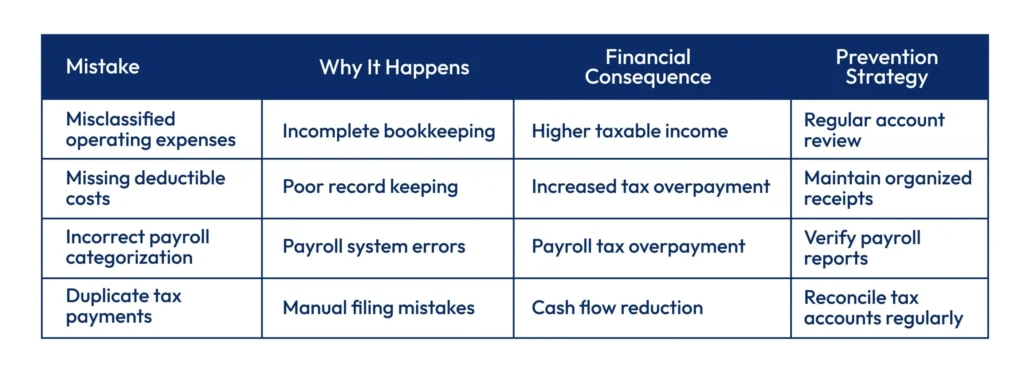
These financial misreporting taxes problems are common when businesses rely on outdated bookkeeping data.
Filing Taxes Without Updated Bookkeeping Records
Filing returns without accurate records is one of the biggest tax filing mistakes for small businesses.
When bookkeeping is incomplete:
- Deductions may be missing
- revenue figures may be incorrect
- tax estimates may be inflated
This increases the likelihood of tax overpayment.
Safe Harbor Rules for Estimated Taxes (2026)
For 2026, the IRS safe harbor rules allow businesses and individuals to avoid underpayment penalties by meeting one of two thresholds:
- Pay 100% of the prior year’s tax liability, or
- Pay 90% of the current year’s actual tax liability
For higher-income taxpayers (AGI over $150,000), the prior-year threshold increases to 110%. Meeting either threshold protects against penalties even if a balance is owed at filing.
Safe harbor does not prevent overpayment, but it gives businesses a reliable baseline for setting quarterly estimates without the risk of penalty.
What Happens If a Business Overpays Taxes?
Tax overpayment reduces your available working capital and ties up funds that could support day-to-day operations. While the IRS does process refunds for overpaid taxes, the recovery process takes time and that delay has real consequences for cash flow.
For payroll tax overpayments, businesses may apply excess credits to future tax periods or request direct refunds. For income tax overpayments, refunds are typically issued after filing and processing, which can take weeks.
IRS Tax Overpayment Refund Process
If your business has overpaid taxes in previous periods, there are clear processes to recover those funds:
- File an amended return using File Form 1040-X for individual returns (including Schedule C) or business-specific forms like 1120X for corporations. The IRS generally allows amendments within three years of the original filing date.
- Request a payroll tax refund by filing Form 941-X to correct overpaid payroll taxes for a specific quarter.
- Claim a refund for overpaid estimated taxes when filing your annual return overpayments are automatically credited or refunded.
Always document the original error and the corrected figures clearly when filing amendments.
How Small Businesses Can Avoid Tax Overpayment?
Preventing tax overpayment requires consistent financial discipline throughout the year, not just at filing time:
- Maintain accurate, up-to-date bookkeeping records so your financial statements reliably reflect your position
- Reconcile bank accounts and financial statements monthly to catch discrepancies early
- Review your deduction eligibility annually, particularly for new categories relevant to your business
- Recalculate estimated taxes each quarter using actual income and expense data
- Verify payroll tax calculations before each payroll run and at year-end
- Work with a qualified tax preparer or accounting professional who understands your industry
Conclusion
Tax overpayment is a fixable problem but only when you know where the errors are occurring. The mistakes covered in this guide, from miscalculated estimated payments to missed deductions and payroll inaccuracies, all share a common root: financial records that don’t accurately reflect business reality.
Correcting these issues requires attention to bookkeeping throughout the year, not just during tax season. When your financial data is clean, complete, and reconciled, you file accurately and stop leaving money with the IRS that belongs in your business.
Professional accounting support can help businesses maintain accurate financial records and reduce the risk of costly tax errors.
FAQs
Why do small businesses overpay taxes?
How to avoid overpaying taxes as a small business?
What happens if a business overpays taxes?
What causes payroll tax overpayment?
Can bookkeeping errors increase tax payments?
How to recover overpaid business taxes?
How to amend a business tax return in the USA?
How long does a tax refund take after overpayment?
What are safe harbor rules to avoid estimated tax penalties?
How long to file for payroll tax overpayment refund?

Parul is a content specialist with expertise in accounting and bookkeeping. Her writing covers a wide range of accounting topics such as payroll, financial reporting and more. Her content is well-researched and she has a strong understanding of accounting terms and industry-specific terminologies. As a subject matter expert, she simplifies complex concepts into clear, practical insights, helping businesses with accurate tips and solutions to make informed decisions.