
Form 941, the Employer’s Quarterly Federal Tax Return, reports federal income tax withholding and the employer and employee shares of Social Security and Medicare tax. Most employers with an active EIN file it once every quarter, four times a year.
Getting the filing date right is not the same as staying compliant. A business can submit Form 941 exactly on time and still owe a penalty, because the tax deposit behind it runs on its own separate schedule, one that depends on how much the business reported in a prior period, not on the quarter currently being filed.
That gap, between knowing when the form is due and knowing when the money itself was due, is where most Form 941 penalties actually come from. The quarterly dates, the deposit rules, and the specific cost of getting either one wrong follow next.
Key takeaways
- Form 941 is due April 30, July 31, November 2, 2026, and February 1, 2027.
- A 10-day filing extension applies only if every deposit for the quarter was made in full and on schedule.
- Deposit deadlines run on a monthly or semiweekly schedule, separate from the quarterly filing date.
- A late deposit costs 2% to 15%, depending on how many days late the payment was.
- The two penalties can both apply in the same quarter to the same business for two different mistakes.
When is Form 941 Due in 2026?
Each quarter gets its own return, due on the last day of the month following the end of that quarter. When the standard date is a weekend or legal holiday, the IRS moves the deadline to the next business day.
| Quarter | Months covered | Standard due date | Due date with full, on-schedule deposits |
|---|---|---|---|
| Q1 | January–March | April 30, 2026 | May 10, 2026 |
| Q2 | April–June | July 31, 2026 | August 10, 2026 |
| Q3 | July–September | November 2, 2026 | November 10, 2026 |
| Q4 | October–December | February 1, 2027 | February 10, 2027 |
These dates and the weekend/holiday shift rule are confirmed in the IRS’s 2026 calendar of filing and deposit due dates.
Q3 and Q4 are the two quarters to watch closely in this cycle. The usual Q3 date, October 31, is a Saturday in 2026, which pushes the deadline to Monday, November 2.
The usual Q4 date, January 31, is a Sunday in 2027, which pushes it to Monday, February 1. A business working from a saved calendar template from a prior year would miss both shifts.
How to File Form 941
Employers have two routes to file, and each comes with its own trade-off.
- E-filing through an IRS-approved provider confirms receipt the same day. It also reduces transcription errors on figures like federal income tax withholding and FICA tax, since the numbers are entered once rather than copied across a paper form.
- Paper filing is still accepted. The correct mailing address depends on the state and on whether a payment is included with the return, and that address can change between filing periods.
Either way, use the current version of the Form 941 instructions for the relevant quarter rather than a saved copy from a prior year, since the IRS updates fields, mailing addresses, and line items between revisions. The March 2026 revision should be used for all four 2026 quarters.
What is the 10-Day Filing Extension?
An employer who deposits the full amount owed for the quarter, on time and correctly, receives an additional 10 calendar days to file the return.
However, the extension is available only when the entire tax liability has been deposited. Even if a business pays 90% of what it owes on time, it does not qualify for the extension. The same applies if no deposit is made.
Are Deposit Deadlines the same as the Filing Deadline?
No, the filing date and the deposit date are governed by different rules entirely. Filing the return does not satisfy the deposit requirement, and depositing in full does not remove the need to file.
Each employer is assigned a deposit schedule based on tax reported during a prior 12-month reporting window.
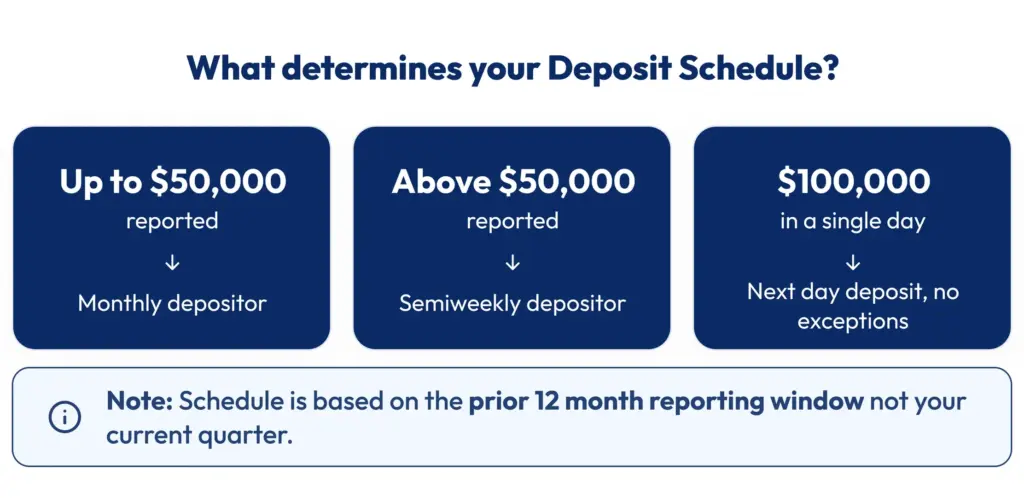
This schedule can shift between years without the business being formally notified, which is where most deposit errors begin.
Monthly Depositor
Taxes on wages paid during a calendar month are due by the 15th day of the following month. This applies when an employer reported $50,000 or less in tax during the prior reporting window.
Consider a business running payroll on the last Friday of the month under the monthly schedule. It has until the 15th of the next month to deposit, before the quarterly return for that period is due.
Semiweekly Depositor
Taxes on wages paid Wednesday through Friday are due the following Wednesday. Taxes on wages paid Saturday through Tuesday are due the following Friday.
This applies above the $50,000 threshold, and the cycle resets with every pay run rather than once a month. Both schedules are explained in section 11 of IRS Publication 15, which an employer uses to confirm which deposit schedule currently applies.
Next-Day $100,000 Rule
If accumulated liability reaches $100,000 on any single day, the deposit is due the next business day. This rule takes priority over whichever schedule the business normally follows.
A semiweekly depositor running a large bonus payroll mid-cycle can reach this threshold without realizing the regular Wednesday or Friday deadline no longer applies to that specific amount.
What happens if you File Late?
A return submitted after its due date, including any earned extension, results in the failure-to-file penalty.
| Scenario | Penalty rate | Cap |
|---|---|---|
| Filed late, tax unpaid | 5% of unpaid tax per month or partial month | 25% of unpaid tax |
| Filed late AND unpaid in the same month | 4.5% filing penalty + 0.5% failure-to-pay penalty for that month | 25% combined |
Note: This combined rate applies only in months where both the filing and payment penalties overlap; in other late months, the full 5% filing penalty applies separately.
For example, a business that owes $8,000 for the quarter and files two months late without paying any of it faces a filing penalty of $800, before interest. If the same return had been filed on time, even with the $8,000 still unpaid, no filing penalty would have applied.
What happens if you Deposit Late?
This penalty applies regardless of whether the return itself was filed on schedule. The failure-to-deposit penalty scales with how many calendar days past the deposit due date the payment was made.
| Days late | Penalty (of unpaid deposit) |
|---|---|
| 1–5 days | 2% |
| 6–15 days | 5% |
| More than 15 days | 10% |
| More than 10 days after an IRS notice | 15% |
A business that files Form 941 the moment the quarter ends, before its due date, but deposited a payroll tax payment nine days late, still owes 5% of that deposit. A timely filing does not reduce a deposit penalty that has already started accruing.
Does Form 940 follow the Same Calendar as Form 941?
No, these two forms run on entirely separate calendars, even though both report payroll-related obligations to the IRS.
| Category | Form 940 | Form 941 |
|---|---|---|
| Tax reported | Federal Unemployment Tax (FUTA) | Federal income tax withholding, Social Security, Medicare |
| Filing frequency | Annual | Quarterly |
| Due date | January 31, moving to the next business day when it falls on a weekend or holiday (February 1, 2027 for 2026 wages) | April 30, July 31, Nov 2, Feb 1 (2026 cycle) |
A business closing out Q4 is often handling its Form 941 deposit schedule and its annual Form 940 filing inside the same few weeks. This overlap is often when one deadline slips through, simply because attention is on the other.
Where Deadlines actually get missed?
Most employers already know the filing date by the time a quarter is closing. What catches them is rarely the date itself.
- The 12-month reporting window reset and the business is now semiweekly instead of monthly, without anyone updating the deposit calendar to match
- A bonus or commission payroll pushed liability past $100,000 in a single day, activating the next-day deposit rule mid-cycle
- The Form 940 annual deadline and a Form 941 quarterly deadline land within the same two or three weeks
- Payroll spans multiple states, and each state’s withholding deadlines are tracked separately from the federal Form 941 schedule
Each of these is a scheduling problem rather than a filing problem, and each one tends to surface only in the final days before a deadline, when there is little time left to correct it.
When does In-House Payroll Tax Management stop working?
A business with a simple and predictable payroll schedule can usually manage Form 941 without difficulty. The form changes very little from one quarter to the next, making it easier to keep track of both filing and deposit deadlines.
As a business grows, payroll often becomes more complex. Weekly payroll instead of monthly, a mix of W-2 employees and 1099 contractors, employees working across multiple states, or a larger payroll that changes the deposit schedule from monthly to semiweekly can all increase the risk of errors.
These changes are not obvious from Form 941 itself. Businesses often realise there is a problem only after they continue following the wrong deposit schedule or miss a required deposit.
What an Outsourced Provider tracks?
This is the specific point where outsourcing starts to matter, not because the form is difficult to fill complete, but because the schedule behind it needs checking on an ongoing basis rather than once a quarter. A provider managing this consistently confirms three things before they turn into a missed deadline:
- Which deposit schedule currently applies, based on the most recent 12-month reporting window, since this can shift without an internal team noticing
- Whether any single payroll run is approaching the $100,000 next-day deposit threshold, particularly around bonus or commission cycles
- Whether Form 940 and Form 941 deadlines sit on one combined calendar, rather than being tracked as two unrelated obligations that happen to land close together
What to look for when choosing a Provider?
Not every payroll or accounting provider tracks deposit schedules and filing schedules as separate items, and that distinction is worth confirming before engaging one. Three things to check specifically:
- Deposit schedule and filing schedule tracked separately, not folded into one combined “tax due” date that hides which obligation is actually at risk
- IRS-authorized e-file process with same-day confirmation, so there’s a receipt on record the moment the return goes in, not a wait-and-hope mailing
- Form 940 and Form 941 reviewed together at year-end, rather than treated as two disconnected tasks handled by different parts of the process
Conclusion
The dates on Form 941 are simple enough to put on a calendar. What actually determines whether a business owes a penalty is whether the deposit schedule behind those dates was tracked correctly, and that is the part most employers only notice after a notice has already arrived.
Outbooks works with US businesses to track filing dates, deposit schedules, and Form 940 and Form 941 obligations together, so one deadline does not get missed while attention is on another. To have your 2026 payroll tax calendar reviewed before the next quarter closes, call +1 386 251 5318 or email info@outbooks.com.
FAQs
Is there a new Form 941 for 2026?
Yes, the March 2026 revision applies to all four quarters of 2026. Always confirm the current version in the Form 941 instructions rather than reusing a prior year’s saved copy.
What’s the difference between Form 941 and Form 944?
Form 944 is an annual return for employers expecting $1,000 or less in yearly employment tax. The IRS must notify a business of this status, it cannot be self-selected. All other employers file Form 941 quarterly.
Can the failure-to-deposit penalty be reduced?
The IRS can reduce or remove this penalty if the employer demonstrates reasonable cause, such as a documented deposit attempt that failed due to a banking error or another circumstance outside the employer’s control. A written explanation alongside the penalty notice response is generally required.
Do I file Form 941 if I had no employees this quarter?
Yes, in most cases. An employer with an active EIN must continue filing each quarter and report zero wages, unless they have filed a final return with the IRS or received approval as a seasonal filer who has notified the IRS in advance.
What is EFTPS and is it mandatory?
EFTPS, the Electronic Federal Tax Payment System, is the free government platform used to make federal tax deposits electronically. Federal deposits must be made electronically by one of the approved methods, and EFTPS is the most commonly used option for employers.
What is Form 941-X used for?
Form 941-X corrects errors discovered on a previously filed Form 941, such as misreported wages, incorrect tax amounts, or missed adjustments. It can result in either an additional amount owed or a refund claim, depending on the nature of the correction.
Does Form 940 follow the same deadline as Form 941?
No, Form 940 is filed once a year by January 31, covering FUTA tax for the entire prior year, while Form 941 follows its own four-date quarterly schedule throughout the year. Businesses with both obligations often need to track them on a combined calendar.
Can missed deposits lead to personal liability?
Yes, for willful failure to collect or pay over withheld income and FICA taxes, the IRS can pursue the trust fund recovery penalty against responsible individuals. This applies in addition to the standard failure-to-deposit penalty on the business.

Parul is a content specialist with expertise in accounting and bookkeeping. Her writing covers a wide range of accounting topics such as payroll, financial reporting and more. Her content is well-researched and she has a strong understanding of accounting terms and industry-specific terminologies. As a subject matter expert, she simplifies complex concepts into clear, practical insights, helping businesses with accurate tips and solutions to make informed decisions.