Managing bookkeeping in Chicago is more demanding than most small business owners expect when they first take it on. The compliance environment is layered, the time it pulls from the business adds up quietly, and the cost of getting it wrong arrives later than the mistake itself.
At some point, the internal setup stops making sense. Not because the business is doing anything wrong, but because the function has grown past what one person or a part-time arrangement was built to handle. That is when most small businesses start looking seriously at outsourcing bookkeeping, and what they find changes the comparison quickly.
Key takeaways
- Businesses in Chicago carry three compliance layers at the same time: federal, Illinois state, and Chicago city. Each run on its own deadlines and filing systems that do not connect to each other automatically
- A single missed payroll tax deposit can trigger an IRS penalty of two to fifteen percent of the unpaid amount a cost that frequently exceeds one to two months of professional bookkeeping fees.
- Outsourcing bookkeeping does not require a software change. Most providers work directly within QuickBooks, Xero, or Sage without disrupting your current setup
- The first 60 to 90 days of any bookkeeping engagement determine the accuracy of everything that follows. Onboarding quality is the starting point, not a formality
5 Signs your Current Bookkeeping Setup has stopped working
Most small business owners do not go looking for a bookkeeping provider on a quiet day. Something builds up first.
The books from the previous month are still incomplete when the new month begins. Reconciliations carry over and reports go out late.
The P&L and the bank account show different numbers. Decisions on hiring, pricing, or taking on new clients are being made without an accurate financial picture.
A filing gap or missed program registration surfaces through a CPA review or a penalty notice. These issues build across quarters before a penalty notice or CPA review brings them to light.
The owner is spending time on financial tasks that should not require their attention. Reconciliations, payroll entries, and chasing receipts take hours every month that are not going toward the business.
Nobody in the business can confirm exactly what the current bookkeeper is and is not covering. That uncertainty makes it harder to know whether filings are complete, payroll is correct or year-end records are accurate, which can lead to extra costs later.
What In-House Bookkeeping actually cost a Small Business in Chicago?
The salary figure is where most business owners stop when they think about the cost of an in-house hire. It is not where the number ends.
According to Indeed’s April 2026 data, the average bookkeeper in Chicago earns $26.20 per hour. Employer FICA contributions, health insurance, paid leave, and training add considerably to that base figure.
When a bookkeeper leaves, recruitment cost and a coverage gap arrive at the same time.
What rarely gets counted is the owner’s time. Most small business owners who have an in-house bookkeeper still spend several hours each month reviewing work, answering questions, and filling gaps. That time has a value. It just never shows up on a report.
A managed bookkeeping service moves all of that to a fixed monthly cost, covered by a team rather than one person. The comparison looks different once every line is included.
What Outsourcing Bookkeeping Covers for a Small Business in Chicago?
Outsourcing bookkeeping is not a handoff of data entry. It is a transfer of an entire financial function, and understanding the full scope matters before choosing a provider.
A complete engagement covers accounts payable and receivable management, payroll processing with state and federal withholding, bank and credit card reconciliation, month-end close and journal entries, accounting software management, monthly financial reporting, and year-end preparation for CPA handover.
The day-to-day reality is that the business receives accurate financial reports on a set schedule. The owner stops chasing reconciliations. Payroll runs correctly and on time.
The CPA gets clean records at year-end, which makes that relationship faster and less expensive. When the books are not clean, a meaningful portion of the annual accounting bill goes toward correction that should not have been necessary.
Software used by Outsourcing Bookkeeping Companies
Most Chicago small businesses already use an accounting platform before they look at outsourcing. Switching providers does not mean switching software.
Most outsourcing bookkeeping companies work within QuickBooks Online, Xero, and Sage. Each platform serves different business needs, and a good provider will work within whichever one the business already uses. There is no need to migrate or learn a new system. The software stays in place. The process behind it improves.
Why is Bookkeeping in Chicago more complex?
Chicago businesses deal with three separate sets of compliance rules at the same time. Each one has its own deadlines and filing requirements.
The Illinois state layer
Illinois has its own income tax system. Employers withhold 4.95% from employee wages, file Form IL-941 every quarter through MyTax Illinois, and send W-2s to the Illinois Department of Revenue at year-end. This is completely separate from federal tax filing.
The IDES layer
Every Illinois employer must register with the Illinois Department of Employment Security and file unemployment insurance reports every quarter. This is a separate obligation with its own deadlines. It is one of the most commonly missed requirements when businesses work with providers who are not based in Illinois.
The Chicago city Layer
Chicago has its own taxes on top of state and federal. From January 2026, the Personal Property Lease Transaction Tax applies at 15% on equipment, vehicle, and technology leases per the City of Chicago’s 2026 Revenue Ordinance. This does not appear on any state or federal filing list. Illinois also requires employers with five or more employees and no qualifying retirement plan to enroll in Illinois Secure Choice, per ilsecurechoice.com and tax.illinois.gov.
A provider without experience in Illinois and Chicago will not know to look for these. The gaps build up quietly and usually surface through a CPA review or a penalty notice.
How to evaluate a provider before you sign?
Choosing a bookkeeping provider is a business decision, not just an administrative one. These four filters help identify the right fit before any commitment is made.
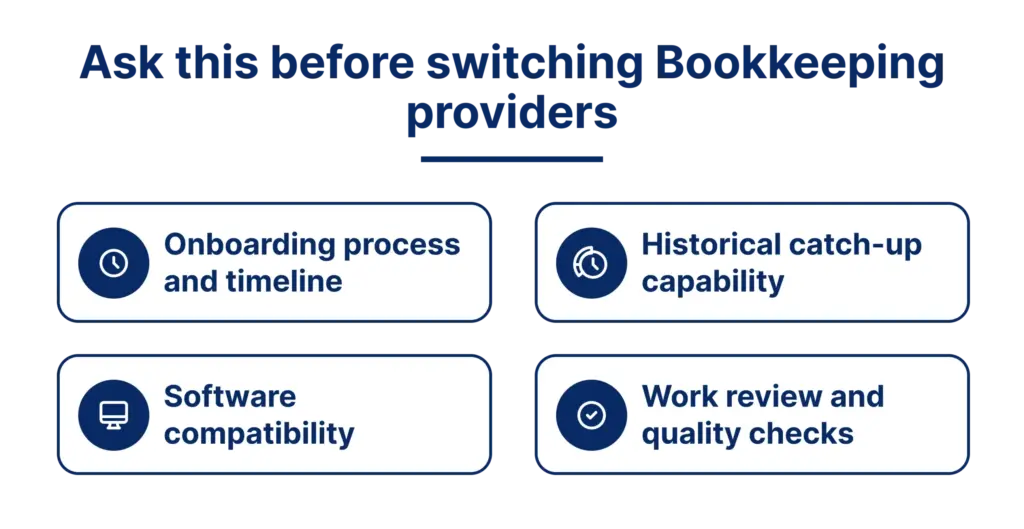
- Ask about their onboarding process: A provider with a real process will describe what the first 60 to 90 days look like in specific terms. One without a clear answer is asking the business to carry the transition risk.
- Ask whether they offer catch-up work: If the books are behind, the starting point matters as much as the ongoing service. Not every provider handles historical cleanup before moving to monthly work.
- Ask about software compatibility: The existing platform should stay in place. A provider who works within QuickBooks, Xero, or Sage without requiring a migration removes a significant source of friction.
- Ask how they handle reviews. A team-based provider reviews work before it goes out. Understanding who checks the work is one of the most practical questions a business can ask before signing.
Top 5 Outsourcing Bookkeeping Services Providers in Chicago
The table below compares five established providers serving Chicago small businesses, based on publicly available information.
| Provider | Best Suited For | Strength | Limitation |
|---|---|---|---|
| Pasquesi Partners | Startups and small businesses in professional services wanting bookkeeping, payroll, and tax planning from a CPA-led team | Founded by a former Deloitte and Grant Thornton CPA, serving Chicago businesses since 2014 with cloud-based QuickBooks Online | Built for growth-stage businesses, less suited for stable small businesses wanting bookkeeping only |
| Steph’s Books | Independent contractors, construction companies, and law firms wanting outsourcing bookkeeping with over 25 years of experience | QuickBooks Certified ProAdvisors with a focus on financial literacy and personalized bookkeeping packages | Based in McHenry IL, serves the greater Chicago area rather than the city directly |
| Outbooks | Chicago small businesses wanting full-scope bookkeeping and payroll with a single dedicated point of contact | Certified bookkeeping experts and payroll specialists with 15 years of experience, supporting QuickBooks, Xero, and Sage | Offshore-supported delivery model, not suited for businesses requiring in-person Chicago meetings |
| South Loop CPA | Chicago small businesses wanting outsourcing accounting with a guaranteed response time and catch-up capability | Chicago-based, dedicated account manager with 24-hour response guarantee, handles catch-up bookkeeping for businesses up to three years behind | Pricing starts at $1,500 per month, may be above budget for early-stage small businesses |
| TJD Accounting | Small business owners in contracting, restaurants, and trucking wanting bookkeeping, accounting, and tax under one roof | Chicago-area firm working with a small client group to allow deeper engagement with each business | Less suited for businesses wanting bookkeeping only without tax advisory involvement |
How to make the switch?
Switching bookkeeping providers does not have to disrupt the business. Most providers pick up from the current position and continue from the next month-end cycle.
If the books are behind, a catch-up engagement runs first. Ask any provider upfront whether they offer this and what it involves. The answer tells you whether they understand the actual starting point or are assuming a clean handover.
Most full-scope providers work within QuickBooks, Xero, or Sage without requiring a platform change. The existing setup stays in place. What changes is the process running behind it, and that is where the difference shows up in the quality of monthly reports.
Your Trusted Outsourced Accounting Partner.
Get Started TodayConclusion
Most small businesses that move to outsourcing bookkeeping do so because the internal arrangement stopped delivering what the business needed. Clean records, accurate payroll, and consistent financial reporting are not always achievable with a single in-house hire or a part-time arrangement. A managed service is built for exactly that scope, and for most businesses.
Outbooks provides outsourcing bookkeeping and payroll services for small businesses across Chicago and the US. Certified bookkeeping experts and payroll specialists support QuickBooks, Xero, and Sage across every engagement. To learn more, call +1 386 251 5318 or email info@outbooks.com.
Frequently Asked Questions
How do I find a bookkeeper for my small business in Chicago?
Look for a provider with local filing experience, QuickBooks or Xero capability, and a structured onboarding process. Ask whether they handle state withholding and quarterly filings as standard.
Can I outsource bookkeeping and payroll together?
Yes, most full-scope providers include payroll within the bookkeeping engagement, covering state withholding, quarterly filings, and employee payment runs as a single monthly service.
What is the difference between a bookkeeper and a CPA?
A bookkeeper maintains accurate financial records throughout the year. A CPA uses those records for tax filing and strategic advice. Most small businesses need both working together.
Do I need to change my accounting software when outsourcing bookkeeping?
No, most providers work within QuickBooks, Xero, or Sage and continue with your existing setup. A software change during a bookkeeping transition adds unnecessary risk.
How long does it take to switch to an outsourcing bookkeeping provider?
Most providers complete onboarding within two to four weeks. If records are behind, a catch-up period runs first. Confirm the timeline before the engagement begins.
What does outsourcing bookkeeping cover for a small business in Chicago?
Accounts payable and receivable, payroll processing, bank reconciliation, month-end close, software management, monthly financial reports, and year-end CPA handover.
Is outsourcing bookkeeping safe? Who has access to my financial data?
Yes, outsourcing bookkeeping can be safe when providers use secure cloud software, encrypted systems and controlled user access. Only authorized bookkeeping staff and approved users should be able to access your financial data.
Can a small business use remote bookkeeping service?
Yes, many small businesses in Chicago use remote bookkeeping services that work through secure cloud accounting platforms, allowing real-time access to financial records and support from anywhere.

Parul is a content specialist with expertise in accounting and bookkeeping. Her writing covers a wide range of accounting topics such as payroll, financial reporting and more. Her content is well-researched and she has a strong understanding of accounting terms and industry-specific terminologies. As a subject matter expert, she simplifies complex concepts into clear, practical insights, helping businesses with accurate tips and solutions to make informed decisions.