
Whether outsourcing CFO services is right for your business depends on one thing whether your current finance support can keep up with where the business is going.
For businesses where cash flow is difficult to predict, reporting is inconsistent or financial decisions are being made without clear numbers, outsourcing CFO services provide the strategic financial leadership needed without the cost of a full-time hire.
This guide covers the stages where businesses typically need this level of support, the challenges it addresses, what it includes, and how to decide if it is the right move for your business today.
Key takeaways
- A CFO’s role goes well beyond bookkeeping it covers cash planning, forecasting, profitability analysis, and financial oversight at a strategic level.
- Many businesses only notice the gap when reporting and planning can no longer support the decisions leadership needs to make.
- Cash flow pressure, weak performance clarity and investor preparation are where this type of support adds the most value.
- The decision depends less on business size and more on whether current financial processes support confident decision-making.
- Engagement models are flexible and can be structured around what the business actually needs at each stage of growth
When does a Business needs more strategic Financial Support?
CFO-level responsibilities become more demanding at each stage of business growth. Budgeting, forecasting, cash management, profitability analysis and financial controls are manageable in the early stages.
As a business grows, managing them without dedicated financial leadership creates gaps that affect decisions across the entire operation.
Early-stage and founder-led businesses
At this stage, a bookkeeper or small accounting team is usually sufficient. Reporting is largely historical and the financial questions are simple to answer.
Basic accounting covers what is needed, and dedicated financial leadership is rarely the priority when the primary focus is building the business and maintaining cash.
Growing businesses with increasing complexity
A business with a larger team, multiple client accounts and rising overhead faces a different financial picture. Decisions around hiring, pricing and cash reserves require more than a record of past transactions.
At this point, clean books are not enough on their own; leadership also needs forward-looking numbers. Accurate books exist, but questions such as whether the business can afford an additional hire, what the cash position will look like in four months, or which clients generate the strongest margins remain unanswered.
Scaling businesses managing multiple functions or revenue lines
Businesses scaling across departments or service lines need management reporting that reflects performance at every level. Profitability analysis must identify which areas contribute to growth and which do not. Internal financial controls need to support a larger, more complex organization. The cost of financial blind spots at this stage is significantly higher.
Businesses preparing for investment or expansion
Investors and lenders expect clarity on current performance, financial projections and business model viability. Producing that standard of financial documentation requires experience that goes beyond standard accounting. Businesses at this stage often find that existing finance support was not built for that level of scrutiny.
When financial responsibilities become more demanding, businesses generally respond in one of three ways:
- Managing internally: founders or senior leadership take on strategic financial decisions alongside existing roles. This works early on but becomes harder to sustain as complexity grows.
- Hiring a full-time executive: provides dedicated financial leadership but comes with a significant cost commitment. According to US CFO salary data from Indeed, the average full-time CFO salary in the United States is $171,812 per year, before recruitment costs, payroll taxes and benefits are factored in.
- Outsourcing CFO services: gives businesses access to senior financial expertise on a flexible basis, without a permanent executive appointment. For businesses that need strategic financial leadership but are not yet at the scale where a full-time hire makes sense, this is often where the conversation begins.
Each approach has its place. The right choice depends on the business’s current stage, budget and the nature of the financial challenges it faces.
What Financial Challenges can Outsourcing CFO support address?
Outsourcing CFO support is most relevant when specific financial problems are affecting how a business operates and plans ahead. The challenges below reflect what businesses commonly experience before engaging this level of support, and what it directly addresses.
Limited visibility into business performance
When monthly reports document past activity without explaining what it means for what comes next, leadership is making decisions without all the information. Structured financial reporting, management dashboards and business performance analysis give a clearer, more actionable view of where the business stands.
Cash flow that is reactive rather than planned
Many businesses only become aware of a cash problem once it has already developed. Cash flow forecasting, monitoring and shortage identification allow businesses to plan for what is ahead rather than respond to what has already happened.
This challenge is particularly common in industries with project-based revenue cycles. Construction businesses, for example, often work with milestone-based billing, extended project timelines and fluctuating material cost, which can make cash planning more difficult.
Forecasting cash requirements, monitoring project profitability and evaluating the financial impact of new contracts are areas where outsourcing CFO support can provide additional structure and oversight.
Uncertainty about where profit is actually coming from
Revenue growth does not always reflect profitability. Department-level and project-level analysis shows which parts of the business generate the strongest margins and which are underperforming, directly informing pricing, resource allocation and strategic decisions.
Preparing for investment, funding or significant growth decisions
Businesses exploring external investment or planning major financial decisions need investor-ready financial reports, financial modeling and operational performance monitoring. Without that preparation, those conversations are difficult to enter with confidence.
What Outsourcing CFO support typically includes?
The scope of these services covers the financial functions that growing businesses need but do not always have dedicated resources for. Depending on the engagement, support may include:
| Service area | What it covers |
|---|---|
| Financial Reporting | Monthly financial statements, management dashboards, business performance analysis |
| Budgeting and Forecasting | Annual budgets, revenue and expense projections, cash flow forecasting |
| Cash Flow Management | Cash flow monitoring, shortage identification, improvement planning |
| Financial Planning and Analysis | Profitability analysis, department and project-level margin review |
| Virtual Controller Services | Month-end close oversight, internal financial controls, accounting process improvements |
| Business Advisory Support | Strategic financial guidance aligned to business goals |
| CFO Support for Startups and Growing Businesses | Investor-ready reports, financial modeling, operational performance monitoring |
The level of involvement is structured around the business’s requirements, which means the engagement reflects the complexity and pace of the operation rather than a fixed arrangement.
How the Cost Conversation usually works?
Hiring a full-time executive is a significant financial commitment. According to US CFO salary data from Indeed, the average salary in the United States is $171,821 per year, ranging from around $99,841 to $295,664 depending on company size, industry and location, before recruitment costs, payroll taxes, health benefits and retirement contributions are considered. For businesses not yet at that scale, a full-time CFO hire simply does not make financial sense.
Outsourcing arrangements are structured differently. The cost reflects the scope of the engagement, reporting requirements, business complexity and the level of strategic involvement needed, with no recruitment costs, benefits obligations or long-term employment commitment.
Common concerns about Outsourcing CFO Services
It is reasonable to have reservations before changing how financial leadership is structured. The concerns below are ones businesses commonly raise.
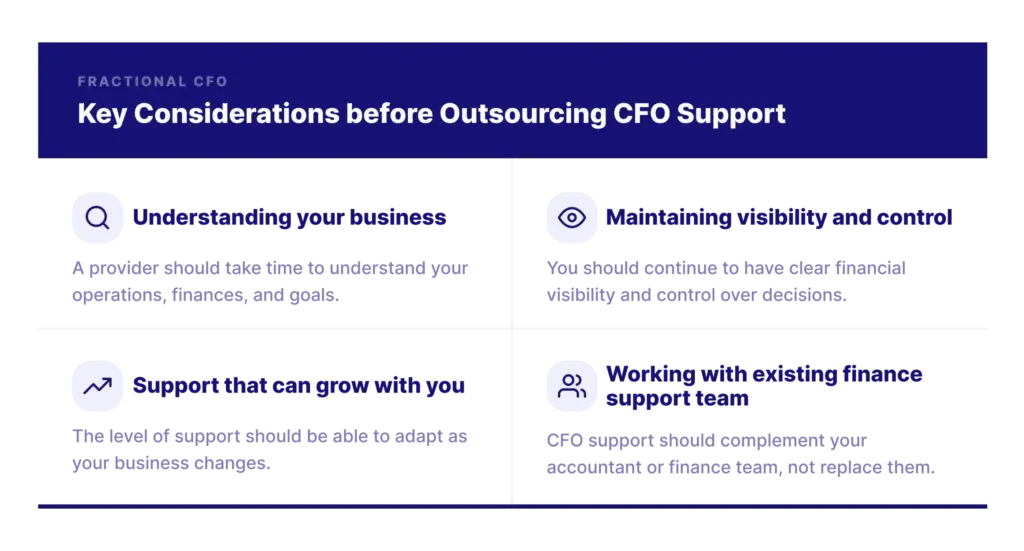
- Will outsourcing support understand our business? A well-structured engagement begins with a thorough review of the business, its financials, its operations and its goals. Understanding the business is the starting point, not an afterthought.
- Will we lose visibility or control? This type of support is designed to increase financial visibility, not reduce it. Reporting, dashboards and regular reviews give leadership a clearer picture of performance than most businesses have before engaging external support. Decision-making authority remains with the business.
- Can it scale as the business grows? Engagements are structured to reflect where the business is and can be adjusted as requirements change. A startup preparing for its first funding round has different needs from a scaling business managing multiple departments, and the arrangement can reflect that.
- We already have an accountant. Is this still relevant? Accounting handles records, compliance and historical reporting. Senior financial leadership covers forecasting, strategic planning, performance analysis and decision support. The two serve different functions and work together rather than replacing one another.
Concerns like these become easier to address once you understand what is available in the market and which providers fit your needs.
These concerns are reasonable, and each one has a direct answer. Before comparing providers, it helps to be clear on what a well-structured engagement actually looks like in practice.
With those points addressed, the next step is identifying which providers in the US market are structured to deliver at this level.
Outsourcing CFO Firms worth considering in the USA
For businesses exploring this option, several firms are established providers of outsourcing financial leadership in the US market.
| Firm | Best For | Engagement Model | Notable Strength |
|---|---|---|---|
| NOW CFO | All industries and growth stages | Outsourced, fractional and interim CFO, controller and accounting | Operating since 2005, with a multi-state presence across the US |
| Preferred CFO | Startups and businesses in transition | Outsourced and fractional | Founded 2013, focused on tailored CFO and HR solutions |
| Outbooks | Growing businesses needing scalable financial leadership | Staff Augmentation, PAYG or Managed Service | 500+ professionals, Virtual CFO Services across the US |
| B2B CFO | Privately held companies across industries | Advisory services delivered by equity-owner partners | 200+ professionals, each with 20+ years of senior-level experience, founded 1987 |
| CRI CFO Hub | Businesses needing strategic financial direction | Fractional CFO support, now part of Carr, Riggs & Ingram | Voted San Diego’s #1 Accounting Firm in 2025 |
NOW CFO, founded in 2005 in Salt Lake City, has grown to offer outsourcing fractional and interim financial leadership, controller and accounting support across multiple US states.
Preferred CFO, founded in 2013 by Jerry Vance, has offered outsourced financial and HR services with a focus on tailoring strategy and operational guidance to each client’s needs.
Outbooks supports growing businesses across the United States with a team of 500+ professionals. Virtual CFO Services cover financial reporting, budgeting, forecasting, cash flow management, FP&A, controller services and investor-ready reporting.
Engagements are available across three models:
- Staff Augmentation, where a dedicated remote professional works exclusively for the business
- PAYG, where businesses pay only for hours worked with no long-term commitment
- Managed Service, where Outbooks operates as a back-office team managing deadlines and delivery end to end.
B2B CFO, founded in 1987, has provided strategic business advisory services for nearly four decades. Its 200+ professionals are each equity owners with 20 or more years of senior-level experience, working directly with privately held companies across the country.
CRI CFO Hub provides fractional financial leadership to growing businesses, including controller services, accounting support and audit readiness, and was voted San Diego’s #1 Accounting Firm in 2025. The firm joined Carr, Riggs & Ingram (CRI).
Conclusion
Strategic financial leadership is not exclusive to businesses with a full-time CFO on payroll. For growing businesses managing increasing complexity, outsourcing CFO services provide the same level of input at a cost and commitment that actually works for where they are.
The decision comes down to whether current finance support is enough for where the business is heading, and for many, it is not.
Outbooks works with growing businesses across the United States to provide outsourcing financial leadership structured around what each business actually needs. To discuss your requirements, call +1 386 251 5318 or email info@outbooks.com.
FAQs
What tasks can a fractional CFO handle?
A fractional CFO can support budgeting, forecasting, cash flow management, profitability analysis, financial reporting, KPI monitoring, financial modeling, investor-ready reporting and strategic decision-making. The scope of involvement depends on the agreed engagement.
How is an outsourcing CFO different from a financial controller?
A financial controller oversees accounting operations, internal controls and reporting accuracy. An outsourcing CFO focuses on financial strategy, forecasting, business planning and decision support. Many growing businesses benefit from both functions working together.
What is the difference between a fractional CFO and a full-time CFO?
A full-time CFO is a permanent employee dedicated exclusively to one business. A fractional CFO provides similar strategic financial expertise on a part-time, project-based or retainer basis, allowing businesses to access senior-level support more flexibly.
At what stage should a business consider outsourced CFO support?
There is no fixed revenue threshold. Businesses typically consider outsourcing CFO support when financial complexity increases, cash flow becomes more difficult to manage, growth plans accelerate or existing resources no longer provide the insight needed to support informed decision-making.
How much does an outsourcing CFO cost?
The cost of outsourcing CFO support varies depending on the scope of services, business complexity and frequency of involvement. Some providers charge hourly rates, while others offer monthly retainers or project-based arrangements.
Is outsourcing CFO support suitable for businesses with an existing finance team?
Yes, outsourcing CFO support complements internal finance teams by providing senior-level strategic oversight, performance analysis and planning capabilities that extend beyond day-to-day accounting activities.
Can outsourcing CFO support help businesses preparing for investment or expansion?
Yes, outsourcing CFO support can assist with financial modeling, forecasting, investor-ready reporting and performance analysis, helping businesses prepare for funding discussions, expansion plans or lending applications.
Can you outsource a CFO for a small business?
Yes, small businesses can outsource CFO support when they need budgeting, cash flow forecasting, financial planning or strategic guidance but do not require a full-time executive. Engagements are typically tailored to the business’s needs, allowing businesses to access senior-level financial expertise as their operations become more complex.

Parul is a content specialist with expertise in accounting and bookkeeping. Her writing covers a wide range of accounting topics such as payroll, financial reporting and more. Her content is well-researched and she has a strong understanding of accounting terms and industry-specific terminologies. As a subject matter expert, she simplifies complex concepts into clear, practical insights, helping businesses with accurate tips and solutions to make informed decisions.