
As U.S. businesses expand into subsidiaries, franchise structures, and additional operating entities, the accounting function does not simply grow. Each entity adds its own books, its own tax obligations, and its own reporting deadlines and all of them must be resolved before group-level financials are ready.
The pressure does not come from transaction volume. It comes from coordination. One entity closing late holds up the entire group. One inconsistent account structure distorts consolidated reporting across every entity connected to it.
This article covers why managing accounting across multiple entities creates compounding operational pressure, where software and internal capacity reach their limits, and how professional accounting support helps U.S. businesses maintain accuracy and visibility across every legal structure they operate.
Key takeaways
- Each legal entity requires its own close cycle and reconciliations before group reporting can begin.
- Manual intercompany processes increase reconciliation risk at every month-end close.
- Accounting software for multiple businesses standardizes reporting structure, not accounting quality.
- Two or more consistent close cycle failures signal a structural problem, not an operational one.
- Multi-entity accounting outsourcing covers bookkeeping, intercompany accounting, close support, and management reporting.
- Consistent account structures across a group reduce the gap between month-end and reliable reporting.
Where the Accounting Pressure actually comes from?
Managing finances across multiple legal entities is not a scaled-up version of single-entity operations.
The moment a second legal entity exists, an entirely new layer appears: intercompany activity that has no equivalent in a single-entity structure. Every entity added after that multiplies the coordination required across close cycles, account structures, and reporting timelines.
Deloitte’s Finance Trends 2026 report, which surveyed 1,326 global finance leaders across industries, found that today’s leading CFOs are thinking differently, operating differently, and hiring differently helping navigate new markets, preparing for acquisitions and divestitures, and building future-ready teams, all while contending with a complex growth environment.
Intercompany Accounting
When one entity charges another for shared services, management fees, internal loans, or cost allocations, both parties must record the same value at the same time. When one side is missing or recorded at a different amount, the consolidated statement overstates assets or revenue.
Consider a construction business allocating payroll, insurance, and equipment costs across multiple project LLCs every month. Each allocation generates a paired entry on both sides. Both must carry identical values before consolidation can produce accurate group-level figures.
The entity-level books appear correct in isolation. The error only surfaces when both sides are compared during consolidation often after close has already been delayed.
How Intercompany Eliminations work in practice:
Intercompany transactions are eliminated during consolidation to prevent internal activity from overstating group revenue, expenses, assets, and liabilities.
For example, if one entity charges another for shared services, the corresponding revenue and expense entries are removed at the group level. This ensures consolidated financial statements reflect only external transactions.
Chart of Accounts Inconsistency
When entities use different account structures for the same transaction type, group-level comparisons produce figures that look accurate but are not.
As organizations expand, maintaining a consistent group chart of accounts becomes the responsibility of a central finance function. Without that oversight, classification differences between entities become increasingly difficult to control.
One entity records freight cost within Cost of Goods Sold. Another records them under Operating Expenses. Consolidated revenue remains correct, but gross margin comparisons across the group are now distorted.
A finance leader reviewing performance by entity is comparing numbers built on different foundations and drawing wrong conclusions from figures that were never structurally aligned.
This gap repeats at every close cycle until the chart of accounts is standardized across all entities.
Consolidation and Reporting Delays
Group reporting cannot begin until every entity has closed accurately. One entity running late does not just delay its own numbers it holds up the consolidated report for the entire group.
For organizations where close procedures differ across legal structures, the timeline between month-end and available management reporting lengthens with every entity added. Leadership reviews financial information that is weeks old and makes decisions on that basis.
Multi-entity bookkeeping transaction coding, bank reconciliations, accounts payable, and accounts receivable must be completed consistently across all entities before any of this improves. That is where inconsistency creates the most downstream disruption to consolidation and reporting.
What a Monthly Close looks like across Multiple Entities?
In a multi-entity environment, month-end close follows a sequence rather than occurring simultaneously. Each entity completes its reconciliations and review procedures before intercompany balances are matched and elimination entries are prepared.
Because consolidated reporting depends on every entity closing accurately, delays in one company can hold up financial reporting across the entire group.
Common Mistakes in Multi-Entity Close
Most close failures across multi-entity groups stem from the same recurring process weaknesses rather than isolated mistakes.
- Closing entities on different schedules.
- Using inconsistent account classifications across subsidiaries.
- Delaying intercompany reconciliations until after month-end.
- Maintaining separate charts of accounts without group-level oversight.
- Relying heavily on spreadsheets for consolidation adjustments.
- Failing to assign clear ownership of the close process.
Accounting Software for Multiple Entities: Benefits and Limits
Most U.S. businesses turn to accounting software when entity count grows beyond what spreadsheets can handle. Dedicated platforms address real coordination problems but the results depend entirely on the consistency of the accounting work behind them.
What these platforms do well:
When transactions are coded correctly and account structures are aligned across the group, the best accounting software for multiple businesses delivers genuine operational advantages:
- Automated intercompany eliminations during consolidation
- A shared chart of accounts maintained across all entities
- Entity-level and group-level reports produced without manual data assembly
- Transaction-level audit trails across the entire organization
Purpose-built multi-entity software is designed to handle these requirements more effectively at scale. Multi-location accounting software of this type is designed for the coordination demands that arise when one organization operates across several legal structures simultaneously.
What these platforms cannot replace:
Accounting software standardizes reporting structure. It does not standardize accounting quality.
A platform cannot investigate why one entity recorded a management fee at $12,000 while another recorded the same transaction at $11,500. It cannot assess whether a cost allocation reflects actual usage. It will not identify a balance sheet account unchanged for three months that may contain a stale entry.
A general-purpose platform like QuickBooks, for example, requires separate logins per company file and manual consolidation performed entirely outside the platform. For a business managing two entities with limited intercompany activity, that is manageable.
For a group managing five or more entities with regular intercompany charges and monthly reporting requirements, the manual effort becomes unsustainable and purpose-built multi-entity accounting software becomes necessary.
A franchise group can implement the same online accounting software for multiple companies across every location and still produce unreliable consolidated financials if coding practices differ between them. The technology is only as reliable as the accounting execution behind it.
When the Internal Process stops producing reliable results?
Software can organize the process, but it cannot fix inconsistent accounting work. Over time, the pressure shifts from transaction processing to coordination across entities, close timelines, and reporting responsibilities.
- Process fragmentation is the first problem. When each entity develops its own close procedures, coding conventions, and reconciliation timelines independently, the group has no unified accounting process. It has several disconnected ones running in parallel.
- Timing mismatches compound the issue. Intercompany entries depend on both sides posting at the same time. When entities close on different schedules, timing gaps between related entries become a recurring feature of every close cycle rather than an occasional exception.
- Accountability gaps are the third factor. As entity count grows without a proportional increase in accounting oversight, no single person or team has clear responsibility for how the accounting function performs across the group as a whole. Errors that would be caught in a single-entity operation go undetected until consolidation forces a comparison.
Over time, fragmentation, timing mismatches, and accountability gaps make multi-entity accounting increasingly difficult to manage internally.
Different structures create different pressures
The point at which internal processes become difficult to manage depends partly on how the organization scales.
- Holding companies depend heavily on consolidated reporting and intercompany balances.
- Franchise groups require both location-level visibility and group-wide consistency.
- Service groups, including healthcare and professional services firms, manage frequent cost allocations and intercompany activity.
Regardless of structure, fragmentation, timing differences, and unclear ownership become more challenging as operations scale.
For many organizations, this is the point at which external support becomes necessary to maintain consistent execution across all entities.
What Multi-Entity Accounting Outsourcing covers?
Multi-entity accounting is the framework. Multi-entity bookkeeping is the execution layer that determines whether the framework produces reliable results. Intercompany accuracy, consolidation readiness, and management reporting all depend on bookkeeping being performed correctly and consistently at the entity level, every month, across all entities at once.
Professional multi-entity accounting services cover that full execution layer from daily transaction processing through to consolidated management reporting within the organization’s existing platform and close structure.
Entity-level Bookkeeping and Reconciliations
The foundational work that keeps each entity’s records accurate and close-ready:
- Transaction coding and categorization across all legal structures
- Bank and credit card reconciliations on a defined monthly schedule
- Accounts payable processing and vendor management
- Accounts receivable tracking and collections support
When this work is handled consistently across all entities by the same team, account structures align, close timelines become predictable, and the finance function reviews results rather than corrects records.
Intercompany Accounting and Close Support
Intercompany entries are recorded consistently across all entities, elimination entries are prepared before consolidation begins, and entity-level close checklists run on a defined monthly timeline.
Reconciliation discrepancies are identified and resolved before they reach group reporting not discovered during consolidation. Accurate consolidation depends on this kind of consistent entity-level execution every month. Multi-divisional financial statements are only as reliable as the accounting records behind them.
Management Reporting
Beyond transaction processing, accounting teams prepare regular entity-level and consolidated management accounts giving ownership and finance leadership the visibility they need without depending on a tax preparation cycle.
Entity-level performance summaries, consolidated group reports, and multi-entity reporting packages form part of a regular schedule that leadership can plan around.
Industries where this model is most common
Construction businesses, healthcare groups, franchise organizations, and real estate businesses are among the most frequent users of multi-entity accounting outsourcing in the U.S. Each involves a structure where legal entities multiply faster than internal accounting capacity can adapt.
A healthcare group adding a second practice location does not simply double the accounting workload. It adds a new close cycle, new intercompany cost allocations for shared staff and equipment, and a new set of entity-level reports all of which must be ready before consolidated financials can be produced for ownership or lenders.
How to evaluate an Accounting Partner for Multiple Entities?
The right partner for a multi-entity organization brings more than processing capacity. A few direct questions reveal whether a provider can genuinely support a growing group structure.
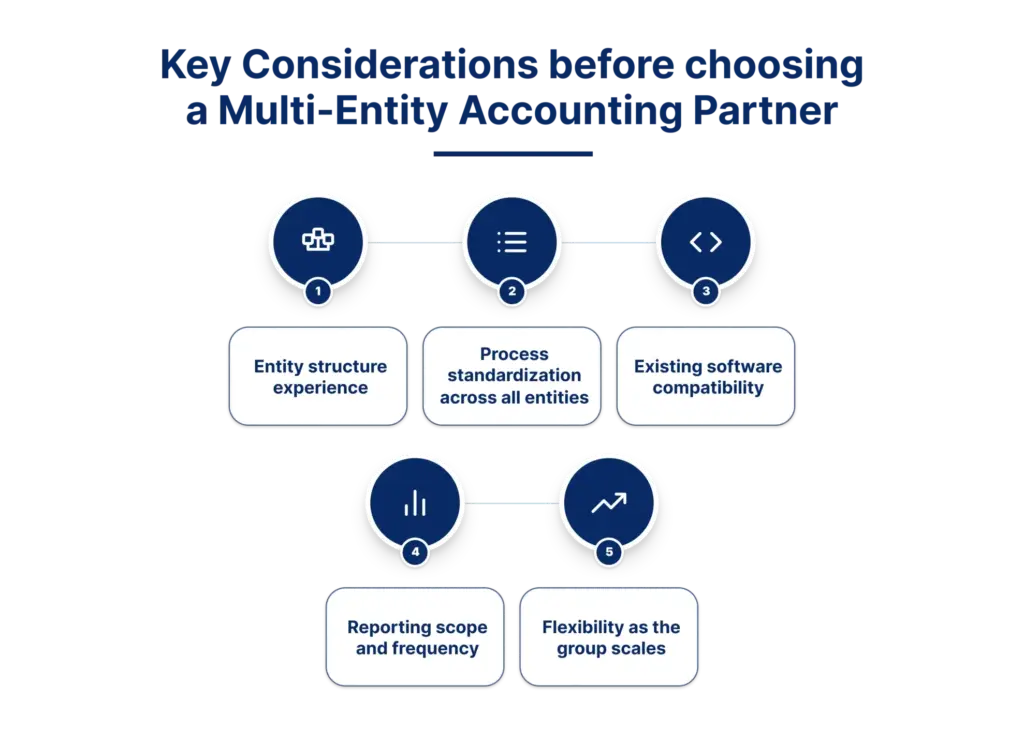
Experience with your entity structure
A provider with experience in holding companies, franchise groups, or construction businesses will understand the specific intercompany and reporting requirements those structures create. Ask for examples of comparable engagements before deciding.
Approach to process standardization
Ask how the provider onboards new entities, aligns coding structures across the group, and manages intercompany recording consistently. Standardized procedures across all entities is the core deliverable not transaction volume alone.
Technology compatibility
A capable provider should work within your existing platform rather than requiring a system change. Confirm their familiarity with the accounting software your organization currently uses.
Reporting scope and frequency
Entity-level and consolidated management reports should be part of the initial engagement scope confirmed in terms of frequency and format before the arrangement begins.
Ability to adjust
As entities are added or transaction volumes shift, the engagement structure should adapt without a full renegotiation. Confirm that flexibility is built in from the start.
Conclusion
Managing accounting across multiple legal entities is a coordination challenge as much as a financial one. Accurate group reporting depends on every entity closing on time, every intercompany entry matching on both sides, and every account structure following the same logic across the group. When any of those elements are inconsistent, the consolidated picture is unreliable regardless of which platform is in use.
For many growing U.S. businesses, the point at which this becomes difficult to manage internally arrives earlier than expected. Bringing in dedicated multi-entity accounting services at the entity level, rather than waiting for reporting delays to become a pattern, gives finance leadership reliable numbers when they need them.
Outbooks helps U.S. businesses manage multi-entity accounting, bookkeeping, intercompany transactions, accounts payable and receivable, and management reporting. Contact us at +1 386 251 5318, info@outbooks.com, or reach out through our contact us page.
Frequently Asked Questions
What is multi-entity accounting?
Multi-entity accounting manages separate financial records, intercompany activity, consolidation, and reporting across a group of related legal entities. The added complexity compared to single-entity accounting comes from coordinating close cycles and account structures across every entity simultaneously.
How is multi-entity bookkeeping different from multi-entity accounting?
Multi-entity bookkeeping maintains day-to-day financial records for each entity transaction coding, reconciliations, and payables and receivables. Multi-entity accounting is broader, covering reporting, consolidation, and financial oversight across the group.
What is the best accounting software for multiple businesses?
Purpose-built platforms handle intercompany eliminations, shared chart of accounts structures, and group-level reporting more effectively than general-purpose tools. General-purpose software like QuickBooks may support multiple company files, but group consolidation and standardized multi-entity reporting are still limited and often require manual work.
Why do intercompany transactions cause problems at month-end?
Both sides of an intercompany transaction must record the same amount at the same time. When one entity posts a charge and the other has not yet recorded it, timing gaps accumulate and delay consolidation if not resolved before close.
How do you consolidate multiple entities accurately?
Accurate consolidation requires consistent account structures, intercompany entries that match on both sides, and a defined close timeline every entity follows. When those elements are in place, consolidation becomes a repeatable process rather than a monthly investigation.
Why choose multi-entity accounting outsourcing over hiring internally?
Internal hiring takes time, creates fixed overhead, and does not adjust as entity count changes. Professional support scales with the organization’s structure covering bookkeeping, intercompany accounting, and management reporting without the cost of building an internal team.
At what point does a business need dedicated accounting support for multiple entities?
When close is regularly delayed, intercompany reconciliations require significant manual work, or management accounts are unavailable within a reasonable window after month-end, the internal process has reached its capacity. Consistency of reporting matters more than entity count alone.

Parul is a content specialist with expertise in accounting and bookkeeping. Her writing covers a wide range of accounting topics such as payroll, financial reporting and more. Her content is well-researched and she has a strong understanding of accounting terms and industry-specific terminologies. As a subject matter expert, she simplifies complex concepts into clear, practical insights, helping businesses with accurate tips and solutions to make informed decisions.